
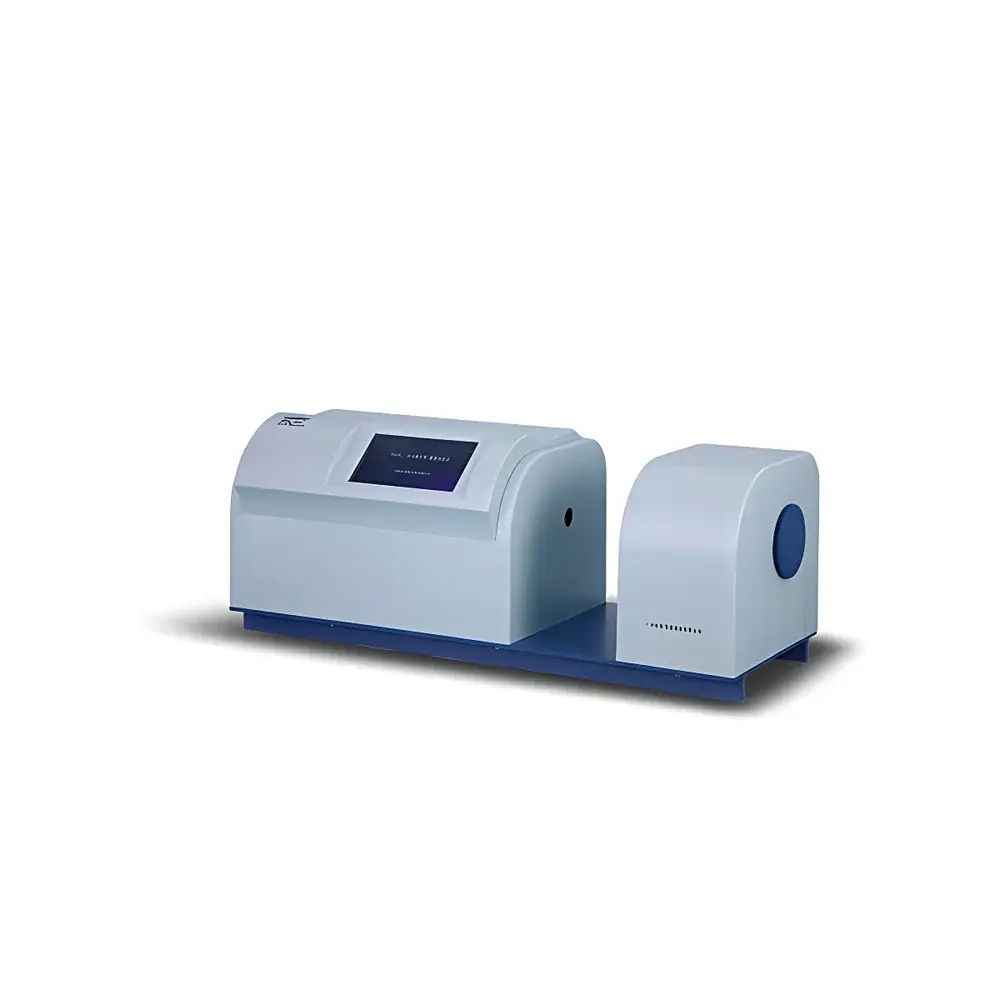
GBPI SGW-810C Automatic Haze and Luminous Transmittance Meter
| Brand | GBPI |
|---|---|
| Model | SGW-810C |
| Origin | Guangdong, China |
| Manufacturer Type | Direct Manufacturer |
| Product Type | Fully Automatic |
| Haze Range | 0–30.0% |
| Transmittance Range | 0–100.0% |
| Haze Repeatability | ≤±0.1% (for haze ≤0.5%) |
| Transmittance Repeatability | ±0.5% |
| Preheat Time | 30 min |
| Transmittance Accuracy | ≤±1.0% |
| Haze Accuracy | ≤±0.1% (≤0.5%), ≤±0.3% (>0.5%) |
| Minimum Resolution | 0.01% (both haze and transmittance) |
| Light Source | C-illuminant (6774 K) |
| Detector | Silicon Photocell |
| Optical Configuration | Collimated Illumination, Diffuse Viewing, Integrating Sphere Detection |
| Sample Port Aperture | Input Ø25 mm, Output Ø21 mm |
| Solid Sample Size | 50 mm × 50 mm |
| Liquid Cell Dimensions | 50 mm × 50 mm × 10 mm |
| Film Sample Size | 50 mm × 50 mm |
| Display | Large-Touch LCD Screen |
| Power Supply | 220 V, 50 Hz |
| Net Weight | 21 kg |
| Compliance Standards | GB/T 2410–2008, ASTM D1003–2007, JIS K7105–1981 |
Overview
The GBPI SGW-810C Automatic Haze and Luminous Transmittance Meter is an ISO/ASTM-compliant optical measurement instrument engineered for precise, repeatable quantification of haze and total luminous transmittance in transparent and translucent planar materials. Based on the principle of integrating sphere photometry with collimated C-illuminant excitation (6774 K), the system conforms to the geometric and spectral requirements defined in ASTM D1003–2007 (Standard Test Method for Haze and Luminous Transmittance of Transparent Plastics) and GB/T 2410–2008 (Determination of Haze and Transmittance of Transparent Plastics). The instrument employs a dual-detector configuration within a high-reflectance BaSO4-coated integrating sphere to separate diffuse transmission (haze component) from total transmission, enabling simultaneous calculation of haze (%) and transmittance (%) per ISO 14782:1999. Designed for laboratory and QC environments, it delivers traceable metrology suitable for regulatory documentation under GLP and GMP frameworks.
Key Features
- Fully automatic operation with integrated touchscreen interface—no manual calibration or alignment required between measurements
- High-stability C-illuminant LED source with thermal regulation ensures spectral consistency over extended preheated operation (30-minute stabilization time)
- Optimized integrating sphere geometry (input port Ø25 mm, output port Ø21 mm) minimizes edge diffraction effects and enhances signal-to-noise ratio for low-haze samples
- Resolution of 0.01% for both haze and transmittance supports detection of subtle batch-to-batch variations in thin films and coatings
- Dual-sample compatibility: accommodates rigid solids (50 mm × 50 mm), flexible films (same footprint), and liquid samples via standardized 10-mm pathlength cuvette (50 mm × 50 mm × 10 mm)
- Robust mechanical architecture with vibration-damped base and sealed optical chamber reduces environmental drift during long-duration testing sequences
Sample Compatibility & Compliance
The SGW-810C accepts flat, parallel-surface specimens conforming to dimensional tolerances specified in ASTM D1003 and GB/T 2410. It is validated for use with polymer sheets (e.g., PET, PC, PMMA), laminated packaging films, coated glass substrates, optical adhesives, and aqueous solutions including pharmaceutical injectables and beverage formulations. All measurements are referenced to NIST-traceable calibration standards (certified haze plates and neutral density filters), ensuring metrological continuity across laboratories. The instrument meets essential requirements for audit readiness under FDA 21 CFR Part 11 when paired with optional secure data logging software—supporting electronic signatures, user access control, and immutable audit trails for transmittance/haze records.
Software & Data Management
Embedded firmware enables real-time display of haze (%), transmittance (%), and statistical summaries (mean, SD, CV%) across up to 20 sequential readings. Data export is supported via USB 2.0 to CSV or PDF formats, preserving timestamp, operator ID, sample ID, and environmental metadata (ambient temperature/humidity if externally logged). Optional PC-based software provides advanced features including SPC charting (X-bar/R charts), comparative trend analysis across material lots, and automated report generation compliant with ISO/IEC 17025 documentation templates. All stored results retain full traceability to calibration certificates and instrument verification logs.
Applications
- Quality control of optical films in display manufacturing (OLED encapsulation, AR/AR coatings)
- Regulatory testing of primary packaging materials per USP and Ph. Eur. 2.2.1 for particulate matter assessment via turbidity correlation
- R&D evaluation of anti-fog additives in polyolefin agricultural films
- Stability monitoring of colloidal suspensions and nanoemulsions in cosmetic and pharmaceutical development
- Validation of surface texturing processes on polycarbonate light-diffusing panels
- Conformance verification of automotive glazing materials to SAE J576 and ISO 3538 specifications
FAQ
What standards does the SGW-810C comply with?
It fully implements ASTM D1003–2007, GB/T 2410–2008, and JIS K7105–1981, with optical design validated against ISO 14782:1999 requirements for integrating sphere performance.
Can the instrument measure liquids directly?
Yes—using the supplied 10-mm pathlength quartz cuvette (50 mm × 50 mm × 10 mm), it performs standardized turbidity-to-haze correlation per ASTM D6505 for clear liquids.
Is user calibration required before each test?
No—factory calibration is retained through power cycles; only periodic verification using certified reference standards (recommended every 6 months) is necessary for ISO/IEC 17025 compliance.
How is haze physically distinguished from transmittance in the optical path?
The integrating sphere separates forward-scattered light (diffuse transmission, defining haze) from direct-beam transmission; their ratio yields haze %, while total detected radiant flux yields transmittance %.
Does the system support multi-user access control for regulated environments?
When used with the optional PC software suite, role-based login, electronic signatures, and 21 CFR Part 11–compliant audit logging are fully implemented.





