
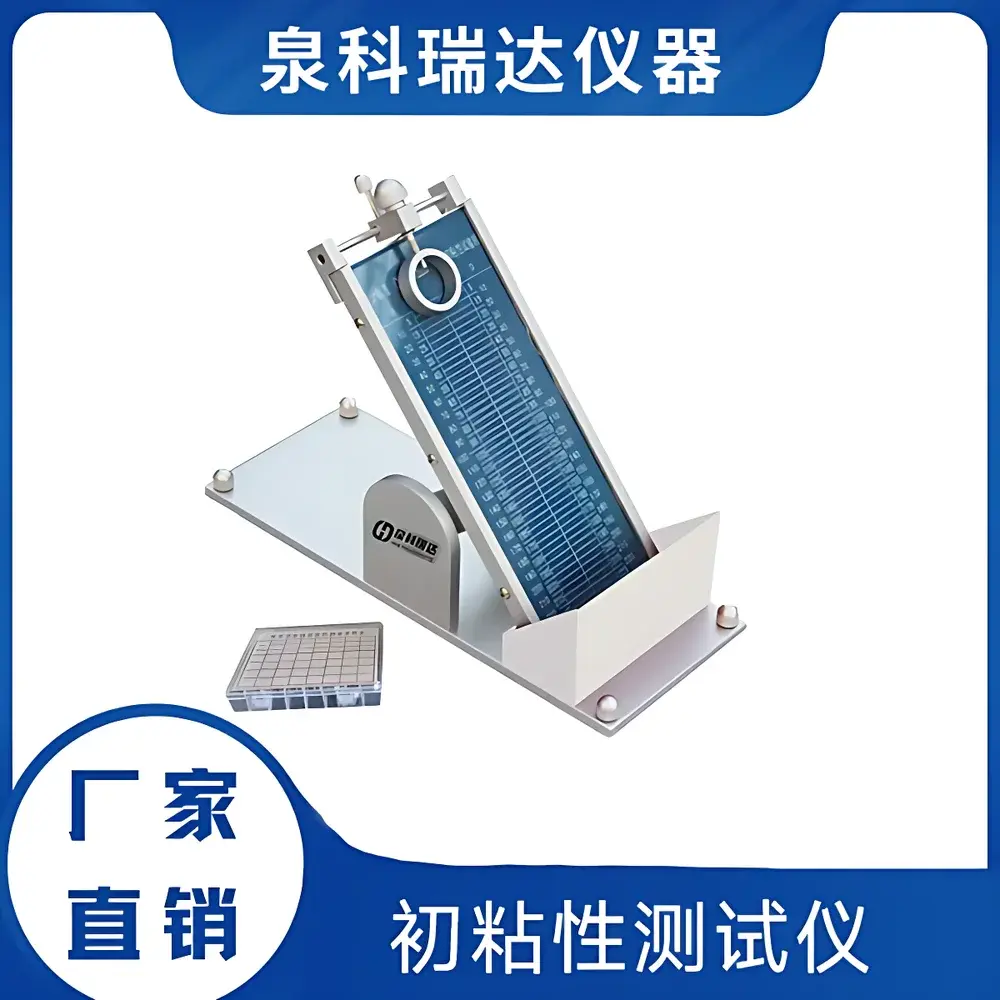
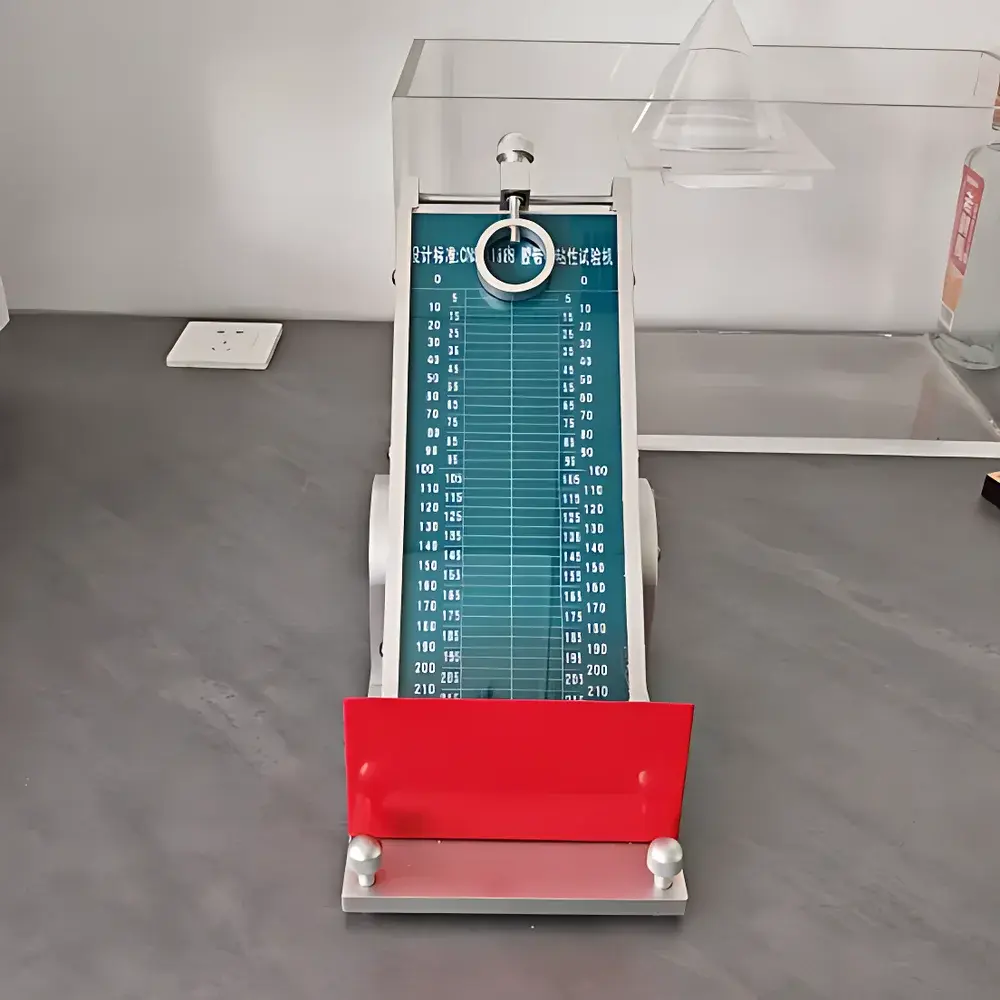
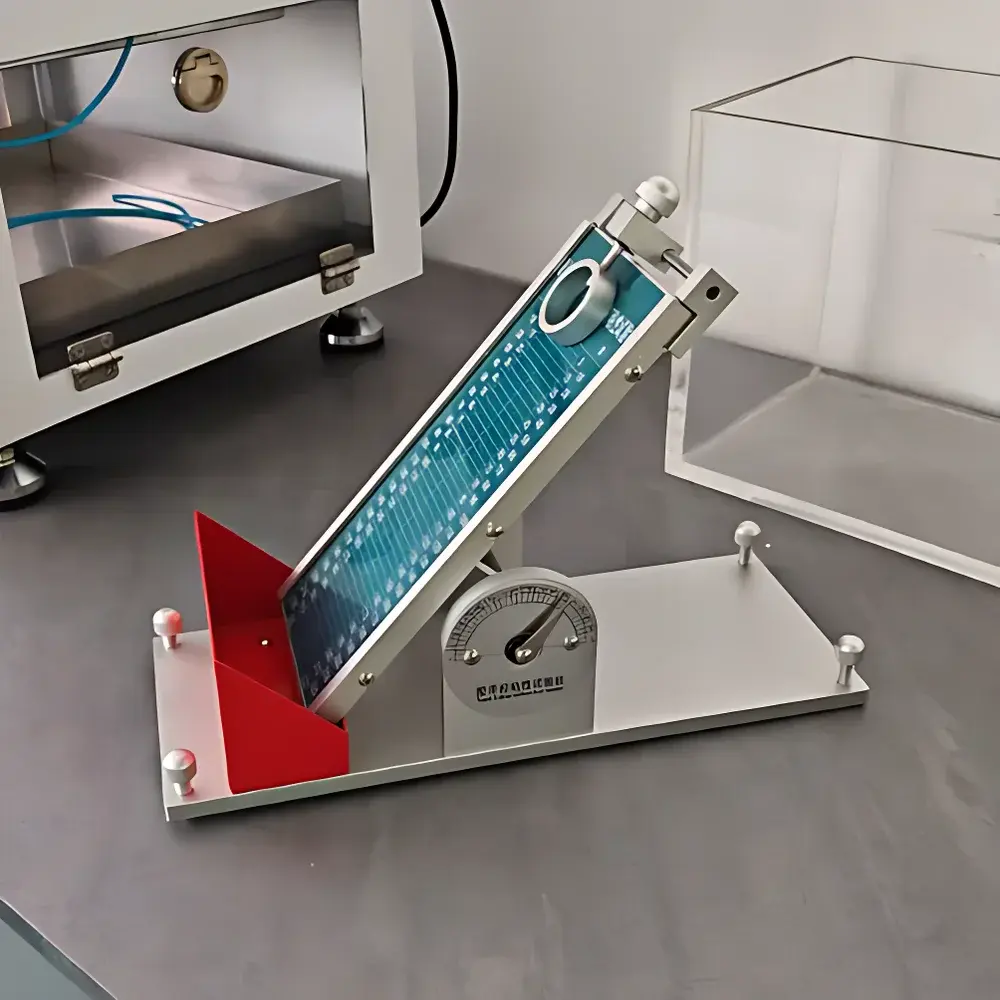
QKTester CZY-01 Initial Adhesion Tester (Rolling Ball Method)
| Brand | QKTester |
|---|---|
| Model | CZY-01 |
| Principle | Rolling Ball Method (Inclined Plane) |
| Adjustable Inclination Angle | 0–60° |
| Test Zone Width | 80 mm |
| Tabletop Width | 120 mm |
| Steel Balls | 32 pcs (Ø25.4 mm, graded per ISO 3290 / ASTM F279) |
| Weight | 7.5 kg |
| Dimensions (L×W×H) | 320 × 140 × 180 mm |
| Compliance | GB/T 4852–2002, JIS Z 0237:2017, YY/T 0148–2013 |
| Standard Configuration | Main Unit + Set of 32 Calibrated Steel Balls |
Overview
The QKTester CZY-01 Initial Adhesion Tester is an engineered precision instrument designed for quantitative evaluation of the initial tack—i.e., the instantaneous adhesive strength developed upon brief, light contact—of pressure-sensitive adhesives (PSAs) and related laminated products. It operates strictly on the rolling ball method (RBM), a standardized physical test principle defined in GB/T 4852–2002, JIS Z 0237:2017, and YY/T 0148–2013. In this method, a polished steel ball of defined diameter and hardness is released from rest at the top of an inclined plane lined with the adhesive specimen. The distance traveled by the ball before stopping—or more critically, whether it adheres to or rolls off the surface—serves as the functional indicator of initial tack. The result is expressed as the largest ball size (in millimeters) that remains immobilized upon contact, providing a discrete, repeatable, and operator-independent metric traceable to internationally recognized reference spheres.
Key Features
- Triple-station modular design enables parallel testing of three specimens under identical angular and environmental conditions—reducing inter-test variability and increasing throughput for QC laboratories.
- Precisely adjustable inclination angle (0° to 60° in 1° increments) allows method optimization across diverse PSA chemistries, including acrylics, rubber-based, silicone, and hydrogel formulations used in transdermal patches and medical tapes.
- Calibrated steel ball set (32 pieces, Ø25.4 mm, grade G10 per ISO 3290 and ASTM F279) ensures metrological traceability; each ball is individually verified for sphericity (<0.4 µm deviation), surface roughness (Ra < 0.025 µm), and hardness (60–66 HRC).
- Rigid aluminum alloy frame with anti-vibration base minimizes mechanical drift during ball release and rolling phases—critical for achieving ≤±0.5 mm positional repeatability over 50+ consecutive tests.
- Non-motorized, gravity-driven operation eliminates electronic interference and aligns with GLP-compliant manual test protocols required in pharmaceutical validation environments.
Sample Compatibility & Compliance
The CZY-01 accommodates flat, flexible substrates up to 120 mm wide and 180 mm long, including but not limited to: medical-grade pressure-sensitive adhesives (e.g., acrylate gels for transdermal drug delivery systems), labeling films, protective masking tapes, wound care dressings, and traditional rubber-based adhesive tapes. Its mechanical architecture conforms to the dimensional and procedural constraints specified in YY/T 0148–2013 (Chinese standard for medical adhesive tapes), GB/T 4852–2002 (general-purpose PSA testing), and JIS Z 0237:2017 (Japanese industrial standard for adhesive tapes). For regulatory submissions under FDA 21 CFR Part 11 or EU MDR Annex I, users may integrate documented calibration records (including ball certification reports and inclinometer verification logs) into their validation master files.
Software & Data Management
The CZY-01 is a hardware-only instrument with no embedded firmware or digital interface—intentionally designed to support paper-based or LIMS-integrated manual data capture workflows. All test parameters (inclination angle, ball ID, pass/fail outcome, ambient temperature/humidity) are recorded directly onto standardized test worksheets compliant with ISO/IEC 17025 documentation requirements. Optional companion templates (Excel-based) are available for automated calculation of mean ball size, standard deviation, and pass/fail thresholds per batch—fully auditable and compatible with electronic signature workflows when deployed within validated document management systems.
Applications
- Quality control of transdermal patch adhesives during formulation development and routine manufacturing release testing.
- Comparative screening of PSA raw materials (e.g., polymer molecular weight distribution impact on initial tack).
- Stability studies assessing tack degradation under accelerated aging (40°C/75% RH) per ICH Q1A(R2).
- Supplier qualification audits where adherence to JIS Z 0237 or YY/T 0148 is contractually mandated.
- Method transfer between R&D, QC, and CMO sites due to instrument portability (7.5 kg) and minimal setup dependency.
FAQ
Does the CZY-01 comply with FDA 21 CFR Part 11 requirements?
No—the instrument itself contains no electronic data capture or storage capability. However, its test outputs are fully compatible with Part 11–compliant LIMS or ELN platforms when paired with controlled procedural documentation and audit-trail-enabled reporting tools.
Can the device be used for non-medical adhesive applications such as packaging tapes?
Yes—provided the substrate meets dimensional and surface uniformity criteria outlined in GB/T 4852; users must validate ball selection and angle settings against application-specific performance benchmarks.
Is calibration certification included with the steel ball set?
Each set ships with a manufacturer’s calibration certificate referencing ISO/IEC 17025-accredited third-party verification of sphericity, diameter tolerance (±0.005 mm), and surface finish.
What maintenance is required for long-term accuracy?
Routine cleaning of the inclined plane with isopropyl alcohol and periodic re-verification of inclinometer accuracy using a certified digital protractor (±0.1° tolerance) every six months.
Are custom fixtures available for irregular or curved samples?
No—the CZY-01 is strictly configured for flat, planar specimens per referenced standards; alternative geometries require method development outside normative scope and are not supported under warranty.



