
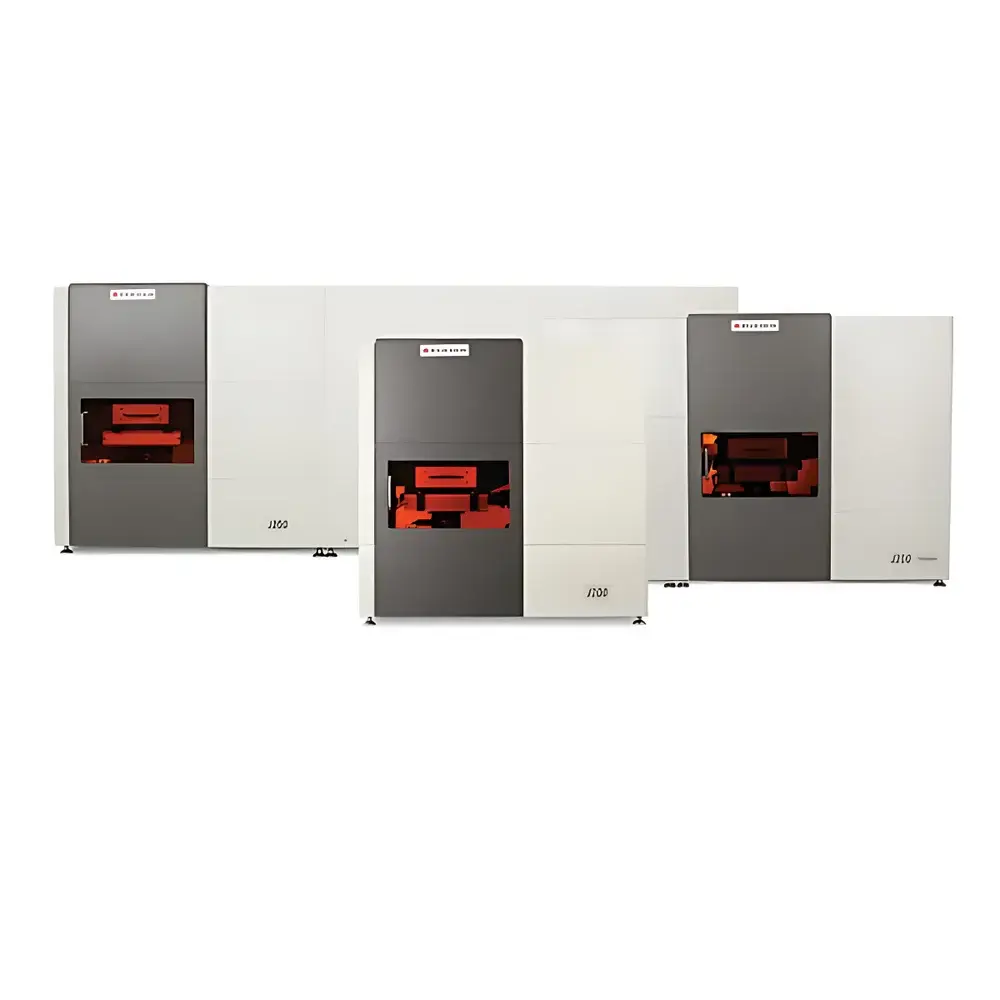
Applied Spectra J200 Laser Ablation–Laser Induced Breakdown Spectroscopy (LA-LIBS) Platform
| Brand | Applied Spectra |
|---|---|
| Origin | USA |
| Manufacturer Type | Authorized Distributor |
| Origin Category | Imported |
| Model | J200 |
| Price Range | USD 140,000 – 700,000 |
| Instrument Type | Benchtop |
| Integration | Fully Integrated |
| Laser Energy | 25–100 mJ |
| Wavelength Options | 1064 nm, 266 nm, 213 nm, 343 nm (femtosecond), 1030 nm (femtosecond) |
| Spectrometer Options | EN4, EN6, SHP, IHP, RHP (dual-spectrometer configurations supported) |
| Sample Cell Options | Standard Flex Chamber, Cryo Cell, FlexSeal LA, FlexSeal Chamber, THP Cell – Standard Washout, THP Cell – Fast Washout |
Overview
The Applied Spectra J200 is a fully integrated, benchtop Laser Ablation–Laser Induced Breakdown Spectroscopy (LA-LIBS) platform engineered for high-precision elemental analysis across solid, heterogeneous, and layered materials. It combines two complementary laser-based analytical techniques—laser ablation (LA) for controlled microsampling and LIBS for real-time, in-situ plasma emission spectroscopy—within a single, modular architecture. The system operates on the fundamental principle of generating transient microplasmas via focused pulsed laser irradiation; emitted atomic and ionic line spectra are collected and resolved by high-resolution spectrometers to enable qualitative, quantitative, and spatially resolved elemental characterization from ultraviolet (UV) to near-infrared (NIR) spectral regions (190–950 nm). Unlike conventional standalone LA-ICP-MS or LIBS systems, the J200’s Tandem configuration supports simultaneous or sequential LA and LIBS acquisition—enabling direct correlation of ablation yield with plasma composition, normalization of ICP-MS signals, and enhanced detection of light elements (H, O, N, C, F, P, S) under inert gas environments (He or Ar).
Key Features
- Patented Auto-Focusing Optics: Real-time height compensation ensures consistent laser fluence and crater morphology across topographically variable samples—including polished sections, rough geological specimens, and irregular forensic evidence—without manual intervention.
- Multi-Branch Gas Flow Module: A proprietary laminar-flow design minimizes turbulence and aerosol particle settling within the ablation chamber, significantly reducing memory effects and cross-contamination between successive analyses.
- High-Precision Gas Management System: Dual mass flow controllers (MFCs) and ultra-responsive electronic valves regulate carrier and shielding gases with sub-1% stability, enabling reproducible aerosol transport and optimized LIBS plasma conditions—critical for light-element detection and isotopic signal consistency.
- Automated 3D Precision Stage: Motorized XYZ translation with sub-micron repeatability supports high-fidelity elemental mapping (mapping resolution down to 1 µm step size), depth profiling, and multi-point calibration routines compliant with ASTM E2890 and ISO 17025 workflows.
- Optimized Light Collection Optics: Large-core, low-dispersion fiber coupling (Ø600 µm) with achromatic collimation delivers uniform spectral throughput across 190–950 nm, maximizing signal-to-noise ratio without chromatic aberration artifacts.
- TruLIBS™ Spectral Database & Chemometric Engine: Pre-calibrated spectral library includes >12,000 reference lines for >70 elements; integrated PCA and PLS-DA algorithms support unsupervised classification, outlier detection, and matrix-matched quantification—validated per USP and FDA 21 CFR Part 11 data integrity requirements.
Sample Compatibility & Compliance
The J200 accommodates diverse sample geometries and matrices through interchangeable chambers: the Standard Flex Chamber for routine geochemical and metallurgical samples; the Cryo Cell for volatile-rich or temperature-sensitive biological and environmental specimens; the FlexSeal variants for air-sensitive materials (e.g., battery cathodes, hydrous minerals); and the THP Cells with rapid washout kinetics (<3 s) for high-throughput forensic or clinical tissue analysis. All configurations maintain vacuum-tight integrity and support purge-gas compatibility (He, Ar, N2, air) to meet ISO/IEC 17025 method validation criteria. System firmware logs full audit trails—including laser energy, focus position, gas flow rates, spectrometer settings, and user actions—ensuring full traceability for GLP/GMP-regulated environments.
Software & Data Management
J200 Control Suite v5.x provides unified instrument control, spectral acquisition, and post-processing via a role-based interface compliant with FDA 21 CFR Part 11. Raw spectra are stored in HDF5 format with embedded metadata (wavelength calibration, integration time, detector temperature). Quantitative modules support internal standardization (e.g., Ca, Si, Fe), matrix-matched calibration curves, and certified reference material (CRM) referencing per ISO 11097. Export options include CSV, ASCII, and mzML-compatible formats for third-party chemometric platforms (MATLAB, Python scikit-learn, Unscrambler X). Audit logs are encrypted, tamper-evident, and exportable as PDF reports for regulatory submissions.
Applications
The J200 serves as a primary analytical tool in academic, governmental, and industrial laboratories requiring multi-modal elemental insight. Key use cases include: (i) geochronology and mineral zoning via U–Pb and REE depth profiling; (ii) inclusion chemistry in diamonds and volcanic glasses; (iii) forensic glass and paint chip discrimination using trace-element fingerprinting; (iv) Li-ion battery electrode heterogeneity mapping; (v) soil and sediment nutrient/light-element speciation (C/N/P/S/O/H) under He atmosphere; (vi) archaeological ceramic provenance studies via multivariate elemental clustering; and (vii) nuclear fuel pellet burnup analysis with isotopic sensitivity (when coupled to magnetic sector ICP-MS). Its Tandem mode uniquely enables real-time correction of ICP-MS signal drift using LIBS-based plasma electron density metrics.
FAQ
Can the J200 operate independently as a pure LA or pure LIBS system?
Yes—the platform supports three operational modes: standalone LA (for coupling to ICP-MS), standalone LIBS (for rapid bulk screening), and synchronized Tandem mode (simultaneous LA + LIBS acquisition).
What spectral resolution is achievable with the EN6 spectrometer option?
The EN6 delivers ≤0.025 nm FWHM at 250 nm with 2400 grooves/mm grating—sufficient to resolve adjacent Mn II (257.610 nm) and Fe II (257.622 nm) lines under optimal signal conditions.
Is helium required for light-element detection?
Helium purge is strongly recommended for H, O, N, and C detection due to its superior plasma thermal conductivity and UV transmission; argon may be used for heavier elements but attenuates below 190 nm.
How does the system handle calibration for unknown matrices?
TruLIBS™ supports both empirical calibration (using CRMs) and physics-based plasma modeling (Local Thermodynamic Equilibrium assumption) for semi-quantitative screening when standards are unavailable.
Does the J200 comply with ISO/IEC 17025 for accredited testing labs?
Yes—its automated calibration verification, electronic signatures, full audit trail, and uncertainty estimation tools align with ISO/IEC 17025:2017 Clause 7.7 and Appendix B requirements for measurement traceability.



