
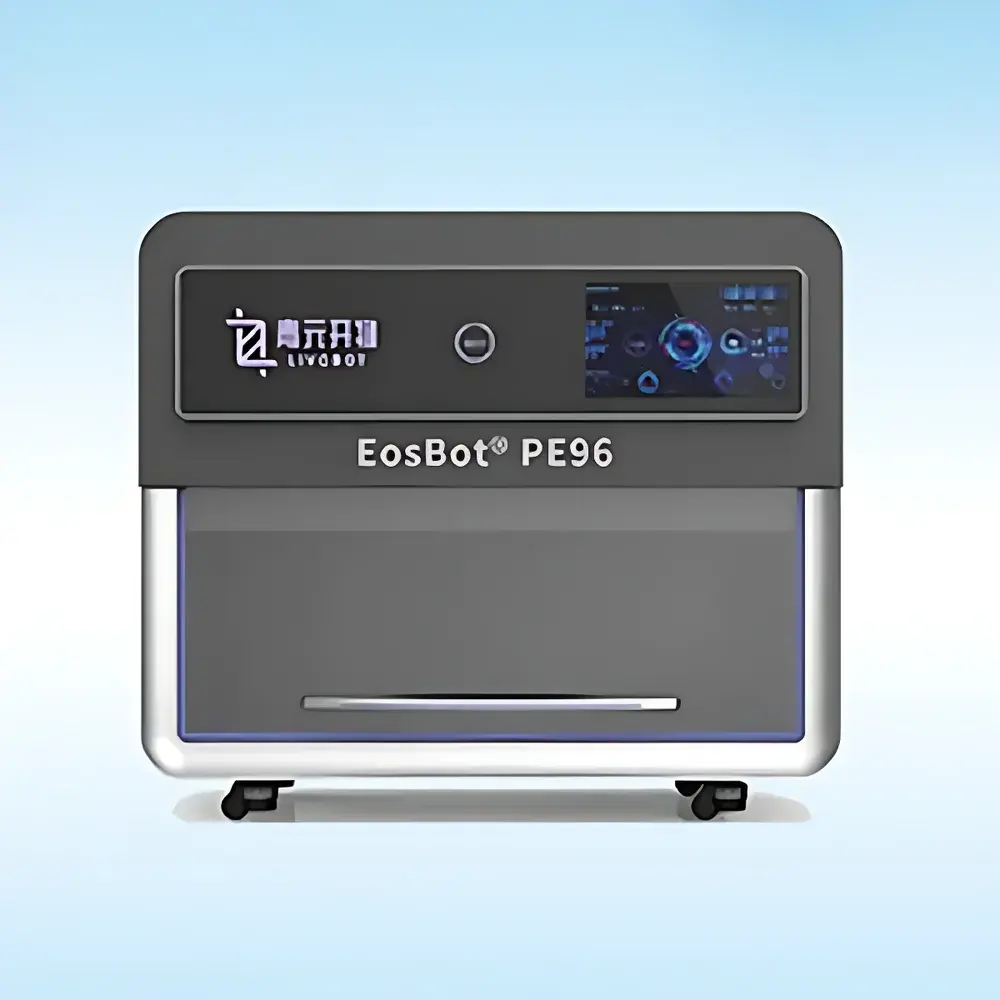
EosBot® PE96 Plasmid Miniprep Workstation
| Brand | LIVOBOT |
|---|---|
| Origin | Beijing, China |
| Manufacturer Type | Direct Manufacturer |
| Product Origin | Domestic (China) |
| Model | EosBot® PE96 |
| Pricing | Available Upon Request |
Overview
The EosBot® PE96 Plasmid Miniprep Workstation is an automated, benchtop nucleic acid extraction platform engineered for high-reproducibility plasmid isolation from bacterial cultures in low-to-moderate throughput research laboratories. It implements a magnetic bead–based solid-phase purification principle—leveraging paramagnetic silica-coated particles that selectively bind plasmid DNA under chaotropic salt and pH-controlled binding conditions, followed by on-instrument washing and elution. Designed specifically for miniprep-scale workflows (typically 1–5 mL bacterial cultures), the system replaces manual spin-column or alkaline lysis protocols with standardized, walk-away automation while maintaining compatibility with common commercial lysis and wash reagents. Its architecture supports end-to-end processing—from cell lysis and binding to final elution—within a single integrated deck, minimizing cross-contamination risk and operator variability. The workstation is optimized for routine use in academic labs, core facilities, and early-stage biotech R&D where consistency, traceability, and hands-on time reduction are critical operational priorities.
Key Features
- 96-well plate format processing with full deck automation: integrated pipetting, heating, shaking, magnetic separation, and liquid handling modules
- Dual-channel pipetting system (single- and 8-channel modes) enabling flexible reagent dispensing and sample transfer
- Programmable thermal control (37–95 °C) for controlled lysis, incubation, and elution steps
- Orbital shaking with adjustable speed and duration for uniform cell resuspension and bead mixing
- Magnetic rod array with precise Z-axis positioning for efficient bead capture and minimal carryover
- Onboard barcode scanning for consumable tracking and protocol versioning (optional)
- Modular design supporting future integration with downstream applications (e.g., PCR setup, quantification)
Sample Compatibility & Compliance
The EosBot® PE96 accepts standard 96-well deep-well plates (V-bottom or U-bottom) and compatible magnetic bead-based plasmid kits—including those compliant with ISO 13485–certified manufacturing standards. It supports common E. coli strains (DH5α, TOP10, BL21) and yields high-purity plasmid DNA suitable for restriction digestion, Sanger sequencing, transfection, and next-generation cloning workflows. All liquid handling operations adhere to CLSI EP15-A3 guidelines for precision verification, and instrument logs meet GLP/GMP data integrity requirements per FDA 21 CFR Part 11 when paired with validated software configuration. No hazardous waste generation beyond standard lab biosafety Level 1 practices; all reagents remain contained within sealed plates during processing.
Software & Data Management
The workstation runs on LIVOBOT Control Suite v3.x—a Windows-based application offering protocol authoring, real-time run monitoring, and electronic lab notebook (ELN)-ready export (CSV, PDF, XML). Each run generates a timestamped audit trail including user ID, protocol name, step-by-step execution logs, temperature/pipette calibration records, and error flags. Software supports role-based access control (RBAC), digital signature enforcement, and encrypted local storage. Exported data conforms to MIAME and MIAPE metadata standards for seamless integration into institutional LIMS environments. Remote diagnostics and firmware updates are performed via secure TLS 1.2–encrypted connection without exposing internal network infrastructure.
Applications
- Routine plasmid validation in CRISPR vector construction and mutagenesis screening
- Preparation of transfection-grade DNA for mammalian cell line development
- High-fidelity template generation for site-directed mutagenesis and Gibson assembly
- Quality control testing in plasmid library construction and synthetic biology chassis characterization
- Supporting DOE-driven optimization of expression vectors under GLP-aligned documentation
FAQ
What is the typical yield and purity range for plasmid DNA extracted using the EosBot® PE96?
Yield varies by strain, culture volume, and plasmid copy number (typically 1–20 µg per 1.5 mL culture); A260/A280 ratios consistently exceed 1.80, and A260/A230 > 2.0 when using recommended reagents.
Can the system be validated for regulated environments such as clinical assay development?
Yes—full IQ/OQ/PQ documentation packages are available upon request; instrument performance qualifies under ISO/IEC 17025 and USP <85> endotoxin testing prerequisites when used with low-endotoxin reagents.
Is third-party kit compatibility supported?
The platform is open-protocol and fully compatible with major magnetic bead–based plasmid kits (e.g., Thermo Fisher GeneJET, Zymo Research Zyppy, Norgen Biotek); method adaptation requires no hardware modification.
How is maintenance and calibration managed?
Automated self-calibration routines execute prior to each run; pipette accuracy is verified quarterly using gravimetric assessment per ISO 8655-6; service contracts include remote calibration support and annual on-site verification.





