
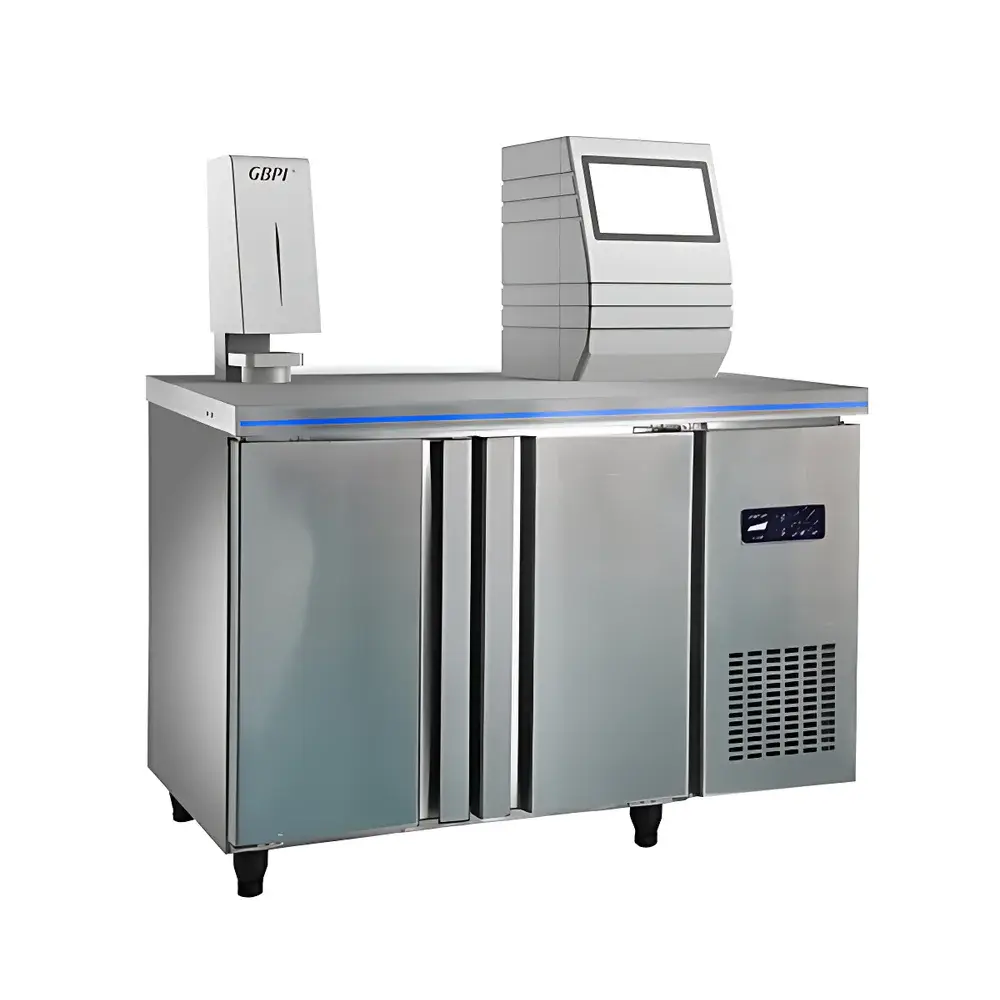
GBPI GB-PF500L Oil-Based Particulate Filtration Efficiency Tester for Melt-Blown Nonwovens
| Brand | GBPI |
|---|---|
| Origin | Guangdong, China |
| Manufacturer Type | Direct Manufacturer |
| Country of Origin | China |
| Model | GB-PF500L |
| Price Range | USD 14,000 – 42,000 |
| Filtration Efficiency Range | 0–99.999% |
| Flow Rate Range | 20–100 L/min |
| Pressure Drop Range | 0–1000 Pa |
| Test Particle Sizes | 0.3, 0.5, 1.0, 2.5, 5.0, 10.0 µm |
| Aerosol Type | Oil-based (DEHS or Paraffin Oil) |
| Standard Test Area | 100 cm² (mask fixture optional) |
| Dimensions | 1220 × 630 × 1225 mm |
| Weight | 250 kg |
| Power Consumption | <1500 W |
| Power Supply | AC 220 V, 50 Hz |
Overview
The GBPI GB-PF500L Oil-Based Particulate Filtration Efficiency Tester is a precision-engineered instrument designed to quantify the filtration performance of melt-blown nonwoven fabrics—particularly those used in respiratory protective devices—against oil-based aerosols under controlled, standardized airflow conditions. It operates on the principle of challenge-and-measurement: a stable, monodisperse or polydisperse oil-based aerosol (typically DEHS or paraffin oil) is generated and delivered at a constant volumetric flow rate across a conditioned test specimen; upstream and downstream particle concentrations are simultaneously measured using calibrated optical particle counters, enabling real-time calculation of filtration efficiency (%) and pressure drop (Pa). The system adheres to core physical measurement principles defined in ISO 16890, EN 1822-3:1998 (for single-layer filter media), and YY 0469–2011, while maintaining full compatibility with Chinese national standards including GB/T 32610–2016, GB 2626–2006, GB 19082–2009, GB 19083–2010, and GB 24539–2009. Its architecture integrates aerosol physics, fluid dynamics, and metrological traceability to support regulatory compliance and inter-laboratory reproducibility.
Key Features
- Cold-generation aerosol generator delivering continuous, stable oil-based aerosol (DEHS or paraffin oil) with simplified solution refilling and minimal thermal perturbation to particle morphology.
- Dedicated mixing chamber with integrated temperature and relative humidity monitoring, ensuring aerosol homogeneity and minimizing concentration drift during extended testing cycles.
- Domestically manufactured optical particle counter equipped with automatic cleaning functionality to mitigate sensor fouling and preserve counting accuracy over repeated use.
- Full containment design with leak-tight seals and negative-pressure operation to prevent unintended aerosol release—critical for operator safety and laboratory environmental control.
- Integrated bipolar corona discharge neutralizer to eliminate electrostatic charge effects on test specimens, aligning measurements with standardized neutralized aerosol protocols (e.g., ISO 16890 Annex C).
- Pneumatically actuated specimen clamp with mechanical safety interlocks, enabling rapid, repeatable loading of flat filter media (100 cm² standard area) or optional mask fixtures without manual torque variation.
- Industrial-grade touch-panel HMI (Human-Machine Interface) coupled with embedded industrial PC for standalone operation, complemented by optional Windows-based software for advanced data logging, audit trail generation, and report export (CSV/PDF).
Sample Compatibility & Compliance
The GB-PF500L accommodates a broad range of filtration media relevant to medical and occupational PPE manufacturing, including glass fiber filters, polypropylene (PP) melt-blown nonwovens, and laminated or membrane-coated substrates (e.g., PTFE- or PU-film composites). Its standardized 100 cm² test area supports both flat-sheet evaluation per EN 1822-3 and masked-device testing via configurable fixtures. All operational parameters—including flow stability (±2% of setpoint), pressure transducer calibration (NIST-traceable), and particle counter sizing resolution—are validated against internal SOPs aligned with GLP principles. The system supports full documentation of instrument qualification (IQ/OQ), test method validation, and electronic record retention compliant with FDA 21 CFR Part 11 requirements when deployed with configured software modules and user access controls.
Software & Data Management
Data acquisition and analysis are managed through a dual-mode control architecture: real-time local operation via ruggedized 10.1″ capacitive touch HMI, and comprehensive post-test analysis via dedicated Windows application. The software logs timestamped raw particle counts (upstream/downstream), differential pressure, environmental conditions (T/RH), and calculated metrics—including filtration efficiency at each specified size channel (0.3–10.0 µm), quality factor (QF = −ln(1−E)/ΔP), and average pressure drop. All datasets include unique test IDs, operator credentials, calibration status flags, and digital signatures. Audit trails record every parameter change, test initiation, and report generation event. Export formats include CSV (for LIMS integration), PDF (with header/footer branding and signature fields), and XML (compatible with enterprise QA systems).
Applications
This instrument serves as a primary verification tool across multiple regulated domains: certification testing of surgical masks and KN95/FFP2 respirators per YY 0469–2011 and GB 2626–2006; R&D evaluation of novel electret-treated melt-blown layers; QC release testing in textile and medical device manufacturing facilities; and proficiency assessment in national reference laboratories (e.g., CDC, NIM, CNAS-accredited centers). Its oil-aerosol capability specifically addresses the “BFE vs. PFE” distinction mandated in regulatory submissions—where bacterial filtration efficiency (aqueous NaCl) alone is insufficient for oil-resistant respirator classification. The system is routinely deployed in pharmaceutical cleanroom validation, occupational hygiene assessments, and academic research on filtration mechanisms (e.g., diffusion, interception, inertial impaction, electrostatic capture).
FAQ
What aerosol agents are supported for oil-based testing?
DEHS (diethylhexyl sebacate) and pharmaceutical-grade paraffin oil are the two validated challenge agents, both meeting ISO 16890 and EN 1822 specifications for hydrophobic aerosol generation.
Can the system test complete face masks—not just flat filter media?
Yes, optional mask-specific fixtures are available to mount intact surgical or respirator masks, enabling total inward leakage (TIL) simulation under standardized flow conditions.
Is particle charge neutralization mandatory for compliance?
Yes—per ISO 16890, EN 1822, and YY 0469, neutralization is required to isolate mechanical filtration performance from electrostatic enhancement effects.
How is calibration traceability maintained?
Critical subsystems—including mass flow controllers, pressure transducers, and particle counters—are calibrated annually against NIST-traceable standards, with certificates stored in the onboard database and exportable with test reports.
Does the system support automated pass/fail decision logic per standard thresholds?
Yes—the software allows pre-definition of acceptance criteria (e.g., ≥95% at 0.3 µm for KN95), triggering visual alerts and auto-flagging nonconforming results during live testing.






