
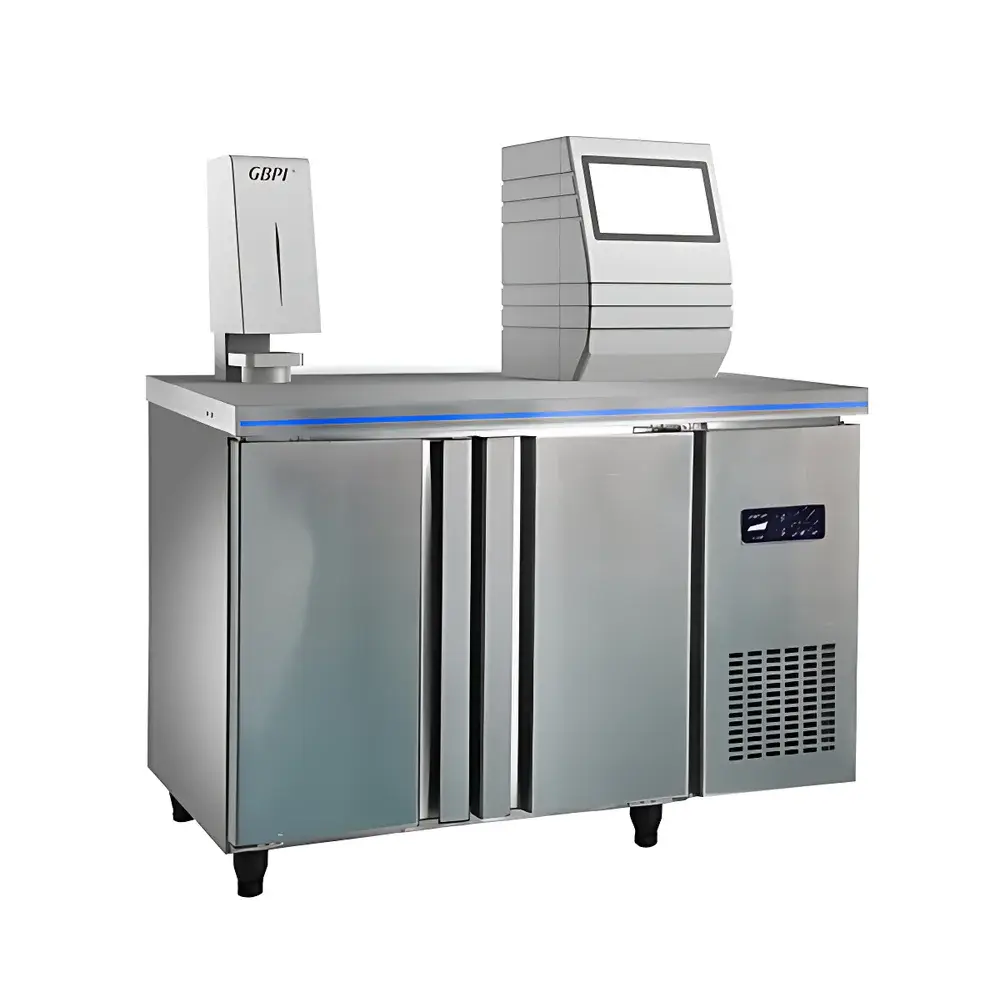
GBPI GB-KF30010TG Particle Filtration Efficiency Tester for Meltblown Nonwovens
| Brand | GBPI |
|---|---|
| Origin | Guangdong, China |
| Manufacturer Type | Direct Manufacturer |
| Country of Origin | China |
| Model | GB-KF30010TG |
| Price Range | USD 42,000 – 70,000 |
| Filtration Efficiency Range | 0–99.999% |
| Flow Rate Control | 20–100 L/min |
| Pressure Drop Measurement Range | 0–1000 Pa |
| Test Particle Sizes | 0.3 µm, 0.5 µm, and 5.0 µm |
| Aerosol Sources | DEHS (oil-based) and 2% NaCl (salt-based) |
| Standard Test Area | 100 cm² (customizable per mask geometry) |
| Dimensions | 130 × 75 × 157 cm |
| Weight | 250 kg |
| Power Supply | AC 220 V, 50 Hz |
| Max Power Consumption | <1500 W |
Overview
The GBPI GB-KF30010TG Particle Filtration Efficiency Tester is a precision-engineered instrument designed specifically for quantitative assessment of filtration performance in meltblown nonwoven materials—particularly those used in respiratory protective devices such as surgical masks, N95/KN95 respirators, and medical-grade face coverings. It operates on the principle of aerosol challenge testing under controlled laminar flow conditions, measuring both particle penetration (via upstream/downstream concentration differential) and airflow resistance (pressure drop across the sample). The system complies with core regulatory test methodologies including YY 0469–2011 (Medical Surgical Masks), GB 2626–2006 (Respiratory Protective Devices), GB/T 32610–2016 (Daily-Use Protective Masks), and references EN 1822–3:1998 for single-layer filter media evaluation. Its dual-aerosol capability (NaCl for hydrophilic particulate challenge; DEHS for oil-based aerosol simulation) enables comprehensive compliance verification against both salt- and oil-aerosol filtration standards.
Key Features
- Cold-generation aerosol generator supporting both NaCl (2% aqueous solution) and DEHS aerosols, ensuring stable, monodisperse particle output without thermal degradation of filter media.
- Integrated electrostatic neutralizer (Bipolar ionizer) to eliminate surface charge effects that may artificially elevate filtration efficiency readings—critical for accurate comparison across electret-based meltblown fabrics.
- Hermetically sealed aerosol pathway with leak-tight gasketed sample chamber and negative-pressure containment, meeting ISO 15195:2018 requirements for operator safety during high-concentration aerosol exposure.
- Pneumatic sample clamping system with mechanical overload protection and position-sensing feedback, enabling repeatable 100 cm² test area application while accommodating variable mask geometries via optional fixtures.
- Dual-channel laser particle counter (0.3–5.0 µm detection range, ±5% counting accuracy per ISO 21501-4) with real-time data streaming to control software.
- Computer-controlled automation including automatic flow regulation, pressure drop logging, efficiency calculation, and pass/fail flagging per user-defined acceptance criteria.
- Industrial-grade touchscreen HMI (10.1″ capacitive display) with embedded logic for standalone operation, plus full PC integration via USB/Ethernet for GLP-compliant audit trails.
Sample Compatibility & Compliance
The GB-KF30010TG accommodates flat-sheet specimens—including glass fiber filters, polypropylene (PP) meltblown webs, and laminated or coated variants (e.g., PTFE-membrane composites)—as well as finished masks mounted on standardized fixtures. All test protocols align with national and international regulatory frameworks: GB 19082–2009 (Medical Protective Gowns), GB 19083–2010 (Medical Protective Masks), GB 24539–2009 (Chemical Protective Clothing), and YY/T 0969–2013 (Disposable Medical Masks). The system supports method validation per ISO/IEC 17025:2017 and includes built-in calibration traceability for flow meters (NIST-traceable rotameters), pressure transducers (±0.5% FS), and particle counters (certified reference aerosols).
Software & Data Management
The proprietary GBPI FilterTest Suite v3.2 provides full lifecycle data governance: automated test sequence execution, dynamic parameter logging (flow, ΔP, upstream/downstream particle counts), and real-time efficiency calculation using the standard formula: FE (%) = [1 − (Cdown/Cup)] × 100. All raw and processed data are stored in encrypted SQLite databases with timestamped metadata, user authentication, and electronic signature support. Export options include CSV, PDF reports (with customizable templates), and XML for LIMS integration. Audit trail functionality complies with FDA 21 CFR Part 11 requirements, recording all user actions, parameter modifications, and result approvals with immutable timestamps.
Applications
- Quality assurance of meltblown PP production lines—monitoring batch-to-batch consistency in fiber diameter distribution and electrostatic charge retention.
- Regulatory submission testing for Class I/II medical devices seeking NMPA registration or CE marking under MDR Annex II.
- R&D evaluation of novel nanofiber coatings, antimicrobial treatments, or hydrophobic/hydrophilic layer architectures.
- Comparative analysis of filter media aging behavior under humidity, temperature cycling, or mechanical flexing per ISO 16900-2:2016.
- Third-party certification testing at accredited laboratories (CNAS, ILAC-MRA signatory bodies) performing routine surveillance per GB/T 32610–2016 Annex A.
FAQ
What aerosol generation methods does the GB-KF30010TG support?
It employs cold nebulization for both sodium chloride (2% w/w aqueous) and diethylhexyl sebacate (DEHS), eliminating thermal artifacts and enabling true electret stability assessment.
Is the system compliant with FDA 21 CFR Part 11 for electronic records?
Yes—the software implements role-based access control, electronic signatures, and tamper-evident audit logs meeting Part 11 Subpart B requirements.
Can the instrument test irregularly shaped masks or respirators?
Standard configuration includes a 100 cm² circular fixture; custom fixtures (e.g., for cup-style N95s or folded surgical masks) are available upon request with dimensional specifications.
Does the system require external calibration services?
All critical sensors ship with factory calibration certificates; annual recalibration is recommended using GBPI-certified service kits or authorized calibration labs.
How is particle charge neutralization verified during operation?
Neutralizer performance is validated daily using a Faraday cup electrometer and polystyrene latex sphere (PSL) aerosol per ISO 14644-3:2019 Annex D protocols.






