
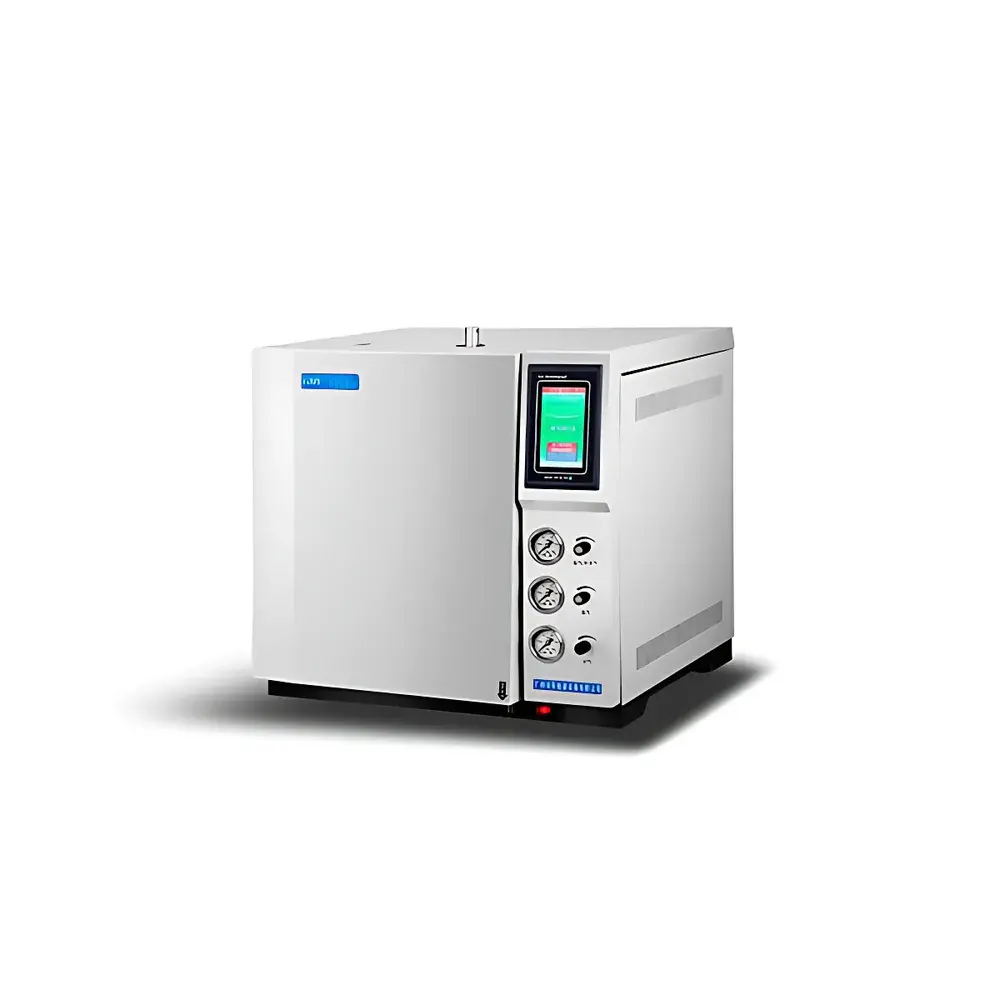
GBPI GC-9802B Laboratory Gas Chromatograph for Solvent Residue Analysis in Packaging and Printing Materials
| Brand | GBPI |
|---|---|
| Model | GC-9802B |
| Origin | Guangdong, China |
| Manufacturer Type | Direct Manufacturer |
| Instrument Type | Benchtop Laboratory Gas Chromatograph |
| Application Scope | General-purpose, with optimized configuration for residual solvent quantification |
| Oven Temperature Range | 40–400 °C |
| Temperature Ramp Rate | 0–40 °C/min |
| Cool-down Time | ~6 min (from 450 °C to 50 °C) |
| Carrier Gas Flow Control Range | 0–1200 mL/min |
| Carrier Gas Pressure Control Range | 0–970 kPa |
| Injector Maximum Temperature | 400 °C |
| Injector Total Flow Setting Range | 0–1200 mL/min |
| Detector | FID (Flame Ionization Detector), Mt ≤ 1×10⁻¹¹ g/s (n-hexadecane), Baseline Drift ≤ 0.02 mV/h, Noise ≤ 0.02 mV |
| Column | OV-1701 fused-silica capillary column (50 m × 0.32 mm ID × 0.5 µm film thickness), max. operating temperature 400 °C |
| Data System | Integrated chromatography data workstation with real-time acquisition, baseline correction, peak integration, calibration curve generation, PDF report export, and audit-trail-ready operation log |
Overview
The GBPI GC-9802B is a benchtop laboratory gas chromatograph engineered for precise, reproducible quantification of volatile organic compounds (VOCs) in complex matrices—particularly residual solvents in flexible packaging films, laminates, and printed substrates. It operates on the principle of partition chromatography, where analytes are separated based on differential volatility and polarity as they migrate through a thermally stable capillary column under controlled carrier gas flow. The instrument employs a flame ionization detector (FID), offering high sensitivity and linear dynamic range for hydrocarbon- and oxygenated-solvent detection—including toluene, ethyl acetate, isopropanol, benzene, xylene, and ketones—commonly used in gravure and flexographic printing inks and adhesives. Designed to meet regulatory requirements for food-contact materials, the GC-9802B supports compliance-driven testing workflows aligned with Chinese national standards Q/BT 2929, GB/T 10004–2008, and YBB 00132002, and provides method transfer compatibility with internationally recognized protocols such as ASTM D3557 and ISO 11843.
Key Features
- Robust thermal management system with ±0.1 °C oven temperature stability and 0.1 °C resolution across a 40–400 °C operating range, enabling precise method development for multi-component solvent mixtures.
- Programmable temperature ramping (0–40 °C/min) and rapid cool-down (~6 minutes from 450 °C to 50 °C), reducing cycle time without compromising column integrity or retention time reproducibility.
- Dual independent gas control modules: digitally regulated carrier (N₂), fuel (H₂), and makeup/air flows, each with full-range pressure (0–970 kPa) and flow (0–1200 mL/min) adjustment and real-time monitoring.
- Capillary-only inlet with split/splitless capability, rated to 400 °C, ensuring quantitative introduction of trace-level volatiles while minimizing thermal degradation of labile solvents.
- Integrated noise-suppression circuitry and dual overtemperature protection (software-based ramp limit + hardware cutoff), enhancing operational safety and long-term detector stability.
- LCD interface with real-time display of oven, injector, and detector temperatures, plus graphical visualization of chromatograms during acquisition.
- Modular unitized chassis design simplifies field maintenance, column replacement, and detector cleaning—critical for high-throughput QC labs handling diverse sample types.
Sample Compatibility & Compliance
The GC-9802B is validated for headspace gas analysis of solvent-extracted packaging samples per standardized extraction procedures (e.g., GB/T 10004–2008). Compatible sample formats include polyethylene (PE), polypropylene (PP), polyester (PET), aluminum foil composites, and metallized films. Extraction solvents (e.g., n-hexane, dichloromethane) and internal standards (e.g., chlorobenzene, n-decane) are fully accommodated within its validated linear range. The system supports GLP-compliant operation through time-stamped audit logs, user-access controls, and electronic signature readiness in its data workstation—facilitating FDA 21 CFR Part 11 alignment when deployed with appropriate IT governance. All hardware and firmware conform to IEC 61010-1 safety standards for laboratory electrical equipment.
Software & Data Management
The bundled chromatography data system provides ISO/IEC 17025-aligned functionality: real-time signal acquisition at ≥10 Hz sampling rate; automated baseline correction using iterative polynomial fitting; customizable peak integration with retention time locking; multi-point external standard and internal standard calibration; and report generation compliant with ISO 17025 documentation requirements. Raw data files (.cdf or .axd format) retain full metadata (instrument parameters, operator ID, sequence ID, audit trail timestamps). Reports export to PDF, CSV, and Excel formats, with configurable templates for QA/QC sign-off, LIMS integration, and regulatory submission. Software supports method validation parameters including LOD/LOQ determination, precision (RSD ≤ 3% for replicate injections), and linearity (r² ≥ 0.999 over 0.1–100 mg/m² range).
Applications
- Quantitative determination of residual solvents (e.g., benzene, toluene, ethyl acetate, isopropanol) in food packaging films and pouches per GB/T 10004–2008.
- Verification of solvent removal efficiency in curing processes for laminated structures and adhesive-coated substrates.
- Purity assessment of industrial-grade solvents used in ink formulation prior to production release.
- Environmental VOC screening in workplace air or exhaust streams from printing facilities (with optional thermal desorption or direct injection).
- Academic research in polymer migration kinetics, barrier property evaluation, and solvent–polymer interaction modeling.
FAQ
What detection limit can be achieved for common packaging solvents using the GC-9802B with FID?
Typical method detection limits (MDL) range from 0.01 to 0.05 mg/m² depending on extraction efficiency, column selectivity, and integration parameters—validated per GB/T 10004–2008 Annex B.
Is the system compatible with third-party chromatography software such as OpenLab CDS or Chromeleon?
The GC-9802B outputs standard .cdf files readable by most commercial CDS platforms; however, native instrument control and method upload require the proprietary GBPI workstation due to custom firmware communication protocols.
Can the oven accommodate longer columns or packed columns?
The column chamber (240 × 210 × 240 mm) is optimized for capillary columns up to 60 m; packed column operation is not supported in this configuration.
Does the FID support hydrogen-air flame optimization for improved sensitivity to oxygenated solvents?
Yes—the H₂ and air flow rates are independently adjustable via front-panel controls or software, allowing fine-tuning of flame stoichiometry for enhanced response to alcohols and esters.
What maintenance intervals are recommended for routine operation?
FID jet cleaning every 200 injections; column trimming every 500 injections or after exposure to dirty extracts; carrier gas filter replacement every 6 months; annual calibration verification against certified reference standards.






