
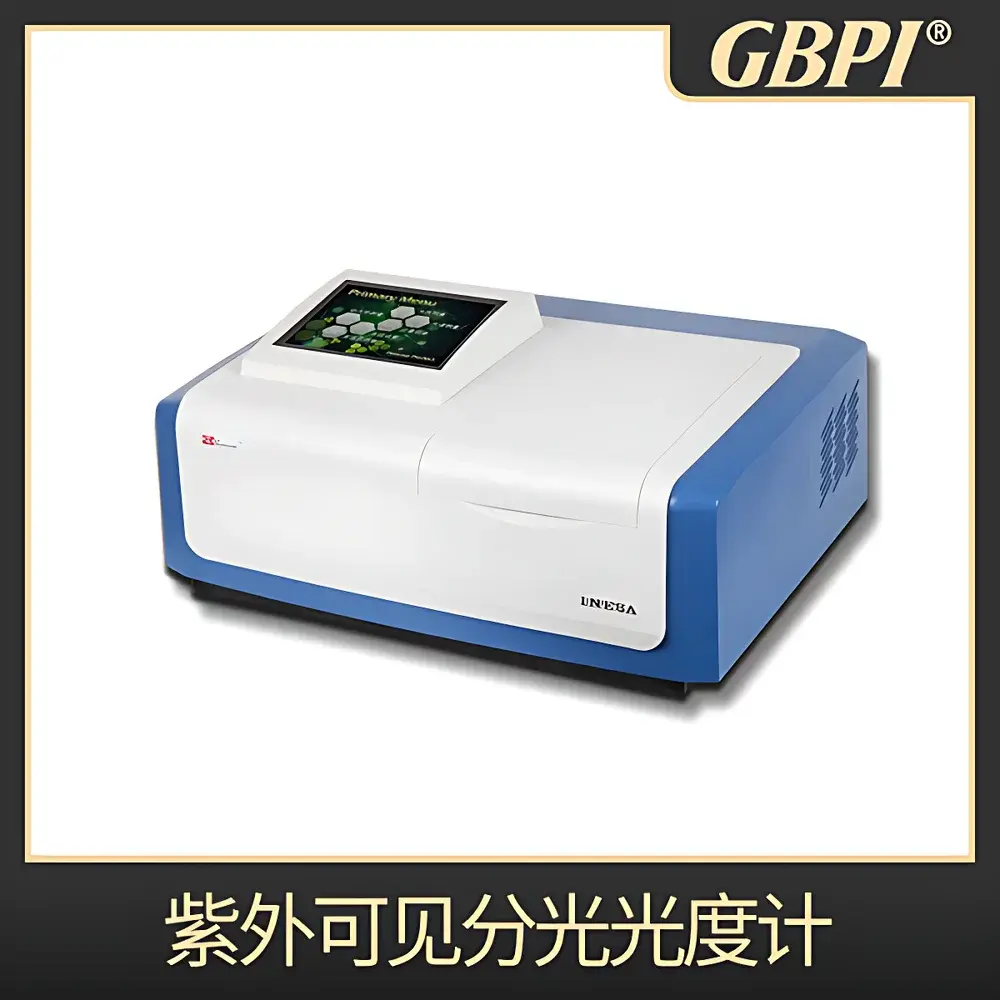
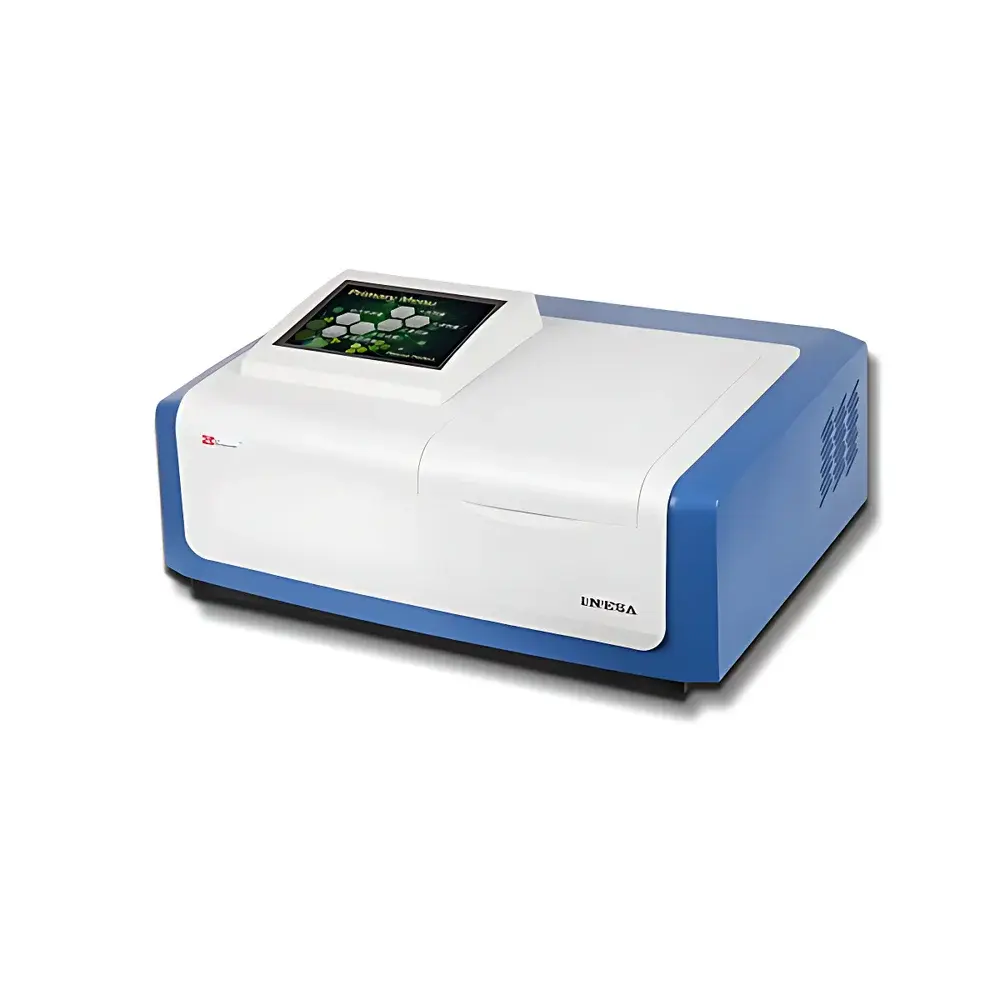
GBPI L6S / L6 UV-Vis Spectrophotometer
| Brand | GBPI |
|---|---|
| Origin | Guangdong, China |
| Manufacturer Type | Manufacturer |
| Product Type | Automatic |
| Model | L6S / L6 |
| Haze Range | ≤ 0.15% T |
| Transmittance Range | 0.0–200.0% T |
| Absorbance Range | −0.301–4.000 A |
| Concentration Range | 0.000–9999 C |
| Haze Repeatability | 0.1 nm |
| Transmittance Repeatability | ≤ 0.15% T |
| Wavelength Range | 190–1100 nm |
| Spectral Bandwidth | 1.8 nm |
| Wavelength Accuracy | ±0.3 nm |
| Wavelength Repeatability | ≤ 0.1 nm |
| Stray Light | ≤ 0.03% T (at 220 nm, NaI |
| Photometric Accuracy | ±0.3% T |
| Photometric Repeatability | ≤ 0.15% T |
| Baseline Flatness | ≤ ±0.0015 A (200–1090 nm, L6S only) |
| Baseline Drift | 0.0009 A/0.5 h (after 2 h warm-up, at 250 nm & 500 nm, L6S only) |
| Detector | Imported photodetector |
| Monochromator | Czerny-Turner, 160 mm focal length, 1200 lines/mm holographic blazed grating |
| Light Source | Imported long-life deuterium lamp (D₂) and OSRAM tungsten-halogen lamp |
| Light Path | Ratio-monitoring double-beam |
| Wavelength Switching Point | 340 nm |
| Interface | USB |
| Power Supply | AC 220 V ± 22 V, 50 Hz ± 1 Hz |
| Rated Power | 200 W |
Overview
The GBPI L6S / L6 UV-Vis Spectrophotometer is a precision optical measurement instrument engineered for quantitative and qualitative analysis across research laboratories, quality control environments, and industrial R&D settings. It operates on the principle of ratio-monitoring double-beam spectrophotometry, which compensates for source intensity fluctuations and detector drift by simultaneously measuring sample and reference beam intensities. This architecture ensures high photometric stability, superior baseline reproducibility, and robust performance under variable ambient conditions. The system employs a Czerny-Turner monochromator with a 160 mm focal length and a high-efficiency 1200 lines/mm holographic blazed grating, delivering a fixed spectral bandwidth of 1.8 nm across its full 190–1100 nm wavelength range. With ≤ 0.03% T stray light (measured per ASTM E275 and ISO 9050 using NaI at 220 nm and NaNO₂ at 360 nm), the instrument meets stringent requirements for low-absorbance measurements in pharmaceutical, polymer, and thin-film applications.
Key Features
- Ratio-monitoring double-beam optical design with real-time background correction and automatic zero/100% T calibration.
- 8-inch color capacitive touch screen interface (10.1-inch optional tablet control for L6S PAD version), enabling intuitive method setup, parameter entry, and real-time spectrum visualization.
- High-stability dual-light-source configuration: imported long-life deuterium lamp (D₂) for UV region and OSRAM tungsten-halogen lamp for visible-NIR, with automated 340 nm switching and tool-free lamp replacement via flange-mounting mechanism.
- Advanced photometric performance: ±0.3% T accuracy, ≤0.15% T repeatability, and baseline flatness of ≤ ±0.0015 A (200–1090 nm, L6S model), supporting compliance with USP <857>, EP 2.2.25, and ISO/IEC 17025 method validation criteria.
- Multi-mode scanning capability (L6S only): full-range wavelength scan, segmented scan, kinetic time course, GOTO λ, peak/valley detection, linear regression, and direct concentration calculation.
- Integrated USB interface compatible with UVwin8 spectral acquisition and analysis software, enabling GLP-compliant data handling, audit-trail logging, and export to CSV, PDF, or image formats per FDA 21 CFR Part 11 requirements.
Sample Compatibility & Compliance
The L6S / L6 accommodates standard 10 mm pathlength cuvettes (1 cm rack included) and supports optional multi-cell holders (e.g., 4-, 6-, or 8-position auto-samplers). Its transmittance range of 0.0–200.0% T and absorbance range of −0.301–4.000 A enable accurate quantification of highly transparent films (e.g., optical substrates, packaging materials) and concentrated solutions (e.g., dye formulations, enzyme kinetics assays). Haze measurement capability (≤0.15% T repeatability) aligns with ASTM D1003 and ISO 14782 for clarity assessment of polymers and coatings. All firmware and software modules are designed to support traceable calibration, electronic signature workflows, and secure user access levels—critical for GMP/GLP-regulated environments.
Software & Data Management
UVwin8 software provides comprehensive spectral acquisition, post-processing, and reporting functions. It supports multi-curve overlay, derivative spectroscopy, spectral subtraction, and custom equation programming for derived parameters (e.g., haze index, color coordinates). Raw data files include metadata such as date/time stamp, operator ID, instrument serial number, and calibration history. Audit trails record all user actions—including method edits, data deletions, and report generation—with immutable timestamps. Data encryption and role-based permissions ensure integrity during shared-lab deployments. Export options comply with LIMS integration standards (ASTM E1467, HL7) and facilitate seamless transfer to statistical analysis platforms (e.g., JMP, Minitab).
Applications
- Pharmaceutical QC: assay of active pharmaceutical ingredients (APIs), dissolution testing, excipient compatibility studies.
- Materials science: optical density profiling of anti-reflective coatings, bandgap determination of semiconductors, degradation kinetics of UV-stabilized polymers.
- Environmental analysis: nitrate/nitrite quantification in water, COD estimation, heavy metal complexation studies.
- Food & beverage: colorimetric quantification of anthocyanins, carotenoids, and Maillard reaction products.
- Academic research: enzyme kinetics (Michaelis-Menten modeling), ligand-binding stoichiometry, nanoparticle surface plasmon resonance characterization.
FAQ
What is the difference between the L6 and L6S models?
The L6S includes full-wavelength scanning, baseline flatness certification (≤ ±0.0015 A), enhanced thermal stability (0.0009 A/0.5 h drift), and optional tablet-based wireless control. The L6 is optimized for routine fixed-wavelength measurements with identical core optics and photometric accuracy.
Does the instrument support 21 CFR Part 11 compliance?
Yes—when used with UVwin8 software configured with electronic signatures, audit trails, and user-level access controls, the system satisfies key technical requirements for electronic records and signatures in regulated laboratories.
Can I perform haze and transmittance measurements on the same instrument?
Yes—the L6S/L6 is calibrated and validated for both parameters per ISO 14782 and ASTM D1003, with dedicated measurement modes and traceable NIST-traceable reference standards.
Is lamp alignment required after replacement?
No—patented flange-mounted lamp design ensures repeatable optical positioning; only two screws need removal/reinstallation, eliminating manual collimation or alignment procedures.
What data export formats are supported?
CSV (tabular), PNG/JPEG (spectra images), PDF (formatted reports), and XML (structured metadata), all embed instrument configuration and calibration status for full traceability.



