
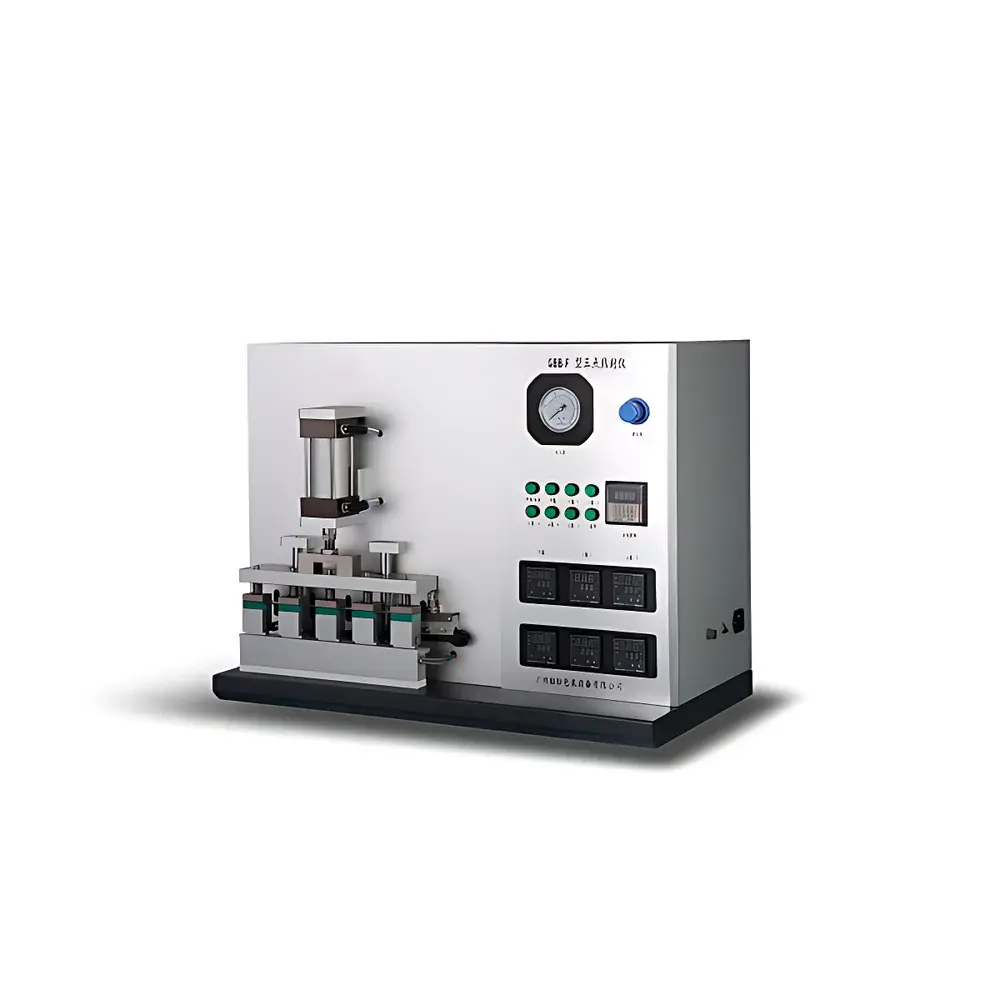
GBPI GBB-F9A Five-Point Heat Sealing Tester
| Brand | GBPI |
|---|---|
| Origin | Guangdong, China |
| Manufacturer | GBPI Packaging Equipment Co., Ltd. |
| Model | GBB-F9A |
| Temperature Range | Ambient to 250 °C |
| Temperature Control Accuracy | ±1 °C |
| Sealing Time | 0.1–999.9 s |
| Sealing Pressure | 0.1–0.8 MPa |
| Sealing Surface | Five independent 35 mm × 10 mm upper sealing blades (heated) + silicone-padded lower sealing bar |
| Heating Method | Electric resistance heating with pneumatic actuation |
| Operating Modes | Automatic and manual (foot-switch controlled) |
| Power Supply | AC 220 V, 50 Hz |
| Rated Power | 2000 W |
| Dimensions (L×W×H) | 730 × 400 × 535 mm |
| Weight | 35.6 kg |
| Air Source Requirement | Compressed air (recommended: 2.5 HP, 8 bar output) |
Overview
The GBPI GBB-F9A Five-Point Heat Sealing Tester is an engineered laboratory instrument designed for precise, repeatable evaluation of heat seal integrity in flexible packaging materials—particularly critical in food, pharmaceutical, and personal care product packaging development and quality assurance. It operates on the principle of controlled thermal bonding under defined pressure and dwell time, simulating industrial heat sealing conditions across five discrete temperature zones. This multi-zone capability enables simultaneous assessment of seal strength versus temperature gradients—a fundamental requirement for optimizing seal parameter windows per ASTM F2029-2016 and QB/T 2358-1998. The instrument employs electric resistance heating elements integrated into independently controlled upper sealing blades, coupled with a pneumatically actuated lower sealing bar featuring a replaceable silicone elastomer pad. Its architecture supports both automated sequence execution and operator-initiated manual sealing via foot switch, ensuring flexibility in R&D, routine QC, and method validation workflows.
Key Features
- Five independent temperature zones: Each of the five 35 mm × 10 mm upper sealing blades is equipped with dedicated PID-controlled heating and embedded Pt100 sensor feedback, enabling precise thermal profiling across a single sample strip.
- Dual-mode operation: Fully programmable automatic mode (with preset temperature, pressure, and time sequences) and intuitive manual mode activated by foot switch—ideal for rapid prototyping and comparative testing.
- Pneumatic actuation system: Compressed-air-driven mechanism delivers consistent, repeatable sealing force (0.1–0.8 MPa) with minimal mechanical hysteresis; compatible with standard industrial air compressors (≥2.5 HP, 8 bar).
- Modular sealing surface design: Upper blades and lower silicone-padded bar are field-replaceable and customizable—supporting non-standard geometries (e.g., curved, stepped, or patterned surfaces) and optional anti-adhesion coatings for high-slip or PVDC-coated films.
- Traceable thermal calibration: Integrated Pt100 sensors allow direct in-situ verification using external calibrated reference thermometers, facilitating compliance with ISO/IEC 17025 internal calibration requirements.
- Robust mechanical construction: CNC-machined aluminum frame with reinforced linear guides ensures long-term dimensional stability and thermal isolation between zones.
Sample Compatibility & Compliance
The GBB-F9A accommodates a broad range of thermoplastic packaging substrates including LDPE, LLDPE, PP, PET, aluminum laminates, and barrier-coated structures (e.g., SiOx, AlOx). Its five-point configuration allows users to rapidly map seal initiation temperature (SIT), seal strength plateau, and hot-tack onset—parameters essential for validating packaging line settings and shelf-life stability. The instrument conforms to key international test standards including ASTM F2029-2016 (Standard Test Method for Measuring Heat Seal Strength of Thermoplastic Films and Laminates), QB/T 2358-1998 (Plastic Film Heat Seal Strength Test Method), and YBB 00122003-2015 (Heat Seal Strength Testing for Pharmaceutical Packaging Materials). All operational parameters—including setpoints, actual measured temperatures, pressure values, and timestamped event logs—are recordable for audit readiness under GLP and GMP environments.
Software & Data Management
While the GBB-F9A operates as a standalone benchtop instrument with front-panel digital interface, it supports full data export via RS232 or USB-to-serial adapter for integration into laboratory information management systems (LIMS). Raw test records include: seal zone ID, target/actual temperature (±0.5 °C resolution), applied pressure (±0.01 MPa), dwell time (±0.01 s), and cycle completion status. Optional software packages provide graphical trending of seal strength vs. temperature curves, statistical process control (SPC) charts, and PDF report generation compliant with FDA 21 CFR Part 11 requirements when deployed with electronic signature modules and audit trail logging.
Applications
- Determination of optimal heat seal parameter windows (temperature, pressure, dwell time) for new film formulations or laminates.
- Validation of packaging line seal bar settings prior to production ramp-up.
- Hot-tack strength evaluation during cooling phase (via sequential timed seals at fixed temperature).
- Comparative analysis of seal integrity across batch variations or supplier changes.
- Root cause investigation of package leaks, delamination, or seal creep in accelerated aging studies.
- Supporting regulatory submissions requiring documented seal process qualification (e.g., USP , ISO 11607-2).
FAQ
What standards does the GBB-F9A comply with?
ASTM F2029-2016, QB/T 2358-1998, and YBB 00122003-2015 are fully supported through its programmable parameter ranges and five-zone thermal architecture.
Is compressed air supply included with the instrument?
No—the GBB-F9A requires an externally supplied clean, dry, oil-free compressed air source (minimum 2.5 HP, 8 bar); air filters (particulate, coalescing, and desiccant) are strongly recommended for long-term valve reliability.
Can sealing blade geometry be customized?
Yes—GBPI offers OEM engineering support for non-standard blade profiles, widths, edge radii, and surface finishes (e.g., mirror-polished, matte, or PTFE-coated) to match specific substrate requirements.
How is temperature calibration performed?
Each upper blade includes a removable Pt100 sensor port; users may insert a NIST-traceable reference thermometer directly into the bore for point-of-use verification without disassembly.
Does the instrument support GLP-compliant data archiving?
When paired with optional GBPI DataLink software and configured with user authentication, electronic signatures, and immutable audit trails, it meets core GLP and 21 CFR Part 11 data integrity expectations.





