
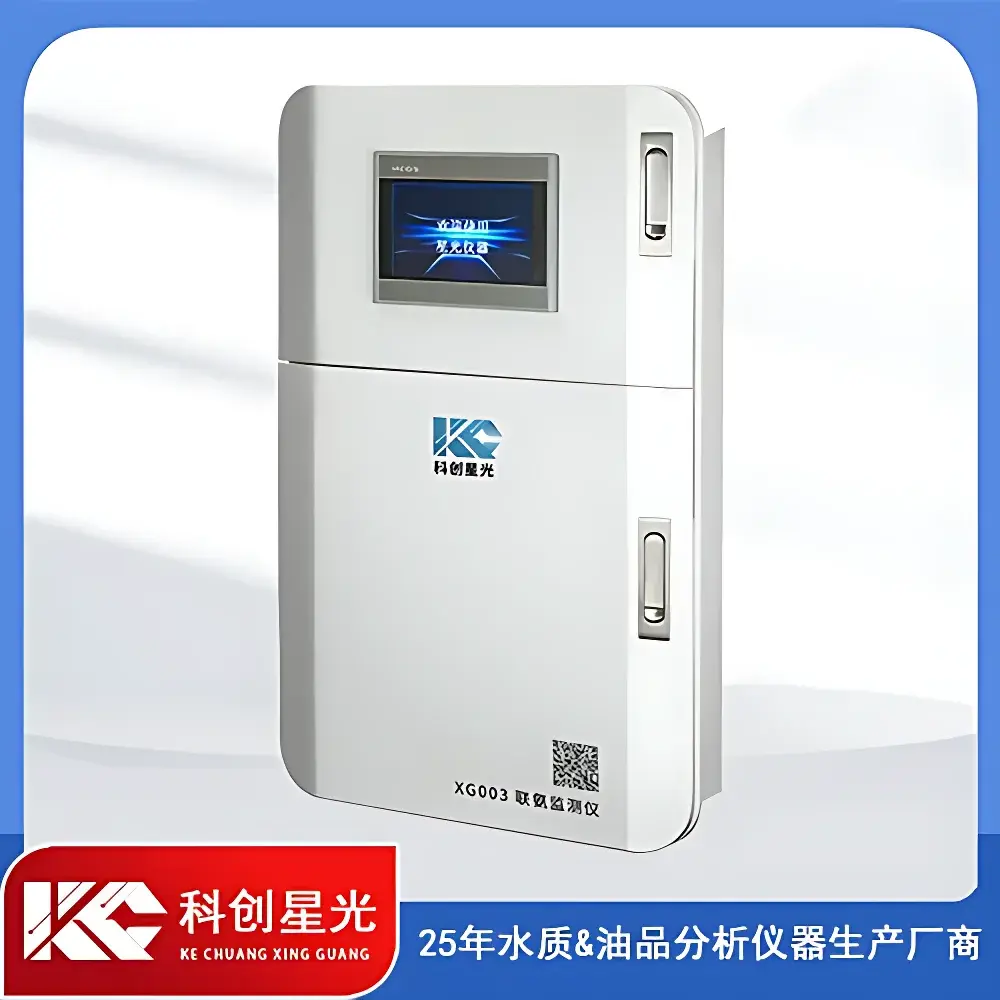
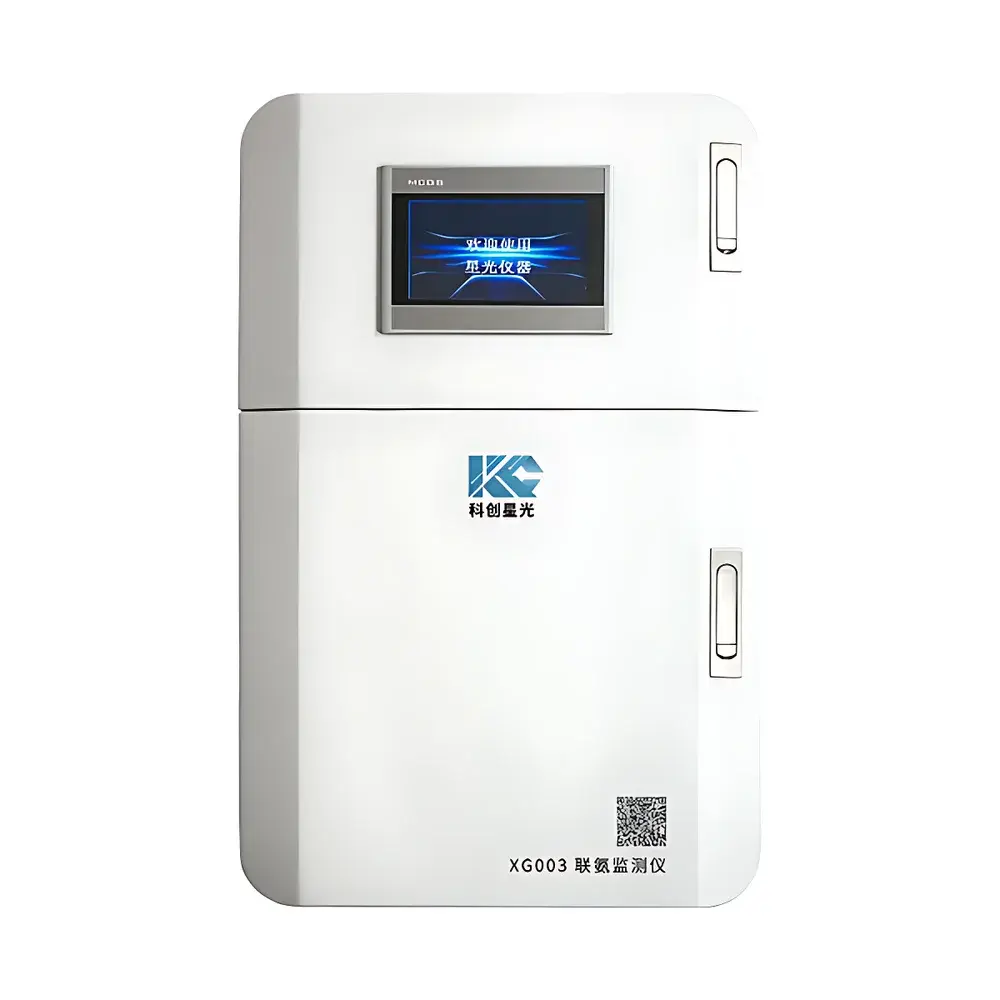
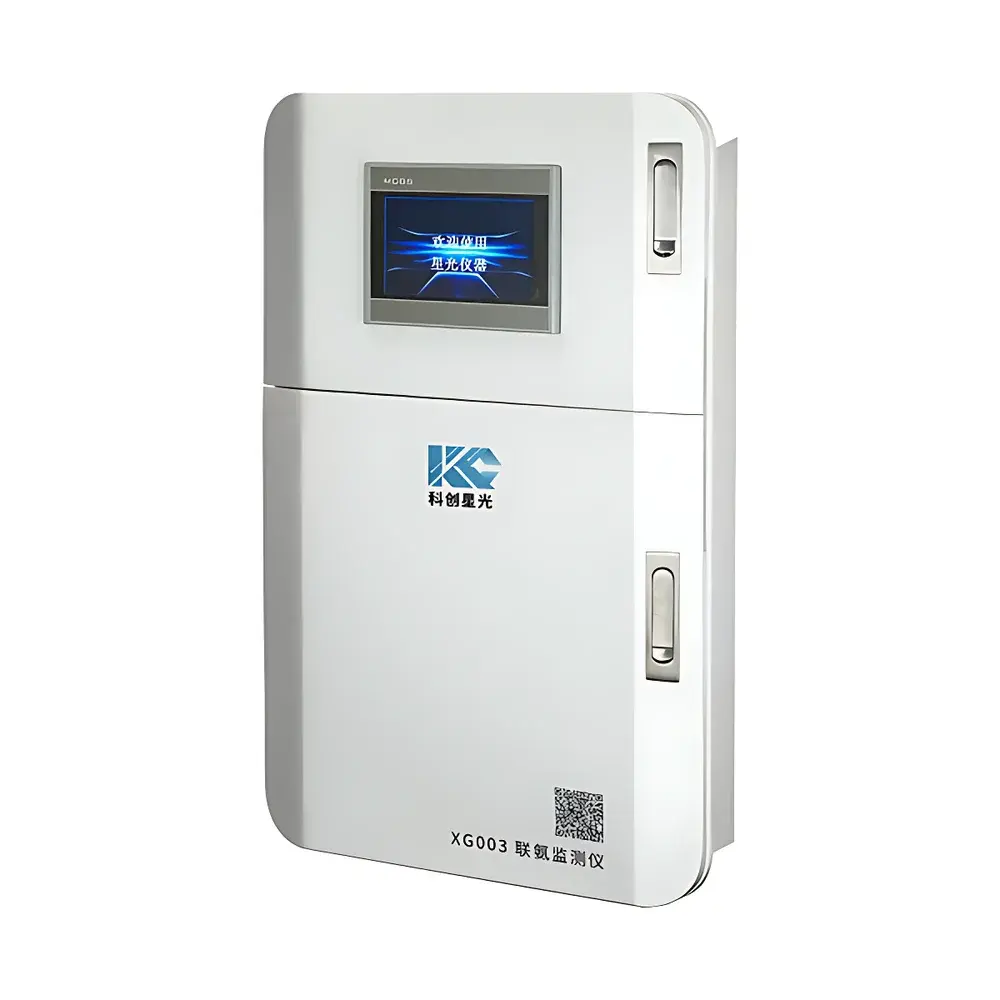
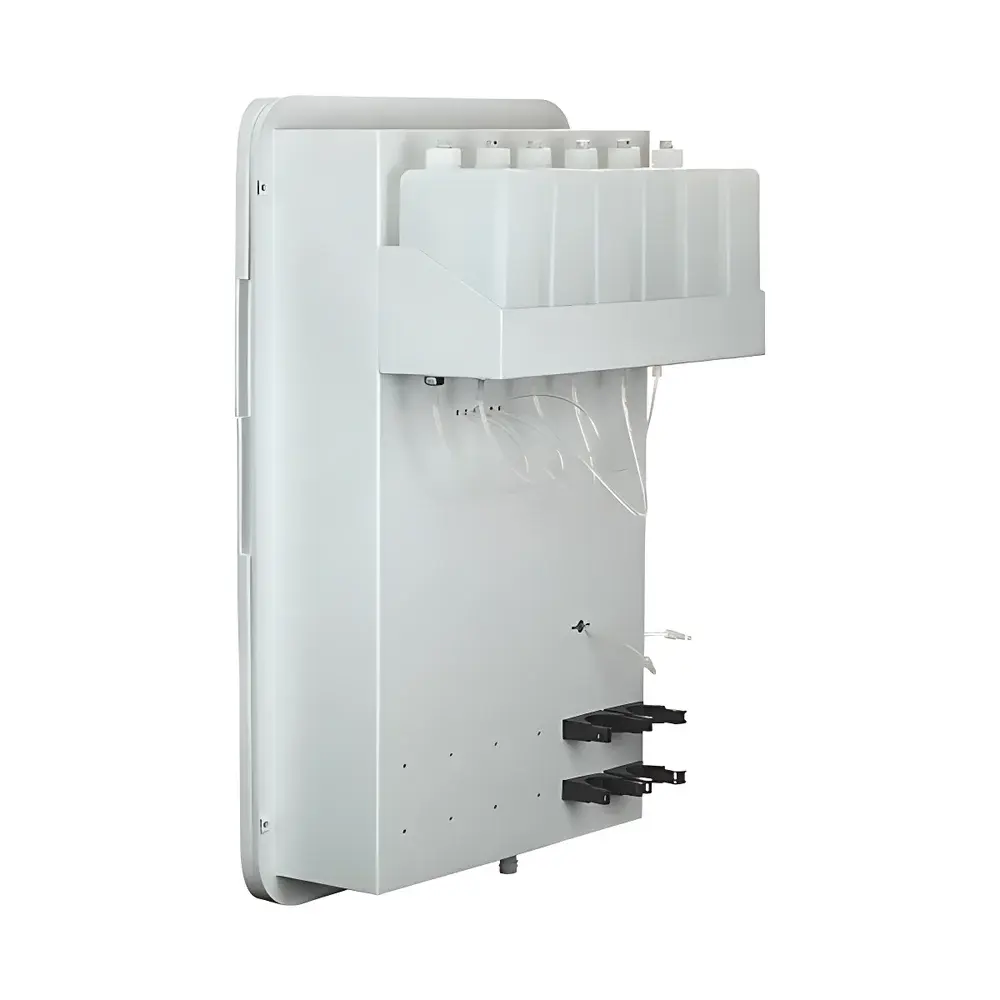
Kechuang Starlight XG03 Online Hydrazine Analyzer
| Brand | Kechuang Starlight (KC) |
|---|---|
| Origin | Beijing, China |
| Manufacturer Type | Direct Manufacturer |
| Instrument Type | Online Analyzer |
| Measurement Principle | Colorimetric Method |
| Measurement Range | 0.0–100.0 µg/L |
| Accuracy | ±2% F.S. |
| Detection Limit | 0.01 µg/L |
| Measurement Time | <4 minutes per cycle |
| Channel Capacity | 1–6 configurable channels |
| Display | 7.0-inch Windows-based HMI touchscreen |
| Sample Flow Rate | 10–40 L/h |
| Sample Temperature Range | 5–50 °C |
| Ambient Operating Temperature | 5–45 °C |
| Ambient Humidity | ≤85% RH (non-condensing) |
| Power Supply | AC 220 V ±10%, 50 Hz ±10% |
| Power Consumption | ≤100 W |
| Dimensions (L×D×H) | 460 × 285 × 720 mm |
| Weight | 23 kg |
| Output Signals | 4–20 mA, 0–20 mA, or 0–10 mA (configurable) |
| Data Storage | Non-volatile memory with >10-year retention after power loss |
Overview
The Kechuang Starlight XG03 Online Hydrazine Analyzer is a dedicated, continuous-monitoring instrument engineered for precise quantification of hydrazine (N₂H₄) in ultrapure water systems—particularly in nuclear power plant secondary coolant loops, boiler feedwater circuits, and high-purity industrial process streams. It employs a validated colorimetric measurement principle based on the reaction between hydrazine and p-dimethylaminobenzaldehyde (DMAB) under controlled acidic conditions, generating a stable yellow-orange chromophore measurable at 455 nm. The analyzer integrates photometric detection with fully automated reagent handling, thermal regulation, and fluidic control within a single optical module—eliminating inter-channel drift and minimizing operator intervention. Designed for unattended operation in Class II or III industrial environments, the XG03 complies with fundamental requirements for continuous emission monitoring systems (CEMS) as referenced in ISO 10523 and ASTM D129-19 for hydrazine determination in low-conductivity aqueous matrices.
Key Features
- Modular physical architecture: Separated water, power, and waste compartments housed in independent enclosures—enhancing electrical safety, reducing cross-contamination risk, and simplifying field maintenance.
- Integrated photometric flow cell: Combines reagent dosing, sample mixing, thermal equilibration (maintained at 37 °C ±0.5 °C), chromogenic reaction, and absorbance measurement in a single sealed optical path—ensuring high reproducibility (±1% RSD) and long-term baseline stability.
- Constant-pressure reagent delivery system: Uses precision diaphragm pumps and pressure-regulated manifolds to achieve volumetric accuracy better than ±0.5% across full reagent viscosity and temperature ranges—eliminating calibration drift due to pump wear or backpressure fluctuations.
- Surface-mount solenoid valves: Designed for >500,000 actuation cycles with minimal particle shedding; accessible without disassembling the main chassis—reducing mean time to repair (MTTR) during routine service.
- Flexible operational modes: Supports both continuous real-time measurement and programmable interval sampling (1–240 minute intervals), with independent start/stop triggers per channel.
- Thermally stabilized measurement chamber: Maintains sample temperature within ±0.3 °C of setpoint during analysis—critical for eliminating thermo-optical artifacts common in sub-ppb-level hydrazine assays.
- Multi-interface I/O: Configurable analog outputs (4–20 mA standard, with optional 0–20 mA or 0–10 mA) compliant with IEC 61000-6-2/4 for electromagnetic immunity in industrial settings.
Sample Compatibility & Compliance
The XG03 accepts samples with suspended solids <5 µm and zero colloidal content—consistent with ASTM D4195 guidance for ultrapure water sampling. It operates reliably across a conductivity range of 0.05–1 µS/cm and pH 6.5–8.5. All wetted materials—including PFA tubing, quartz flow cells, and EPDM-free seals—meet USP Class VI and FDA 21 CFR Part 177 standards for contact with pharmaceutical-grade water. Data integrity conforms to ALCOA+ principles: audit trails record all parameter changes, calibration events, and alarm states with user ID, timestamp, and reason-for-change fields. While not pre-certified for GMP environments, the system supports validation protocols aligned with Annex 11 and ISO/IEC 17025 for method verification.
Software & Data Management
The embedded Windows CE-based HMI features a 7-inch resistive touchscreen with intuitive navigation, multilingual UI (English default), and role-based access control (operator, technician, administrator). All measurement data—including raw absorbance, calculated concentration, QC flags, and diagnostic logs—are stored in a cyclic SQLite database with automatic overwrite protection. Internal non-volatile flash memory retains >10 years of historical records without battery backup. Remote access via Ethernet enables integration with SCADA, DCS, or LIMS platforms using Modbus TCP or OPC UA (optional firmware module). Audit trail export is available in CSV or PDF format, supporting regulatory review and trending analysis.
Applications
- Real-time hydrazine monitoring in nuclear power plant secondary side condensate polishing systems
- Feedwater chemistry control in supercritical coal-fired and combined-cycle gas turbine (CCGT) plants
- Pharmaceutical purified water (PW) and water for injection (WFI) loop surveillance per USP <1231>
- Microelectronics fab ultrapure water (UPW) distribution networks requiring sub-10 ppb detection capability
- Research laboratory validation of hydrazine scavenger performance under accelerated aging conditions
FAQ
What is the minimum detectable hydrazine concentration?
The detection limit is 0.01 µg/L (10 ng/L) under standard operating conditions, verified per ICH Q2(R2) guidelines using blank subtraction and signal-to-noise ratio ≥3.
Can the XG03 be integrated into an existing DCS system?
Yes—via Modbus TCP over Ethernet or isolated 4–20 mA analog output with HART protocol support (optional add-on module). Configuration files are exportable for DCS tag mapping.
How often does the system require calibration verification?
Daily zero/span checks are recommended; full multi-point calibration every 7 days or after reagent batch change, per ASTM D129-19 Section 8.2.
Is the analyzer suitable for outdoor installation?
It is rated for indoor use only (IP54 enclosure). For outdoor deployment, it must be housed in a climate-controlled NEMA 4X cabinet with humidity control.
Does the system meet cybersecurity requirements for critical infrastructure?
Firmware v3.2+ includes TLS 1.2 encryption for remote diagnostics and supports network segmentation, disabled Telnet/FTP by default, and configurable firewall rules per NIST SP 800-82 Rev. 2.
Related Products







