
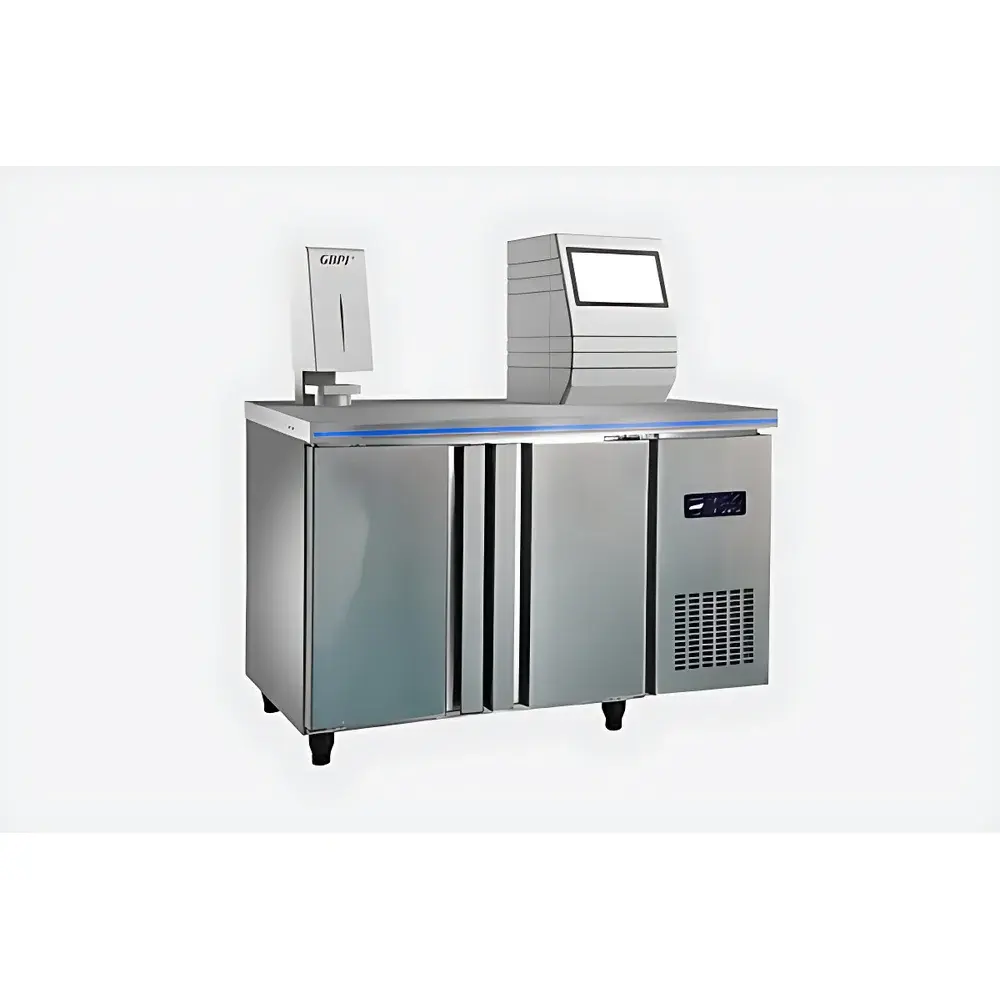
GBPI GB-KF30010AB Particle Filtration Efficiency Tester for Meltblown Nonwovens
| Brand | GBPI |
|---|---|
| Origin | Guangdong, China |
| Manufacturer Type | Direct Manufacturer |
| Model | GB-KF30010AB |
| Filtration Efficiency Range | 0–99.999% |
| Flow Rate Range | 20–100 L/min |
| Pressure Drop Range | 0–1000 Pa |
| Test Particle Sizes | 0.3 µm, 0.5 µm, 5.0 µm |
| Aerosol Sources | DEHS (oil-based) and 2% NaCl (salt-based) |
| Standard Test Area | 100 cm² |
| Power Consumption | <1500 W |
| Dimensions | 130 × 75 × 157 cm |
| Weight | 250 kg |
| Power Supply | AC 220 V, 50 Hz |
Overview
The GBPI GB-KF30010AB Particle Filtration Efficiency Tester is a precision-engineered instrument designed specifically for quantitative assessment of filtration performance in meltblown nonwoven materials—particularly those used in respiratory protective devices such as surgical masks, N95-equivalent respirators, and medical-grade face coverings. It operates on the principle of aerosol challenge testing under controlled, constant-flow conditions, measuring both particle capture efficiency and airflow resistance (pressure drop) across the test specimen. The system conforms to core national standards including GB/T 32610–2016 (Daily Protective Masks), GB 2626–2006 (Respiratory Protection Equipment), YY 0469–2011 (Surgical Masks), and YY/T 0969–2013 (Disposable Medical Masks), while incorporating design logic aligned with internationally recognized methodologies—including EN 1822–3:1998 (High-Efficiency Air Filters) and ASTM F2299/F2101 (for bacterial filtration efficiency). Its dual-aerosol capability (DEHS for oil-based particulates and NaCl for salt-based particulates) enables compliance with both hydrophobic and hydrophilic filtration evaluation requirements.
Key Features
- Cold-generation aerosol generator capable of stable, reproducible output of both DEHS and 2% NaCl aerosols—eliminating thermal degradation risks and ensuring consistent particle size distribution.
- Integrated electrostatic neutralizer (e.g., Kr-85 or soft X-ray source) upstream of the test chamber to eliminate surface charge effects that may artificially inflate filtration readings.
- Hermetically sealed aerosol delivery path with negative-pressure containment and leak-tight joints—meeting ISO 14644–1 Class 5 cleanroom integrity standards and minimizing operator exposure risk.
- Pneumatic clamping mechanism with mechanical safety interlock and force-limiting actuation—ensuring uniform compression of irregularly shaped mask samples without overloading delicate meltblown layers.
- Real-time differential pressure monitoring via calibrated digital transducers (0–1000 Pa full scale, ±0.5% FS accuracy) synchronized with particle counting.
- Laser-based condensation particle counter (CPC) with detection threshold ≤0.3 µm and counting efficiency ≥50% at 0.3 µm—traceable to NIST SRM 1963 calibration standards.
- Touchscreen HMI interface paired with dedicated Windows-based control software supporting automated test sequencing, real-time data overlay, and audit-ready event logging.
Sample Compatibility & Compliance
The GB-KF30010AB accommodates flat-sheet filter media—including glass fiber, polypropylene (PP) meltblown webs, and laminated or coated variants—as well as finished three-dimensional mask forms via customizable fixture inserts. Standardized test area is 100 cm²; optional fixtures support ASTM F2100–22-compliant mask mounting geometries. All hardware and firmware comply with GLP/GMP documentation requirements, including electronic signature support, user access levels (admin/operator/auditor), and 21 CFR Part 11–compliant audit trails for raw data, method parameters, and calibration records. System validation documentation includes IQ/OQ protocols aligned with ISO/IEC 17025:2017 clause 5.5.2 for filter testing laboratories.
Software & Data Management
The embedded test software provides fully automated execution of multi-point filtration efficiency sweeps across user-defined flow rates (20–100 L/min) and particle size bins (0.3/0.5/5.0 µm). Each test generates a timestamped report containing upstream/downstream particle concentrations, calculated efficiency (%), pressure drop (Pa), and flow rate stability metrics. Data export formats include CSV, PDF, and XML—compatible with LIMS integration via ODBC drivers. All measurement events are logged with operator ID, instrument serial number, calibration due dates, and environmental metadata (ambient T/RH recorded via integrated sensor). Software updates are delivered via secure HTTPS channel with SHA-256 hash verification.
Applications
- Quality control of meltblown electret nonwovens during roll-to-roll production.
- Regulatory submission testing for NMPA Class II/III medical mask registration.
- Comparative evaluation of electrostatic decay behavior under humidity conditioning (per ISO 16890 Annex D).
- R&D screening of novel nanofiber-coated substrates and hybrid filtration architectures.
- Third-party certification testing per GB 2626–2019 (revised version) and EU PPE Regulation (EU) 2016/425 Annex II conformity assessments.
- Validation of decontamination protocol efficacy (e.g., UV-C, vaporized H₂O₂) on reusable respirator filters.
FAQ
What aerosol generation methods does the GB-KF30010AB support?
It employs cold aerosol generation using atomization nozzles for both DEHS (di-ethyl-hexyl-sebacate) and aqueous NaCl solutions—ensuring minimal thermal artifact and repeatable MMAD (mass median aerodynamic diameter) profiles.
Is the system compliant with FDA 21 CFR Part 11 requirements?
Yes—the software architecture implements role-based authentication, electronic signatures, immutable audit trails, and data integrity controls required for regulated biocompatibility and medical device testing environments.
Can the instrument test finished masks—not just flat filter media?
Yes. With optional anthropometric fixture kits, it supports testing of intact surgical masks, KN95, and FFP2 respirators per GB/T 32610 and EN 149:2001+A1:2009 Annex B protocols.
How is particle size selection implemented?
Monodisperse aerosol selection is achieved via differential mobility analyzer (DMA) coupling—calibrated to deliver discrete 0.3 µm, 0.5 µm, and 5.0 µm modes with geometric standard deviation (σg) <1.15.
Does the system include calibration certificates traceable to national standards?
Each unit ships with factory calibration reports traceable to CNAS-accredited laboratories (e.g., Guangdong Metrology Institute), covering flow meters, pressure transducers, and CPC response curves.
Related Products





