
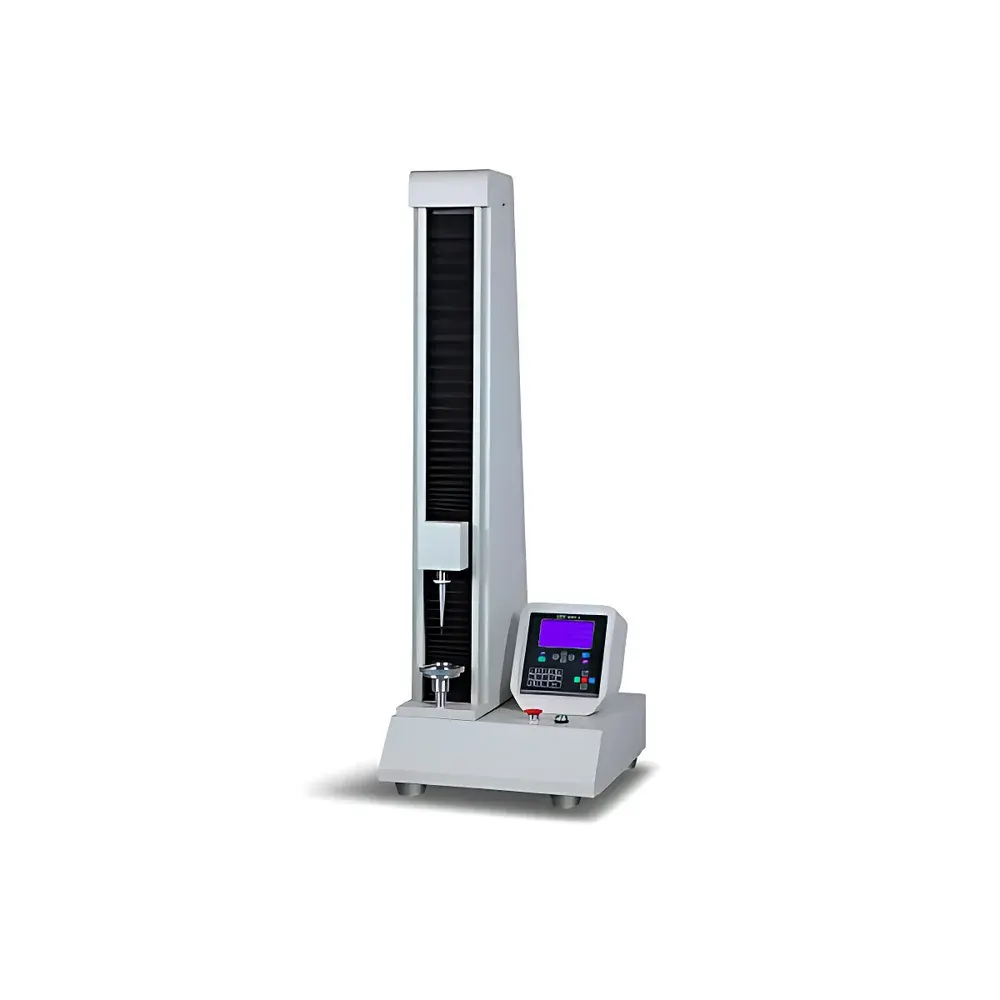
GBPI GBH-1TR Universal Electronic Tensile Testing Machine for Mask and Flexible Packaging Materials
| Brand | GBPI |
|---|---|
| Origin | Guangdong, China |
| Manufacturer Type | Direct Manufacturer |
| Country of Origin | China |
| Model | GBH-1TR |
| Instrument Type | Electronic Tensile Testing Machine |
| Maximum Test Load | 1.5 kN |
| Force Range | 0–500 N (optional 0–1500 N) |
| Elongation Capacity | up to 1400% |
| Force Accuracy | ±0.5% of reading (Class 0.5) |
| Crosshead Travel | 750 mm |
| Displacement Resolution | ±0.5% of reading |
| Effective Specimen Width | 30 mm (customizable to 50 mm) |
| Test Speed | 0–500 mm/min, continuously variable |
| Power Supply | AC 220 V, 50 Hz |
| Rated Power | 1000 W |
| Net Weight | 70 kg |
| Dimensions (W×D×H) | 600 × 600 × 1300 mm |
Overview
The GBPI GBH-1TR Universal Electronic Tensile Testing Machine is an ISO/IEC 17025-aligned, single-column electromechanical system engineered for high-fidelity mechanical characterization of thin, flexible materials—specifically optimized for medical mask substrates, nonwovens, spunbond/meltblown composites, laminated films, and soft packaging structures. It operates on the principle of controlled uniaxial force application via a precision servo-driven crosshead, with real-time load and displacement feedback acquired through dual-channel high-stability transducers and optical encoder-based position sensing. Designed in accordance with ASTM E4 (Standard Practices for Force Verification of Testing Machines) and ISO 7500-1 (Metallic Materials — Calibration of Force-Testing Machines), the GBH-1TR delivers traceable, repeatable mechanical data essential for regulatory compliance in medical device manufacturing, quality assurance labs, and R&D environments where tensile strength, elongation at break, yield point, modulus, peel adhesion, puncture resistance, and seal integrity are critical performance metrics.
Key Features
- Class 0.5 force measurement accuracy (±0.5% of reading) across the full 0–500 N range, extendable to 0–1500 N with optional load cell calibration—certified per JJG 139 and traceable to national metrological standards;
- High-resolution displacement control with ±0.5% repeatability over 750 mm travel; integrated high-speed sampling at 100 Hz ensures capture of transient mechanical events during rapid deformation or failure;
- Dual-mode control architecture: supports both embedded standalone operation (via built-in touchscreen interface) and PC-synchronized testing using GBPI’s proprietary WinTest software;
- Modular sensor interface supporting up to four independent analog input channels—enabling simultaneous acquisition of load, displacement, temperature (with optional probe), and auxiliary analog signals (e.g., environmental chamber feedback);
- Roller-guided, preloaded ball-screw actuation system with imported AC servo motor—ensuring zero drift, low backlash (<0.02 mm), and long-term dimensional stability under cyclic loading;
- Comprehensive safety architecture including hardware-based emergency stop, overload cutoff (120% FS threshold), mechanical end-limit switches, and programmable software interlocks;
- Configurable test fixtures: standard 30 mm manual tensile grips included; optional pneumatic clamps (ISO 2286-2 compliant), puncture probes (ASTM F1306), and heat-seal testers (ASTM F88) available for multi-standard validation.
Sample Compatibility & Compliance
The GBH-1TR accommodates specimens from 0.01 mm to 3 mm thickness—including surgical mask layers (SMS nonwovens), KN95/N95 filter media, earloop elastic bands, nose bridge strips, and aluminum-plastic laminates used in sterile barrier systems. Its 30 mm standard jaw width meets ISO 527-3 requirements for thin plastic sheets, while the optional 50 mm configuration satisfies ASTM D882 for wide-film evaluation. The instrument is validated against over 30 international and national standards cited in the product documentation—including GB/T 1040.3 (plastics tensile testing), GB/T 2792 (peel strength), YY/T 0469 (medical face masks), ASTM D1938 (tear resistance), and ISO 13934-1 (tensile properties of textiles). All firmware and software modules support audit trail generation and electronic signature capability in alignment with FDA 21 CFR Part 11 and GLP/GMP documentation requirements.
Software & Data Management
WinTest v4.2 software provides full IEC 62304-compliant test sequence definition, real-time curve overlay (up to 8 traces), statistical post-processing (mean, SD, CV%, confidence intervals), and automated report generation in PDF/Excel formats. Raw data files (.tdms) are stored with metadata embedding: operator ID, calibration certificate ID, environmental conditions (if external sensors connected), and timestamped event markers (preload, yield, break). The software supports configurable user roles with password-protected access levels (operator, supervisor, administrator), change history logging, and export of raw datasets for third-party analysis (MATLAB, Python pandas, Minitab). Data structures follow ASTM E1447 conventions for mechanical test data exchange, enabling interoperability with LIMS platforms such as LabWare and Thermo Fisher SampleManager.
Applications
- Quantification of breaking force and elongation of meltblown electret filter layers under simulated breathing loads;
- Evaluation of earloop elastic recovery and permanent set after repeated stretching (ISO 20743 Annex C protocol adaptation);
- Heat seal strength validation of mask body seams per ISO 11607-2 and ASTM F1886;
- Tear propagation resistance of SMS laminates using trapezoidal tear method (ASTM D1938);
- Puncture resistance of barrier layers using 1.0 mm diameter hemispherical probe (ISO 13934-2);
- Comparative tensile modulus analysis of hydrophobic vs. hydrophilic nonwoven treatments;
- Accelerated aging studies correlating mechanical degradation with storage time/temperature (per ISO 11607-1 Annex A).
FAQ
Does the GBH-1TR comply with YY/T 0469–2011 for medical face mask testing?
Yes—the system’s force accuracy, speed control resolution, and fixture geometry meet all mechanical test requirements specified in Clause 5.5 (Tensile Strength), 5.6 (Elongation), and 5.7 (Nose Bridge Strip Bending Resistance) of YY/T 0469.
Can test data be exported directly into Excel without proprietary software?
Yes—WinTest supports CSV and XLSX export with column headers mapped to ASTM E1447 field names; no license key or runtime environment is required to open exported files.
Is calibration certification included with shipment?
A factory-issued calibration report (traceable to CNAS-accredited reference standards) is provided; optional third-party ISO/IEC 17025 calibration with uncertainty budget is available upon request.
What maintenance intervals are recommended for long-term reliability?
Ball screw lubrication every 6 months; load cell verification annually; encoder alignment check biannually—detailed procedures documented in the GBH-1TR Maintenance Manual (Revision 3.1).



