
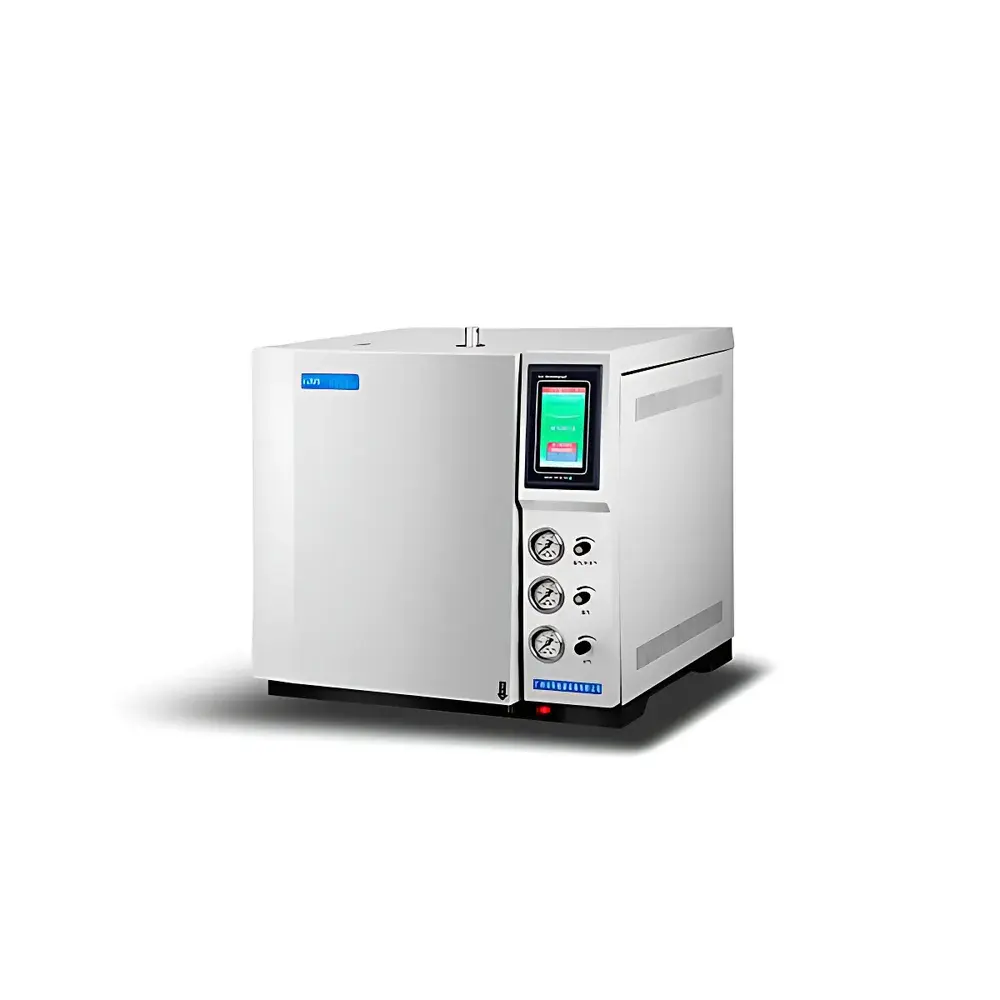
GBPI GC-9802-P Ethylene Oxide Residual Analysis System for Surgical Masks
| Brand | GBPI |
|---|---|
| Origin | Guangdong, China |
| Manufacturer Type | Direct Manufacturer |
| Instrument Category | Domestic Lab-Scale Gas Chromatograph |
| Model | GC-9802-P |
| Price Range | USD 14,000–21,000 |
| Instrument Type | Laboratory Gas Chromatograph |
| Application Field | Environmental & Medical Device Compliance Testing |
| Detector | Hydrogen Flame Ionization Detector (FID) |
| Detection Limit | ≤3×10⁻¹² g/s (n-Hexadecane) |
| Baseline Noise | ≤2×10⁻¹⁴ A |
| Baseline Drift | ≤1×10⁻¹³ A/30 min |
| Column | EO-Specific Capillary Column (30 m × 0.32 mm × 0.5 µm) |
| Oven Temperature Range | 4 °C above ambient to 450 °C (1 °C increments) |
| Temperature Control Accuracy | ±0.1 °C |
| Temperature Gradient Uniformity | ±1% |
| Independent Temperature Zones | 6 |
| Programmable Temperature Ramp Stages | 16 |
| Ramp Rate | 0.1–60 °C/min |
| Maximum Run Time | 6000 min |
| Injection Mode | Split/Splitless with Septum Purge |
| Optional Accessories | 20-Position Headspace Autosampler, Oil-Free Air Generator (3 L/min), H₂ Generator (300 mL/min, 99.999% purity), High-Purity N₂ Cylinder (99.999%) with Regulator |
| Software | Dual-Channel Chinese-Language GC Workstation with Instrument Control, Real-Time Chromatogram Display, Zoom/Scroll Functionality, PDF Report Export, and Manual Trigger Button Support |
Overview
The GBPI GC-9802-P Ethylene Oxide Residual Analysis System is a dedicated laboratory gas chromatograph engineered for precise quantification of residual ethylene oxide (EO) in medical devices—particularly surgical masks, respirators, and sterilized packaging materials. It operates on the principle of capillary gas chromatography coupled with flame ionization detection (GC-FID), delivering high sensitivity, reproducibility, and regulatory traceability required for compliance with international medical device standards. EO, a Class I carcinogen and common sterilant, must be rigorously monitored post-sterilization to ensure patient safety; this system enables laboratories to meet mandated residue limits (e.g., ≤10 µg/g for masks per YY/T 0969–2013 and ≤4 µg/g for surgical masks per GB 19083–2010). The instrument integrates a thermally optimized oven, precision pressure/flow control, and an EO-optimized capillary column to resolve EO from interfering volatiles—including acetaldehyde, ethanol, and ethylene chlorohydrin—without derivatization or complex sample prep.
Key Features
- Optimized thermal architecture with six independently controlled temperature zones, including column oven, injector, and detector—all stabilized to ±0.1 °C for retention time reproducibility.
- FID detector calibrated to ≤3×10⁻¹² g/s detection limit (n-hexadecane), ensuring reliable quantification at sub-µg/g levels required by ISO 10993-7 and USP .
- Programmable 16-stage temperature ramping (0.1–60 °C/min) and 6000-minute maximum run time support extended method development and multi-analyte screening.
- Split/splitless injection system with septum purge minimizes carryover and improves baseline stability during high-throughput EO analysis.
- Integrated noise suppression circuitry and dual overtemperature protection (software + hardware) ensure operational safety and instrument longevity.
- Real-time dual-channel workstation displays chromatograms with interactive zoom, pan, peak integration, and customizable reporting—including PDF export compliant with GLP documentation requirements.
- Modular design allows seamless integration of optional 20-position headspace autosampler for unattended batch analysis of EO-extracted vials.
Sample Compatibility & Compliance
The GC-9802-P is validated for use with aqueous and polymer-bound EO samples extracted via headspace equilibration (per ISO 10993-7 Annex B and YY/T 0681.13–2014). It accommodates standard 20 mL headspace vials and supports both manual and automated injection workflows. The system complies with multiple national and industry-specific standards, including GB 19083–2010 (surgical masks), YY 0469–2011 (medical surgical masks), YY/T 0969–2013 (disposable masks), GB/T 32610–2016 (daily protective masks), and YBB 00132002 (pharmaceutical packaging). While not FDA 510(k)-cleared as a standalone device, its analytical output meets data integrity expectations under FDA 21 CFR Part 11 when used with audit-trail-enabled software configurations and documented SOPs.
Software & Data Management
The dual-channel Chinese-language GC workstation provides full instrument control, real-time signal acquisition, and quantitative analysis using external standard calibration curves. It supports peak identification via retention time matching, area normalization, and manual baseline correction. All acquisition parameters—including method files, raw data (.dat), processed results, and report templates—are stored in a structured local database. Audit trail functionality (user login, method changes, integration edits, and report generation timestamps) can be enabled to align with GLP/GMP-aligned quality systems. Reports are exportable in PDF, Excel, and CSV formats, with configurable headers, footers, and QA/QC metadata fields (e.g., analyst ID, instrument ID, calibration date, LOD/LOQ confirmation).
Applications
- Quantitative determination of residual EO in sterilized surgical masks, N95 respirators, gowns, drapes, and implant packaging.
- Method validation and routine QC testing in medical device manufacturing and third-party contract labs.
- Environmental monitoring of EO emissions from sterilization facilities (per GB 2626–2006 and local VOC regulations).
- Residual solvent analysis in flexible packaging films (per GB/T 10004–2008) and pharmaceutical blister materials.
- Purity assessment of EO reference standards and industrial-grade EO solutions.
FAQ
What regulatory standards does the GC-9802-P support for EO testing?
It is configured to meet the chromatographic requirements of YY/T 0969–2013, GB 19083–2010, YY 0469–2011, ISO 10993-7, and QBT 2929.
Is headspace autosampling included by default?
No—the 20-position headspace autosampler is an optional accessory; the base configuration supports manual headspace injection.
Can the system be upgraded to support other detectors?
Yes—while FID is standard, the detector compartment is mechanically and electrically compatible with TCD and ECD modules for expanded volatile compound profiling.
Does the workstation comply with 21 CFR Part 11?
The software includes user authentication, electronic signatures, and change history logging; full Part 11 compliance requires site-specific validation and IT infrastructure controls.
What nitrogen purity is required for optimal FID performance?
≥99.999% pure nitrogen carrier gas is recommended, with dew point ≤−40 °C and hydrocarbon content <0.1 ppmv.





