
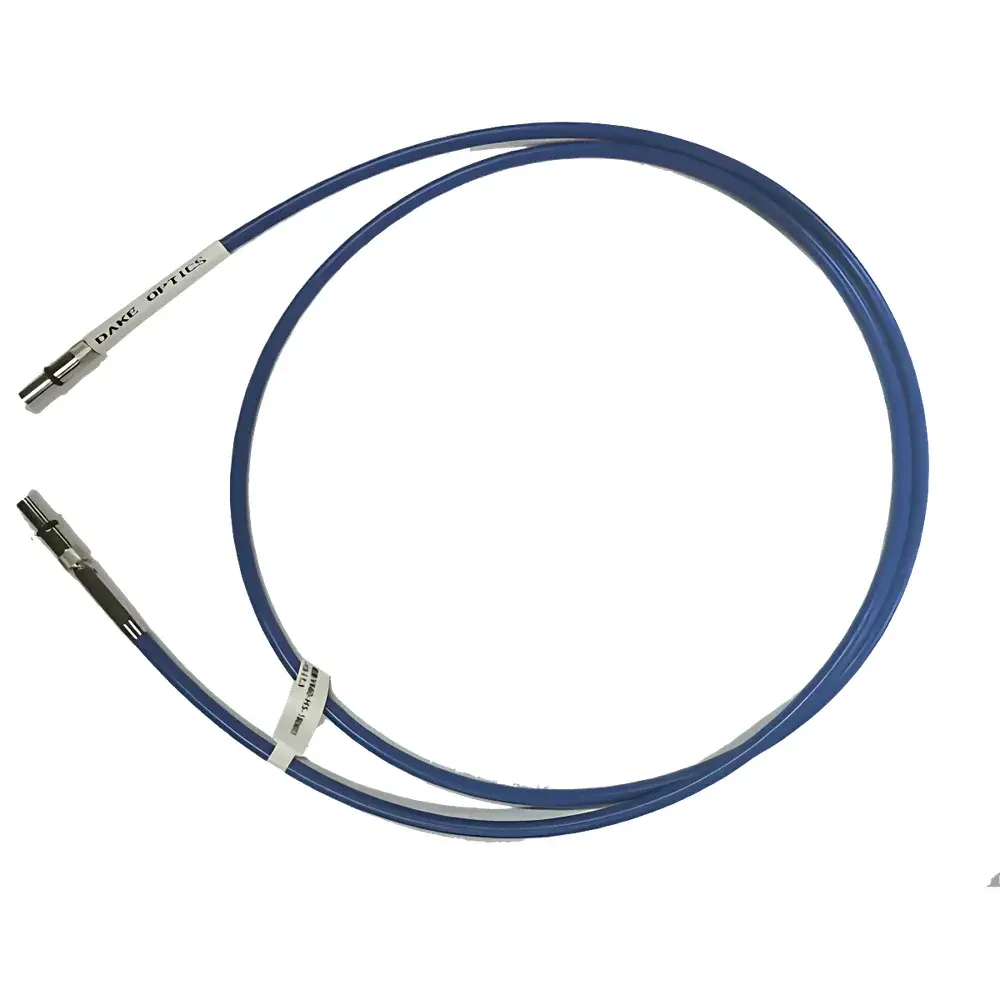
Luchu Tech GX Series Customizable Optical Fibers and Fiber Optic Probes
| Brand | Luchu Tech |
|---|---|
| Model | GX |
| Type | Custom Fiber Optic Assemblies & Probes |
| Spectral Range | 190–2500 nm (UV-VIS-NIR) |
| Core Diameters | 50–1000 µm (model-dependent) |
| Numerical Aperture | 0.12, 0.22, 0.37 |
| Jacketing Options | PVC, Stainless Steel Braid, Hybrid Armor, Custom |
| Connector Types | SMA905, FC, TA (Φ6.35 mm SS), TB (Φ10.0 mm SS), Custom |
| Fiber Configurations | Single-core, Y-branch, Forked, Z-shaped, Custom Geometries |
| Compliance | ISO 9001-certified manufacturing |
| Origin | Anhui, China |
| Manufacturer Status | OEM/ODM Producer |
Overview
The Luchu Tech GX Series comprises a modular family of customizable optical fibers and fiber optic probes engineered for integration into spectroscopic, photometric, and process analytical systems. Designed around fundamental principles of guided-wave optics and spectral transmission efficiency, the GX platform supports precise light delivery and collection across ultraviolet, visible, and near-infrared domains. Each assembly is constructed using high-purity fused silica or specialty glass preforms optimized for minimal attenuation, low fluorescence, and thermal/mechanical stability under demanding laboratory and industrial conditions. The series enables direct coupling to spectrometers, light sources, detectors, and in-situ reaction cells—serving as a critical interface between instrumentation and sample environment.
Key Features
- Multi-band spectral coverage: UV-grade fused silica fibers (190–1100 nm), VIS-grade glass fibers (380–800 nm), and NIR-optimized fused silica (360–2500 nm) are available as discrete material options or hybridized within a single probe.
- Engineered numerical aperture selection: Standard NA values of 0.12 (high resolution, low etendue), 0.22 (balanced throughput/resolution), and 0.37 (maximum light gathering) accommodate divergent optical design requirements.
- Robust mechanical architecture: Optional stainless steel braid, composite armor, or custom polymer jackets ensure resistance to abrasion, chemical exposure, and repeated flexing in automated or field-deployed setups.
- Configurable fiber geometry: Beyond standard linear configurations, the GX series supports Y-branch (dual-input/dual-output), forked (multi-point sampling), Z-shaped (right-angle coupling), and fully custom routing paths—enabling spatially resolved measurements or multi-channel synchronization.
- Interchangeable termination options: SMA905 (industry-standard for spectrometer interfacing), FC (precision alignment for laser coupling), TA (6.35 mm stainless ferrule for ruggedized immersion), and TB (10.0 mm heavy-duty ferrule for high-temperature or high-pressure applications) are all supported with factory-polished end-faces and optional anti-reflective coatings.
Sample Compatibility & Compliance
GX-series fibers and probes are compatible with liquid, solid, gaseous, and particulate samples when integrated into reflection, transmission, diffuse reflectance, or evanescent wave (e.g., ATR) measurement geometries. Their low-autofluorescence quartz construction ensures minimal spectral interference in low-light Raman or fluorescence applications. All production batches undergo spectral transmission verification per ISO 17025-accredited internal protocols. Manufacturing adheres to ISO 9001:2015 quality management standards; documentation packages—including material traceability, spectral transmission reports, and mechanical test summaries—are provided upon request to support GLP/GMP validation workflows.
Software & Data Management
While the GX Series itself is hardware-only, its standardized interfaces ensure seamless compatibility with third-party spectroscopy platforms including Ocean Insight, Avantes, Hamamatsu, and Thermo Fisher spectrometers. When paired with OEM software environments (e.g., OceanView, AvaSoft, or LabVIEW-based DAQ systems), the probes enable stable intensity calibration, dark-current subtraction, and real-time spectral ratioing. For regulated environments, full audit trails—including fiber batch ID, calibration date, connector type, and spectral response curve metadata—can be embedded into instrument control logs to satisfy FDA 21 CFR Part 11 data integrity requirements.
Applications
- In-line process monitoring of pharmaceutical crystallization, polymerization kinetics, and bioreactor pH/O₂ via UV-VIS absorption or NIR overtone analysis.
- Remote sensing in hazardous or confined spaces (e.g., furnace interiors, chemical reactors, or exhaust ducts) using armored NIR probes.
- Microspectroscopy and spatially resolved mapping using Y-branch or forked probes coupled to motorized XYZ stages.
- UV-curable resin monitoring during additive manufacturing, leveraging 190–250 nm transmission stability of anti-UV irradiation fibers.
- Environmental field analysis—such as water quality assessment (COD, TOC, nitrate) or soil nutrient profiling—using portable spectrometers with TA/TB-terminated immersion probes.
FAQ
Can the GX Series support vacuum or high-temperature environments?
Yes—custom variants with metal hermetic seals, ceramic ferrules, and temperature-stable jacketing (up to 300 °C continuous) are available upon engineering review.
Is spectral calibration data provided with each probe?
Standard delivery includes a normalized relative transmission curve (±2 nm resolution) referenced to NIST-traceable standards; absolute radiometric calibration is offered as an optional service.
What is the minimum bend radius for GX-series fibers?
Depends on core diameter and jacket type: 50 µm core fibers maintain integrity at ≥30 mm radius; 1000 µm cores require ≥150 mm radius unless reinforced with stainless steel coil.
Do you support OEM volume orders with custom labeling and packaging?
Yes—Luchu Tech provides full ODM support including serialized labeling, branded packaging, QC documentation, and drop-ship logistics aligned with customer ERP systems.
Are there restrictions on international shipping due to export control regulations?
No dual-use export restrictions apply to standard GX configurations; EAR99 classification applies. Export licenses are not required for standard spectroscopy-grade fibers and probes.




