
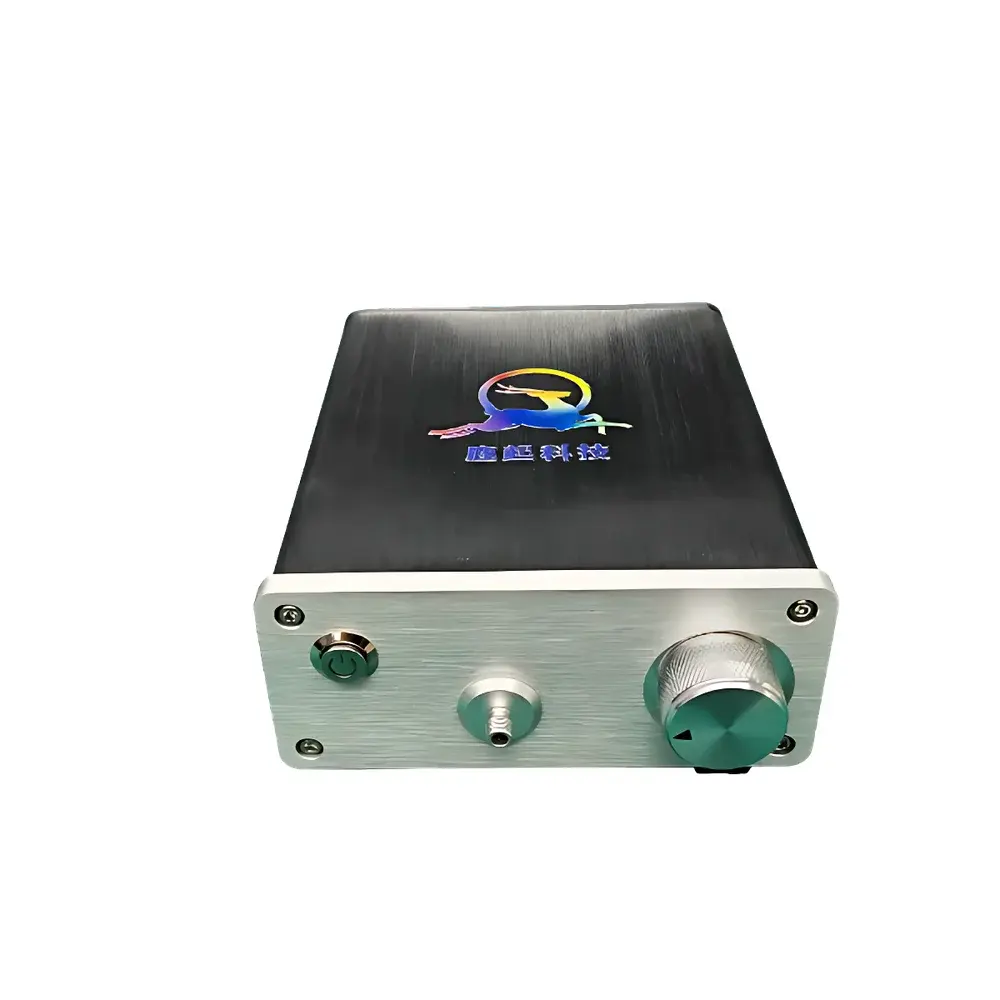
LUQI GY-HL20 Adjustable-Power Halogen Broadband Light Source
| Brand | LUQI |
|---|---|
| Origin | Anhui, China |
| Manufacturer Type | Direct Manufacturer |
| Product Category | Domestic |
| Model | GY-HL20 |
| Light Source Type | Tungsten-Halogen Lamp |
| Maximum Power | 20 W |
| Optical Interface | SMA905 Fiber Coupling Port |
| Spectral Stability | High (Typical Drift < ±0.5% over 1 hr at Constant Power) |
| Spectral Range | ~350–2500 nm (Continuum Emission) |
Overview
The LUQI GY-HL20 is a compact, benchtop-grade tungsten-halogen broadband light source engineered for applications requiring stable, continuous-spectrum illumination across the ultraviolet-visible-near-infrared (UV-VIS-NIR) range. Operating on the principle of incandescent blackbody radiation enhanced by halogen regeneration chemistry, the GY-HL20 delivers a smooth, predictable spectral output from approximately 350 nm to 2500 nm—covering critical regions for spectrophotometric calibration, optical component testing, fiber optic characterization, and sensor validation. Its thermally stabilized filament and precision-matched quartz envelope ensure minimal spectral shift under steady-state operation. Unlike pulsed or line-emission sources (e.g., mercury or xenon arcs), the GY-HL20 provides inherently high temporal stability and absence of spectral spikes—making it particularly suitable for radiometric reference applications, absorbance baseline establishment, and multi-wavelength photodetector responsivity mapping.
Key Features
- Adjustable DC power supply enabling precise control of output intensity from 0% to 100% of rated 20 W—facilitating irradiance tuning without spectral shape distortion;
- SMA905-compatible fiber coupling port with integrated collimating optics, ensuring efficient and repeatable coupling into standard 400 µm or 600 µm core fibers;
- Thermally optimized lamp housing with passive heat dissipation and internal thermal feedback loop, maintaining filament temperature stability within ±2 °C during extended operation;
- Low-noise electronic driver with current regulation accuracy better than ±0.2%, minimizing intensity flicker (< 0.3% RMS at 1 kHz bandwidth);
- Compact form factor (120 × 80 × 55 mm) designed for integration into OEM optical benches, modular spectroscopy platforms, or automated test stations;
- No external cooling required—operates continuously at full power in ambient temperatures up to 35 °C.
Sample Compatibility & Compliance
The GY-HL20 is compatible with standard optical components including monochromators, integrating spheres, spectroradiometers (e.g., Ocean Insight HDX, Avantes AvaSpec), and CCD/CMOS-based imaging spectrometers. Its broadband emission supports reflectance, transmittance, and quantum efficiency measurements per ISO 13406-2, ASTM E308, and CIE S 014/E:2006 methodologies. While not certified to IEC 61000-6-3 for EMC or UL 61010-1 out-of-the-box, the unit meets basic electrical safety requirements for laboratory Class I equipment and may be integrated into systems compliant with GLP and ISO/IEC 17025 quality frameworks when operated within specified environmental conditions (20–25 °C, <60% RH, non-condensing). Calibration reports traceable to NIM (National Institute of Metrology, China) are available upon request for radiometric output verification.
Software & Data Management
The GY-HL20 operates as a stand-alone analog device with no embedded firmware or digital interface. Intensity control is implemented via 0–5 V or 0–10 V analog input (configurable), enabling seamless integration with LabVIEW, MATLAB, Python (via DAQ cards), or PLC-based automation environments. Users may log power settings, operating time, and ambient temperature using external data acquisition systems. For traceable photometric validation, LUQI provides optional NIST-traceable spectral irradiance calibration certificates (measured at 1 m distance, 1 nm resolution, ±0.5 nm wavelength accuracy) compliant with ISO/IEC 17025 requirements. Audit trails for calibration history and maintenance logs can be maintained locally in accordance with FDA 21 CFR Part 11 if paired with validated electronic record systems.
Applications
- Baseline correction and wavelength calibration of UV-VIS-NIR spectrophotometers and hyperspectral imagers;
- Quantitative evaluation of optical filter transmission curves and anti-reflective coating performance;
- Responsivity characterization of photodiodes, pyroelectric detectors, and InGaAs sensors;
- Reference illumination source in colorimetry labs adhering to CIE Publication 15:2018;
- Stability testing of optical encoders, position sensors, and industrial vision systems;
- Educational demonstrations of blackbody radiation, Wien’s displacement law, and spectral filtering principles.
FAQ
What is the typical spectral irradiance output at 550 nm when operated at full 20 W power?
At 1 m distance with a 400 µm core fiber and 10 mm collimated output, measured spectral irradiance is approximately 1.2 µW·nm⁻¹·cm⁻² (±5% uncertainty, NIM-calibrated).
Can the GY-HL20 be used for fluorescence excitation?
It is not recommended for selective fluorescence excitation due to its broad continuum emission and lack of narrowband intensity peaks; however, it serves well as a white-light reference for excitation spectrum normalization.
Is the SMA905 port pre-aligned for optimal coupling efficiency?
Yes—the port incorporates a fixed-focus aspheric lens matched to standard SMA-fiber numerical apertures (NA = 0.22), achieving >75% coupling efficiency with 400 µm core / 0.22 NA fibers.
Does LUQI offer OEM customization options?
Yes—custom mechanical housings, alternative fiber interfaces (e.g., FC/PC, ST), and integrated temperature monitoring outputs are available under NDA.
What is the expected lifetime of the halogen lamp under continuous operation?
Rated average life is 2,000 hours at nominal 20 W; lifetime extends to ~5,000 hours when operated at ≤15 W with periodic cool-down cycles.





