
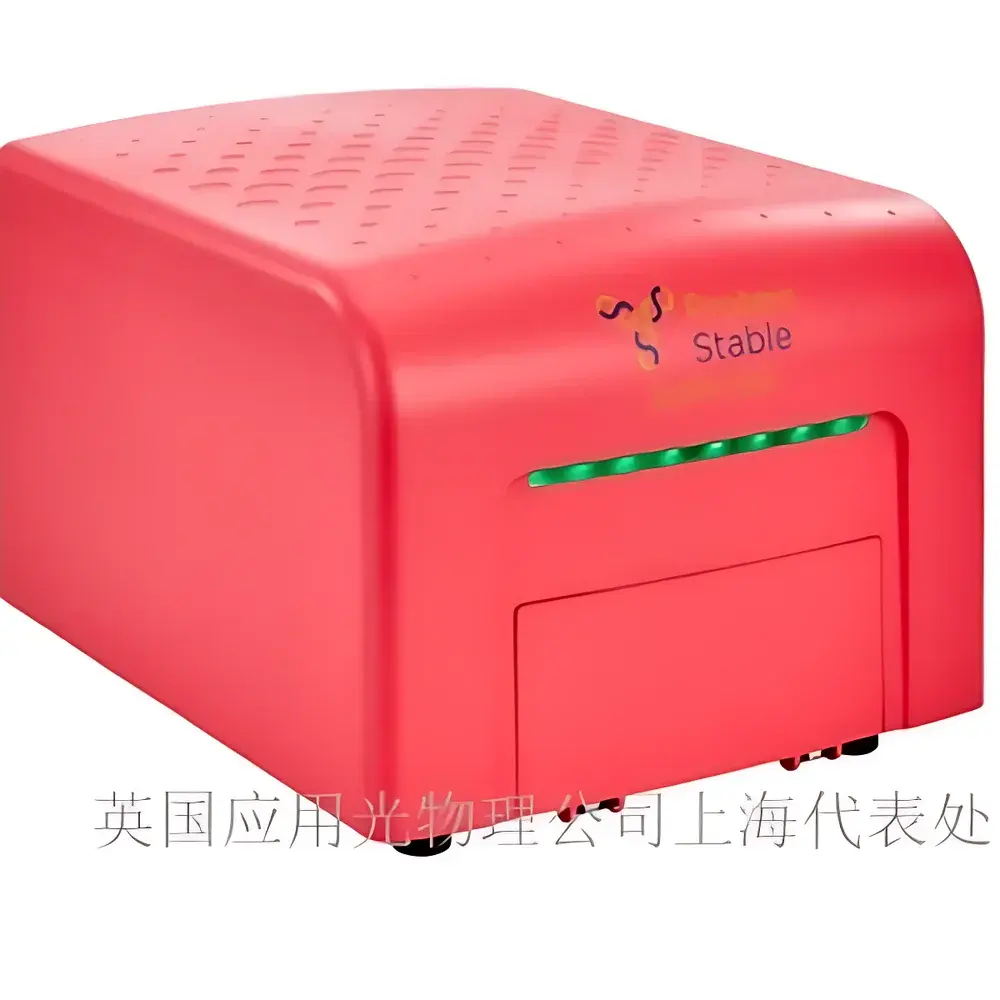
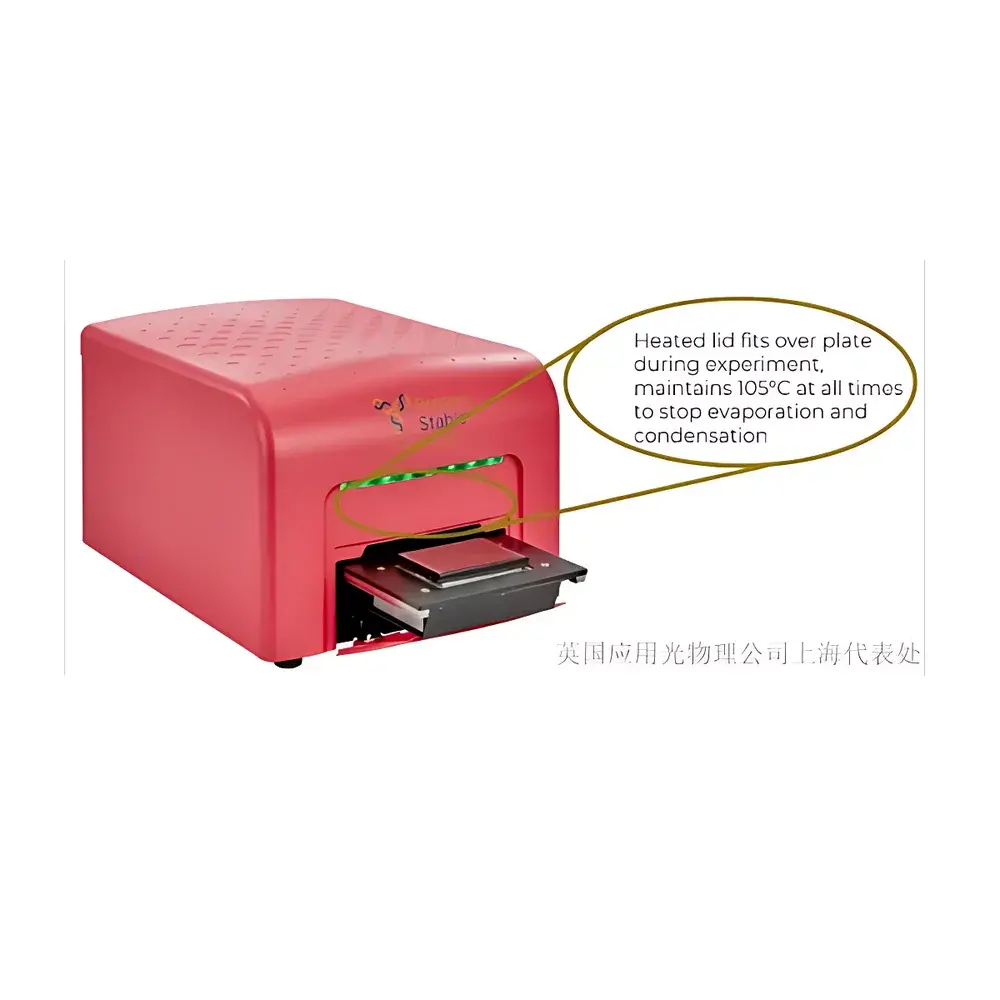
Applied Photophysics SUPR-DSF High-Throughput Differential Scanning Fluorimetry System
| Brand | Applied Photophysics |
|---|---|
| Origin | United Kingdom |
| Model | SUPR-DSF |
| Photomultiplier Tube Wavelength Range | 160 nm – 1200 nm |
| Atomizer Temperature Control Range | −50 °C to 150 °C |
| Throughput | 384 samples per thermal ramp (60–80 min) |
| Sample Volume | 10–20 µL per well |
| Sample Concentration Range | 0.05–250 mg/mL |
| Temperature Scan Range | 10 °C to 105 °C |
| Detection Method | Full-spectrum fluorescence acquisition with centroid-based analysis |
Overview
The Applied Photophysics SUPR-DSF is a high-throughput differential scanning fluorimetry (DSF) system engineered for rapid, label-free thermal stability profiling of proteins and other biomacromolecules. Unlike conventional DSF instruments relying on single-wavelength ratio metrics (e.g., 350/330 nm emission), the SUPR-DSF employs full-spectrum fluorescence acquisition across the UV–Vis range (160–1200 nm), enabling robust centroid wavelength calculation and significantly improved signal-to-noise ratio (SNR) and baseline reproducibility. The system operates on the principle that thermal unfolding induces characteristic shifts in intrinsic tryptophan fluorescence emission profiles; by monitoring spectral centroid displacement as a function of temperature, the SUPR-DSF delivers high-fidelity melting transitions (Tm) with minimal interference from buffer artifacts or aggregation-related scattering. Its integrated Peltier-controlled heating block supports precise linear ramping from 10 °C to 105 °C at programmable rates (0.1–5 °C/min), ensuring compatibility with multi-domain proteins and facilitating domain-specific unfolding resolution.
Key Features
- True high-throughput operation: Simultaneous thermal denaturation analysis of up to 384 samples in a single run (60–80 minutes), using standard commercially available 384-well microplates — no capillaries, no custom consumables.
- Full-spectrum fluorescence detection: Equipped with a high-quantum-efficiency photomultiplier tube (PMT) covering 160–1200 nm, enabling spectral centroid analysis instead of fixed-ratio methods — delivering superior sensitivity, dynamic range, and discrimination of overlapping transitions.
- Minimal sample requirement: As little as 10–20 µL per well, compatible with low-concentration samples (0.05–250 mg/mL), reducing material consumption and accelerating early-stage biopharmaceutical screening.
- Integrated temperature control: Precision Peltier-based thermal module with ±0.1 °C accuracy and uniformity across the entire plate, validated per ASTM E2779 and ISO 11137 standards for thermal mapping consistency.
- Robust architecture: Designed for unattended operation in regulated environments; all thermal and optical subsystems are calibrated traceable to NIST standards and support audit-ready calibration logs.
Sample Compatibility & Compliance
The SUPR-DSF accommodates native, purified proteins (including membrane proteins in detergent micelles), antibodies, antibody fragments, peptides, nucleic acid complexes, and small-molecule–protein adducts. It supports formulation buffers containing common excipients (sugars, amino acids, surfactants, salts) without requiring dye labeling or immobilization. The system complies with key regulatory frameworks for analytical method development: data integrity meets FDA 21 CFR Part 11 requirements (electronic signatures, audit trails, user access controls); thermal ramp protocols are fully scriptable and version-controlled; raw spectral files are stored in vendor-neutral HDF5 format with embedded metadata (temperature, time, well ID, instrument serial number). All firmware and software updates undergo GLP/GMP-compliant validation packages, supporting use in QC release testing and comparability studies under ICH Q5C and Q5E guidelines.
Software & Data Management
The SUPR-DSF is operated via the proprietary DSF Studio software, a Windows-based application supporting automated data acquisition, real-time spectral visualization, and batch-wise Tm extraction using centroid, inflection, or derivative algorithms. The software implements built-in quality metrics including R² of fit, residual variance, and baseline drift correction. Export options include CSV, Excel, and XML formats compliant with LIMS integration (ASTM E1482, ANSI/ISA-88). All processing steps — from raw intensity matrices to final Tm rankings — are fully traceable, with immutable audit trails recording operator ID, timestamp, parameter edits, and file exports. Raw data archives retain full spectral stacks (wavelength × intensity × temperature × well), enabling retrospective reprocessing without re-running experiments.
Applications
- Early-stage candidate selection: Rapid ranking of hundreds of monoclonal antibody variants or engineered enzymes based on thermal midpoint (Tm) and cooperativity (ΔTm between domains).
- Formulation optimization: Screening of pH, ionic strength, excipient type/concentration, and cryoprotectant effects on conformational stability — generating quantitative stability landscapes in under two days.
- Comparability and biosimilarity assessment: Detection of subtle structural perturbations induced by process changes (e.g., purification resin swaps, cell culture media adjustments) through centroid shift magnitude and transition width analysis.
- Fragment-based drug discovery: Identification of ligand-induced stabilization (ΔTm ≥ 0.5 °C) in target proteins, with statistical confidence derived from triplicate well-level replicates and within-plate CV < 0.8 °C.
- Stability-indicating method development: Supporting ICH Q5C long-term and accelerated stability protocols by establishing reference Tm baselines and monitoring degradation-associated spectral broadening.
FAQ
What is the minimum required sample volume per well?
10–20 µL, depending on plate geometry and optical path length.
Can the SUPR-DSF be used for membrane proteins solubilized in detergents?
Yes — the full-spectrum approach mitigates detergent auto-fluorescence interference better than ratio-based methods; recommended to validate with blank detergent controls.
Is the system compliant with 21 CFR Part 11 for electronic records?
Yes — DSF Studio includes role-based access control, electronic signatures, and immutable audit trails meeting FDA requirements for regulated laboratories.
Does the instrument require external calibration standards for routine operation?
No — factory-installed NIST-traceable wavelength and temperature calibrations are retained across power cycles; optional annual verification kits are available.
How is data reproducibility ensured across different plates and operators?
Through standardized thermal ramp profiles, plate-specific background subtraction, and centroid-based analysis — inter-plate CV for Tm is typically ≤ 0.5 °C under controlled lab conditions.




