
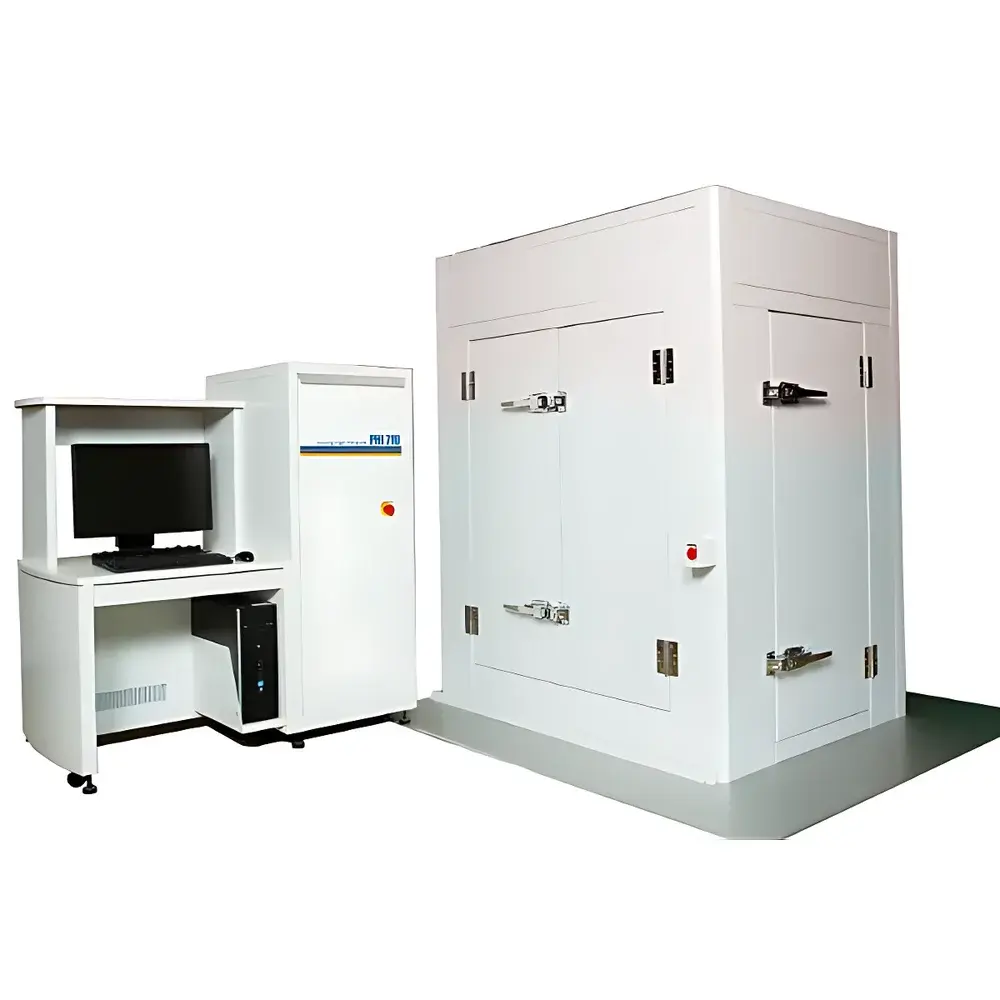
PHI 700 Scanning Auger Nanoprobe (AES)
| Brand | PHI |
|---|---|
| Origin | Japan |
| Model | PHI 700 |
| Type | Scanning Auger Electron Spectrometer |
| Detection Principle | Auger Electron Spectroscopy (AES) |
| Spatial Resolution | <10 nm (beam diameter) |
| Energy Resolution | ≤0.3% at E₀ = 1 keV |
| Ion Sputtering Energy Range | 0.1–5 keV |
| Maximum Magnification | >500,000× |
| Depth Profiling Capability | Sub-nanometer to several micrometers |
| Sample Stage | High-precision motorized XYZ + tilt/rotation |
| Vacuum System | Ultra-high vacuum (UHV), base pressure ≤2×10⁻¹⁰ Torr |
Overview
The PHI 700 Scanning Auger Nanoprobe is a high-performance, ultra-high vacuum (UHV) surface analysis instrument engineered for quantitative elemental mapping, chemical state identification, and nanoscale depth profiling of solid materials. Based on the physical principle of Auger Electron Spectroscopy (AES), it detects energy-resolved electrons emitted following core-level ionization by a focused electron beam—enabling direct, non-destructive characterization of the top 0.5–3 nm of a sample surface. Unlike XPS or SIMS, AES offers superior spatial resolution (<10 nm) and higher surface sensitivity for light elements (Li to F), making it indispensable for failure analysis, thin-film metrology, interfacial chemistry, and semiconductor process development. The PHI 700 integrates a coaxial electron-optical column with a spherical-section analyzer, eliminating shadowing artifacts and enabling unobstructed acquisition from complex topographies—including particles, trenches, and curved substrates.
Key Features
- Sub-10 nm probe size with high-current density electron beam for atomic-scale surface imaging and point analysis
- Coaxial electron gun and hemispherical analyzer geometry ensuring uniform collection efficiency across tilted and textured surfaces
- Integrated floating-column dual-mode ion gun (Ar⁺) supporting both low-energy sputtering (0.1–1 keV) for minimal interface mixing and high-energy etching (2–5 keV) for rapid removal of micrometer-thick layers
- Motorized 5-axis precision stage with ±90° tilt and 360° rotation, enabling angular-resolved AES and cross-sectional analysis of device structures
- Active vibration isolation platform and thermal stabilization system for long-duration, drift-free nanoprobe operation
- Automated image registration and region-of-interest (ROI) mapping for unattended micro-area analysis sequences
- UHV chamber with base pressure <2×10⁻¹⁰ Torr maintained by cryo- and ion-pumping, ensuring surface cleanliness during acquisition
Sample Compatibility & Compliance
The PHI 700 accommodates conductive and semi-conductive samples up to 25 mm in diameter and 10 mm in height, including wafers, TEM lamellae, MEMS devices, catalysts, and coated optical components. Non-conductive specimens may be analyzed using charge neutralization via low-energy electron flood gun. All hardware and software modules comply with international standards relevant to surface science instrumentation, including ASTM E1575 (Standard Test Method for Auger Electron Spectroscopy), ISO 18118 (Surface chemical analysis — Vocabulary), and guidelines supporting GLP/GMP-compliant analytical workflows. Data acquisition and processing protocols are compatible with audit-trail requirements under FDA 21 CFR Part 11 when deployed with validated software configurations.
Software & Data Management
Acquisition and analysis are managed through PHI’s MultiPack™ software suite, which provides real-time spectral deconvolution, PCA-based chemical state mapping, overlay integration with SEM-like secondary electron imaging, and automated quantification using Scofield sensitivity factors. Spectral libraries include reference data for oxides, nitrides, carbides, and intermetallic phases. Raw data files (.pha, .dat) are stored in vendor-neutral formats compliant with NIST SRD-20 and CAMPARI metadata standards. Export options include ASCII, CSV, and HDF5 for integration into third-party platforms such as MATLAB, Python-based data science pipelines, or enterprise LIMS systems. Software updates follow a documented change control process aligned with ISO 9001 quality management principles.
Applications
- Interface segregation analysis in CMOS gate stacks and high-k/metal gate architectures
- Contamination identification and lateral distribution mapping of metallic residues on photomasks and EUV optics
- Depth-resolved composition profiling of ALD-grown dielectric multilayers (e.g., HfO₂/Al₂O₃/SiO₂)
- In situ oxidation kinetics studies on catalytic nanoparticles under controlled gas environments (optional UHV-compatible gas dosing module)
- Failure root-cause determination in solder joint intermetallic compound (IMC) growth and Kirkendall void formation
- Quantitative stoichiometry verification of perovskite thin films (e.g., MAPbI₃) for photovoltaic R&D
FAQ
What is the typical detection limit for AES on the PHI 700?
Detection limits range from 0.1–0.5 atomic % depending on element mass, matrix effects, and acquisition time; light elements (e.g., C, O, N) exhibit higher sensitivity than heavier transition metals.
Can the PHI 700 perform chemical state analysis?
Yes—through high-resolution spectral acquisition (≤0.3% energy resolution) and derivative peak fitting, it resolves chemical shifts in Auger transitions (e.g., Ti LMM, Si LMM) to distinguish between elemental, oxide, and silicate states.
Is depth profiling possible on insulating samples?
Yes, provided charge compensation is applied; however, preferential sputtering and differential charging require careful optimization of ion energy, flood gun current, and raster parameters.
How is instrument calibration verified?
Energy scale calibration is performed using clean Cu, Ag, and Au standards; spatial calibration relies on certified grating replicas traceable to NIST SRM 2053.
Does the system support automated batch analysis?
Yes—MultiPack™ supports script-driven multi-location acquisition, including auto-focus, beam alignment, and spectral library matching across predefined sites.




