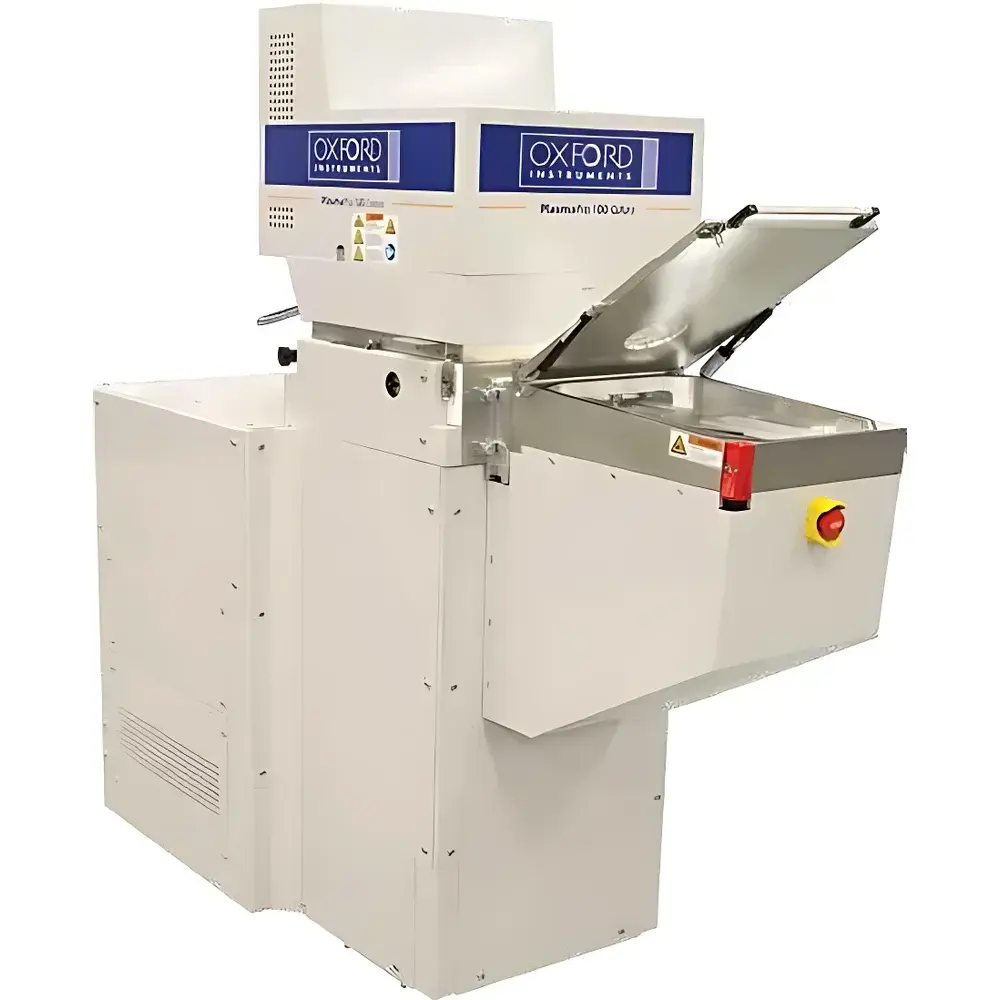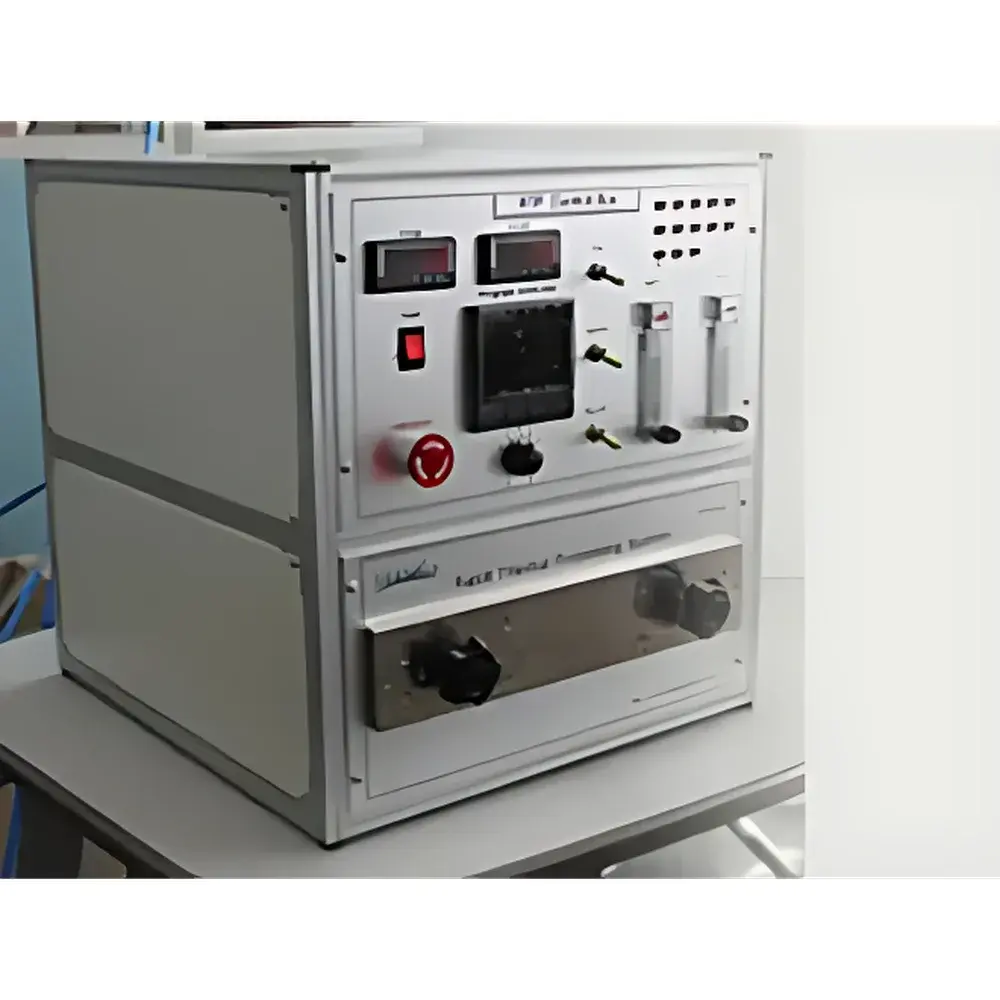
Ecopia RTP-1300 Vacuum Rapid Thermal Annealing Furnace
| Brand | ECOPIA |
|---|---|
| Origin | South Korea |
| Model | RTP-1300 |
| Sample Size | 150 mm (6-inch compatible) |
| Max Temperature | 1200 °C |
| Max Ramp Rate | 150 K/s |
| Cool-down Rate | 200 K/s |
| Temp Accuracy | ±1% of setpoint |
| Temp Uniformity | ±1.5% across wafer |
| Atmosphere Options | Vacuum (10⁻³ Torr, optional mechanical pump), N₂, O₂, H₂, Ar, or ambient air |
| Heating Source | 12 or 18 halogen infrared lamps (1.2 kW each) |
| Control Software | Integrated RTP-specific GUI with recipe management, real-time profiling, and data logging |
| Power Supply | 220 V AC, single- or three-phase |
| Dimensions (W×D×H) | 500 × 400 × 500 mm |
| Net Weight | 60 kg |
Overview
The Ecopia RTP-1300 is a benchtop vacuum rapid thermal annealing (RTA) furnace engineered for precision semiconductor process development and materials research. It operates on the principle of radiative heating via high-intensity halogen infrared lamps—enabling millisecond-scale thermal transients while maintaining tight spatial and temporal temperature control. Unlike conventional tube or box furnaces, the RTP-1300 delivers localized, uniform heating to wafers or planar substrates without significant thermal mass lag, making it ideal for time-sensitive processes such as ion implant activation, silicide formation, and gate oxide densification. Its compact footprint and modular gas/vacuum interface support integration into cleanroom-limited labs and pilot-line environments. Designed in accordance with semiconductor thermal processing fundamentals—including transient heat transfer modeling, emissivity-compensated pyrometric monitoring, and laminar gas flow dynamics—the system meets foundational requirements for reproducible rapid thermal processing (RTP) under controlled atmospheres.
Key Features
- Benchtop architecture with integrated vacuum chamber (base pressure ≤10⁻³ Torr with optional mechanical pump)
- Configurable lamp array: 12 or 18 individually controllable 1.2 kW halogen IR lamps for optimized radial and axial thermal uniformity
- Real-time closed-loop temperature control using dual-wavelength pyrometry (calibrated for Si, SiO₂, and compound semiconductor surfaces)
- Programmable ramp/soak/cool profiles with up to 100-step recipes and sub-second time resolution
- Atmosphere flexibility: compatible with vacuum, inert (N₂, Ar), oxidizing (O₂, dry air), reducing (H₂/N₂ mix), and custom gas blends
- Thermal performance validated per SEMI F27-0203 guidelines for RTP system characterization
- Front-loading quartz chamber with quick-release lid and ceramic wafer support stage (100–150 mm diameter)
Sample Compatibility & Compliance
The RTP-1300 accommodates standard 4-inch (100 mm) and 6-inch (150 mm) wafers, as well as non-circular substrates up to 150 × 150 mm. Substrate materials include silicon, silicon carbide, gallium arsenide, indium phosphide, sapphire, and thin-film metal oxides. All wet and dry process steps—including RTA, RTO, RTN, contact alloying, and post-deposition annealing—are executed within defined thermal budgets compliant with JEDEC JESD22-A108 and ASTM F1992 standards. The system supports GLP-compliant operation through audit-trail-enabled software logging (user actions, parameter changes, alarm events), and its hardware architecture conforms to IEC 61000-6-3 (EMC) and IEC 61010-1 (safety) requirements for laboratory equipment.
Software & Data Management
The bundled Ecopia RTP Control Suite provides a Windows-based graphical interface with intuitive drag-and-drop recipe construction, live temperature vs. time plotting, and multi-channel analog/digital I/O monitoring. All thermal profiles are timestamped and stored in CSV and HDF5 formats for traceability and post-processing in MATLAB or Python. Software features include password-protected user roles (operator, engineer, administrator), electronic signature support for SOP adherence, and export-ready reports compliant with FDA 21 CFR Part 11 Annex 11 requirements. Optional OPC UA connectivity enables integration into MES or factory automation systems for Industry 4.0 deployment.
Applications
- Ion implant activation annealing in CMOS and FinFET fabrication flows
- Rapid thermal oxidation of ultra-thin gate dielectrics (0.5–5 nm SiO₂)
- TiSi₂, CoSi₂, and NiSi silicidation with precise phase transition control
- Low-temperature crystallization of amorphous silicon, IGZO, and perovskite precursors
- Densification of ALD/CVD-deposited high-k films (HfO₂, Al₂O₃, La₂O₃)
- Post-metallization annealing for ohmic contact formation on GaN and SiC power devices
- Thermal stability assessment of 2D materials (MoS₂, WS₂, graphene heterostructures)
- Calorimetric analysis of phase transitions and eutectic melting behavior
FAQ
What wafer sizes does the RTP-1300 support?
The system is configured for 100 mm (4-inch) and 150 mm (6-inch) wafers, with optional custom stages available for square or irregular substrates up to 150 × 150 mm.
Is vacuum pumping included as standard equipment?
A mechanical roughing pump is optional; base pressure of ≤10⁻³ Torr is achievable with this configuration. High-vacuum options (e.g., turbomolecular pumps) are available upon request.
How is temperature uniformity measured and verified?
Uniformity is characterized using a calibrated thermocouple array mounted on a dummy silicon wafer, following SEMI F27-0203 methodology, with results documented in the factory acceptance test report.
Can the system be operated under hydrogen-containing atmospheres?
Yes—hydrogen concentrations up to 10% in nitrogen are supported with appropriate gas panel configuration, leak-tested piping, and integrated H₂ safety interlocks (including O₂ sensor feedback and automatic purge sequence).
Does the software support automated calibration routines?
Yes—the control suite includes guided emissivity calibration workflows for common substrate types and automatic lamp aging compensation based on real-time power-output trending.
Related Products