
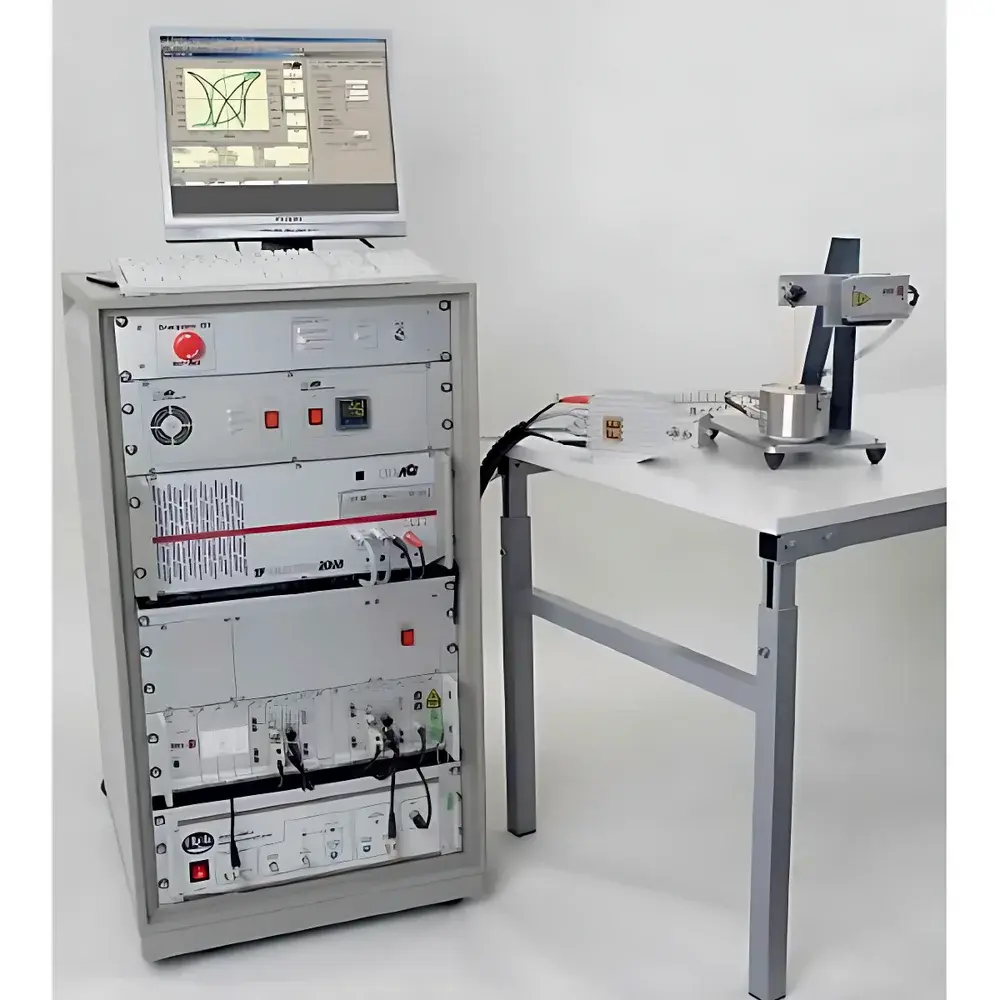
Makeway MKW-4900 Thermally Stimulated Depolarization Current (TSDC) Analyzer
| Brand | Makeway |
|---|---|
| Model | MKW-4900 |
| Origin | Shanghai, China |
| Magnet Type | Electromagnet |
| Temperature Range | 300 °C |
| Measurement Principle | Thermally Stimulated Depolarization Current (TSDC) |
| Voltage Range | ±100 V to ±10 kV |
| Software Platform | aixPlorer / ResoCe Analyzer |
| Interface | GPIB, Ethernet, ODBC |
| Output Format | ASCII |
Overview
The Makeway MKW-4900 Thermally Stimulated Depolarization Current (TSDC) Analyzer is a precision instrumentation platform engineered for quantitative dielectric and ferroelectric property characterization under controlled thermal and electrical stimuli. Based on the fundamental principle of thermally stimulated depolarization current measurement—where a previously polarized dielectric sample is heated at a constant linear rate while the resulting depolarization current is recorded—the system enables direct evaluation of relaxation processes, trap energy distributions, dipole activation energies, and frozen-in polarization states in ferroelectrics, piezoelectrics, relaxors, and polymer-based electrets. Unlike conventional impedance analyzers or static polarization meters, the MKW-4900 integrates synchronized thermal ramping, high-voltage poling, low-noise current amplification, and multi-channel data acquisition into a single modular architecture. Its design adheres to established methodologies described in IEC 60250, ASTM D150, and ISO 257-2 for dielectric loss and polarization behavior, making it suitable for both academic research and industrial R&D environments requiring traceable, reproducible TSDC data.
Key Features
- Modular hardware architecture supporting concurrent TSDC, ferroelectric hysteresis (P–E loop), piezoelectric coefficient (d33, d31) measurement, and pyroelectric current analysis within one software environment.
- Integrated high-voltage poling module with programmable DC bias up to ±10 kV, enabling full-domain polarization saturation of bulk ceramic specimens (e.g., PZT, BaTiO3, PMN-PT).
- Thermally controlled sample stage with precise linear heating rates (0.1–5 K/min) and temperature stability ±0.2 K over the operational range of ambient to 300 °C.
- Low-noise current preamplifier (input noise <1 fA/√Hz) optimized for sub-picoampere depolarization current detection, coupled with dual-range analog-to-digital conversion for dynamic signal fidelity.
- Hardware synchronization via TTL triggers and IEEE-488 (GPIB) or Ethernet interfaces, ensuring phase-coherent coordination between temperature controller, HV amplifier, displacement sensor, and oscilloscope or lock-in amplifier.
- Fully scriptable operation using Python or LabVIEW drivers, compliant with IEEE 488.2 SCPI command sets for automated test sequences and batch processing.
Sample Compatibility & Compliance
The MKW-4900 accommodates standard bulk ceramic discs (diameter: 8–25 mm; thickness: 0.2–2 mm), sintered thick-film substrates, and polymer films (e.g., PVDF, CYTOP) mounted in reusable gold-sputtered electrode fixtures. Sample holders are designed for symmetric top/bottom electrode contact and thermal uniformity verification per ASTM E220. All electrical safety circuits comply with IEC 61010-1 for measurement category CAT II 1000 V. The system supports GLP/GMP-aligned data integrity through audit-trail-enabled software logging, electronic signatures, and 21 CFR Part 11-compliant user access control when configured with aixPlorer Enterprise Edition.
Software & Data Management
Control and analysis are performed via the aixPlorer software suite (Windows 7/10/11 compatible), offering real-time visualization of current vs. temperature, derivative dI/dT spectra, Arrhenius plots, and trap distribution modeling using the initial rise method or curve deconvolution algorithms. Raw data export is supported in ASCII (.txt), CSV, and HDF5 formats. ODBC connectivity enables direct integration with LIMS or enterprise databases for metadata tagging (sample ID, lot number, poling history, thermal protocol). Optional ResoCe Analyzer add-on provides advanced resonance tracking for electromechanical coupling factor (kt, kp) extraction during temperature sweeps.
Applications
- Quantification of defect-related relaxation peaks in ferroelectric ceramics for reliability assessment in MEMS actuators and non-volatile memory devices.
- Energy barrier mapping of domain wall pinning sites in multiferroic heterostructures.
- Thermal stability evaluation of piezoelectric polymers used in wearable transducers.
- Correlation of TSDC peak intensity and position with fatigue-induced degradation in PZT thin films.
- Leakage current separation from true depolarization current using simultaneous voltage-current-phase monitoring.
- Standardized testing per IEC 62047-21 for electroactive material qualification in automotive and aerospace electronics.
FAQ
What sample geometries and electrode configurations are supported?
Standard configurations include parallel-plate electrodes on disc-shaped ceramics with sputtered Au or Pt top/bottom contacts. Custom fixtures for ring electrodes or interdigitated structures are available upon request.
Can the system perform simultaneous TSDC and impedance spectroscopy?
Yes—via external lock-in amplifier integration using the built-in reference output and phase-locked triggering; impedance data can be acquired concurrently with depolarization current during thermal ramping.
Is calibration traceable to national standards?
Current and voltage channels are factory-calibrated against NIST-traceable references; optional annual recalibration services include certificate documentation per ISO/IEC 17025 requirements.
Does the system support cryogenic temperature extension?
The base configuration operates up to 300 °C; liquid nitrogen-cooled stages (–196 °C to 300 °C) are available as an upgrade with vacuum-jacketed chamber and differential thermal analysis (DTA) compensation.
How is data security managed in regulated environments?
aixPlorer Enterprise supports role-based access control, encrypted database storage, immutable audit logs, and electronic signature workflows aligned with FDA 21 CFR Part 11 and EU Annex 11 validation frameworks.



