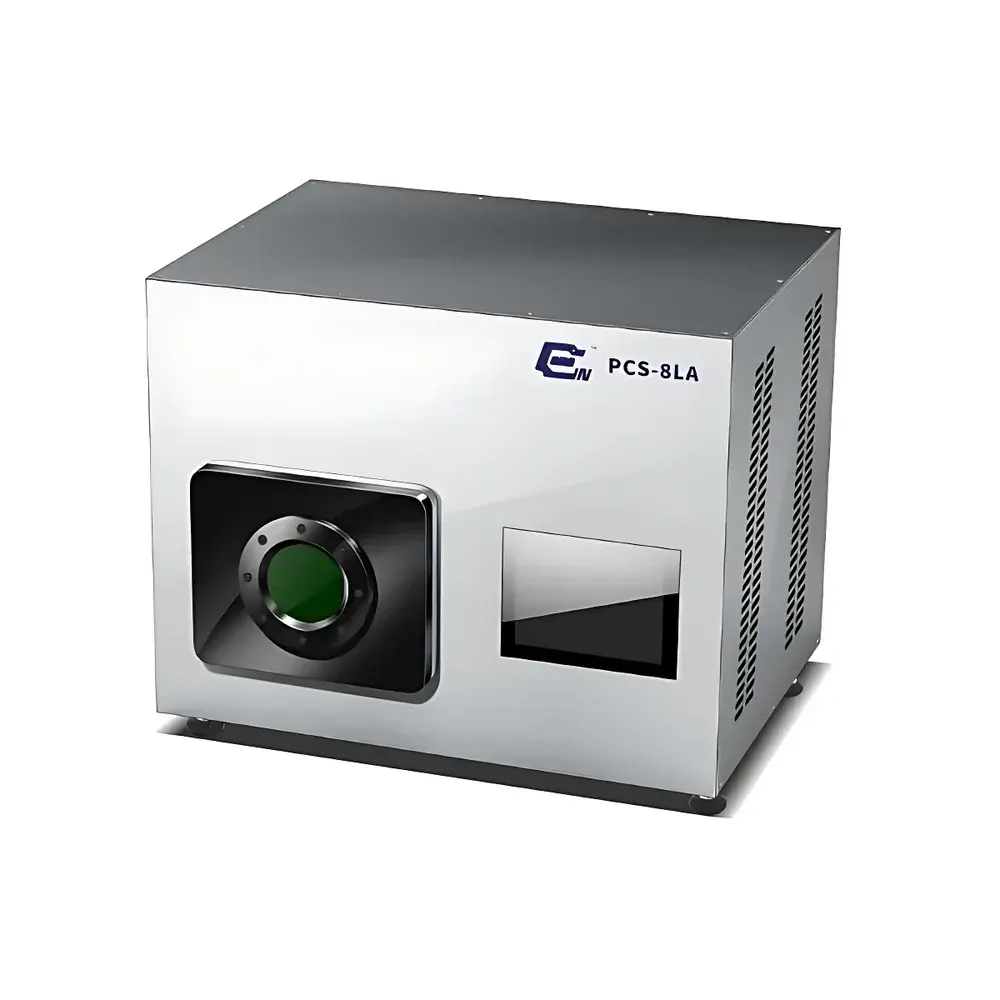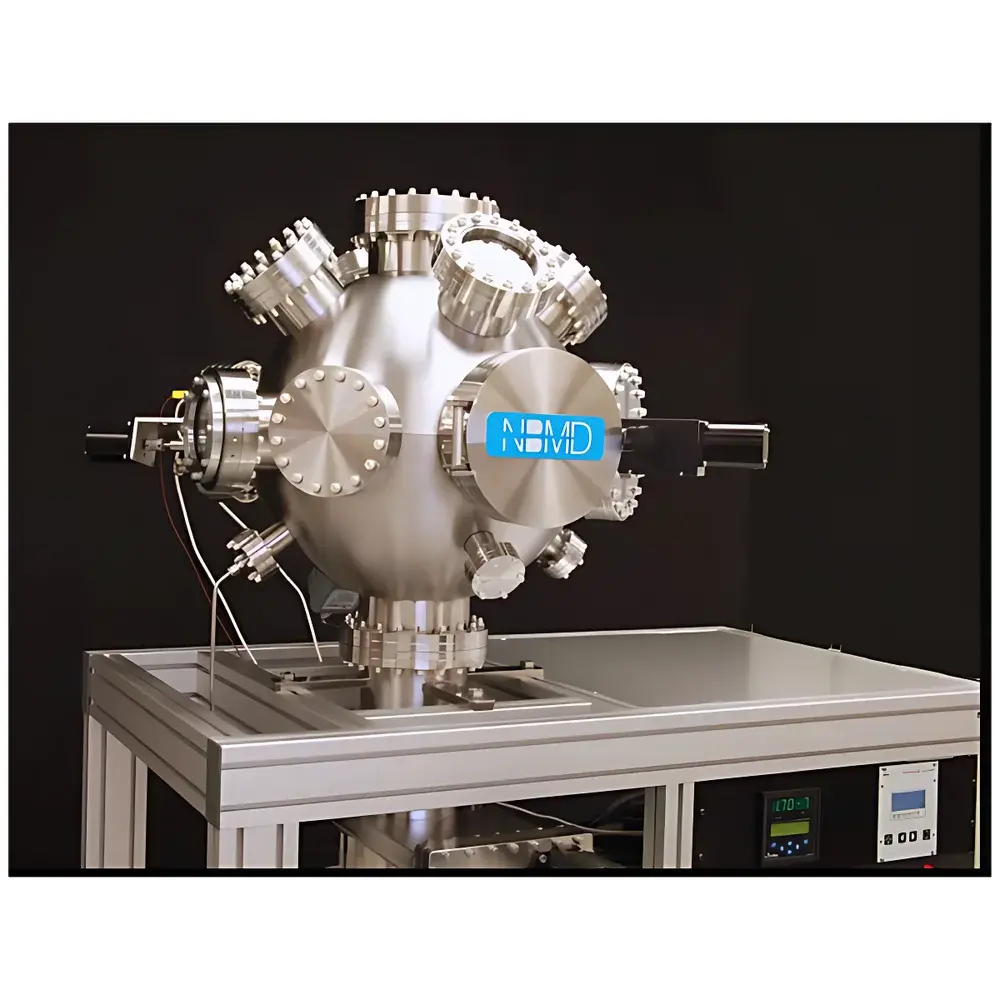
NBM Micro PLD Thin Film Pulsed Laser Deposition System
| Brand | NBM |
|---|---|
| Origin | USA |
| Model | Micro PLD |
| Substrate Heating Temperature | 1200 °C |
| Base Vacuum | 1×10⁻⁶ Torr |
| Substrate Diameter | 2 inch |
| Target Positions | 4 |
| Substrate Rotation Speed | 20 rpm |
Overview
The NBM Micro PLD Thin Film Pulsed Laser Deposition System is a compact, high-vacuum, benchtop-scale epitaxial thin film growth platform engineered for precision pulsed laser deposition (PLD) in academic research laboratories, materials development centers, and semiconductor process prototyping environments. Operating on the fundamental principle of laser ablation—where a high-energy pulsed laser beam (typically KrF excimer at 248 nm or Nd:YAG at 1064/532 nm) irradiates a solid target material to generate a transient, highly energetic plasma plume—the system enables stoichiometric transfer of complex multi-element oxides, nitrides, chalcogenides, and metallic compounds onto heated single-crystal substrates under controlled background gas (O₂, N₂, Ar) conditions. Designed for epitaxial and polycrystalline thin film synthesis, the Micro PLD supports in-situ monitoring-ready configurations and integrates seamlessly into cleanroom-compatible workflows. Its modular architecture facilitates rapid reconfiguration for combinatorial screening, heterostructure stacking, and interface-sensitive growth studies.
Key Features
- Compact footprint (≤0.8 m² floor space) optimized for limited laboratory environments without compromising vacuum integrity or thermal stability
- Four-target carousel with motorized indexing and independent shutter control—enabling sequential, multi-layer, or gradient film deposition without venting
- High-temperature substrate heater capable of stable operation up to 1200 °C, equipped with dual-zone thermocouple feedback and PID-controlled ramp/soak profiles
- Base vacuum level ≤1×10⁻⁶ Torr achieved via turbomolecular pump backed by dry scroll pump; all internal surfaces electropolished stainless steel with metal-sealed CF flanges
- 2-inch diameter substrate holder with continuous 20 rpm rotation for uniform film thickness distribution and reduced plume shadowing effects
- Integrated viewport with quartz window (190–2500 nm transmission) for real-time optical observation and optional in-situ diagnostics (RHEED, optical reflectance)
- Standard laser coupling port (Φ50 mm, 45° incidence) compatible with commercial excimer and solid-state pulsed lasers (up to 500 mJ/pulse, 10 Hz rep. rate)
Sample Compatibility & Compliance
The Micro PLD accommodates standard 2-inch (50.8 mm) wafers and bulk single crystals including SrTiO₃, LaAlO₃, MgO, Si, SiC, sapphire, and GaN templates. Substrate clamping is achieved via spring-loaded molybdenum or graphite holders with low outgassing characteristics. All wetted components conform to ASTM F568M Grade 8.8 stainless steel specifications. The system meets ISO 27427:2017 requirements for vacuum equipment safety and is designed for compliance with institutional radiation safety protocols governing Class IV laser use. Vacuum interlocks, overtemperature cutoffs, and emergency stop circuits satisfy UL 61010-1 and IEC 61000-6-4 electromagnetic compatibility standards.
Software & Data Management
Control is managed via NBM’s proprietary Windows-based MicroPLD Control Suite, supporting deterministic timing synchronization between laser firing, shutter actuation, substrate rotation, and temperature ramping. All operational parameters—including vacuum pressure logs, heater thermocouple readings, shutter open/close timestamps, and user-defined recipe sequences—are timestamped and stored in SQLite databases with optional export to CSV or HDF5 formats. Audit trails comply with GLP documentation requirements, and optional 21 CFR Part 11–compliant electronic signature modules are available for regulated R&D environments. Remote monitoring via Ethernet (TCP/IP) enables integration into centralized lab management systems.
Applications
- Growth of high-Tc superconducting cuprates (e.g., YBCO, LSCO) and iron-based superconductors
- Epitaxial synthesis of complex oxide heterostructures for emergent interfacial phenomena (e.g., LaAlO₃/SrTiO₃ 2DEG)
- Development of ferroelectric, multiferroic, and topological insulator thin films (Bi₂Se₃, Sb₂Te₃, BaTiO₃)
- Deposition of transparent conducting oxides (ITO, AZO, GZO) for optoelectronic device prototyping
- Combinatorial library synthesis for materials discovery—leveraging 4-target capability and programmable substrate translation
- Seed layer preparation for subsequent ALD or MBE integration in hybrid thin-film process flows
FAQ
What vacuum pumping configuration is standard on the Micro PLD?
A turbomolecular pump (≥300 L/s for N₂) backed by a dry scroll pump is standard, achieving ≤1×10⁻⁶ Torr base pressure within 90 minutes after chamber bakeout.
Can the system be upgraded for in-situ RHEED?
Yes—optional UHV-compatible RHEED gun and phosphor screen assembly can be integrated using dedicated CF-63 ports with differential pumping stages.
Is substrate heating uniformity characterized across the 2-inch surface?
Temperature uniformity is ±5 °C over the central 40 mm diameter at 1000 °C, verified by infrared pyrometry and embedded thermocouple mapping.
What laser specifications are recommended for optimal ablation performance?
KrF excimer lasers (248 nm, 5–20 Hz, 100–300 mJ/pulse) are preferred for wide-bandgap oxides; Nd:YAG harmonics (266/355 nm) are suitable for metals and chalcogenides.
Does NBM provide installation support and operator training?
Yes—standard commissioning includes on-site vacuum leak checking, laser alignment verification, and two-day hands-on training covering safety protocols, recipe development, and preventive maintenance procedures.