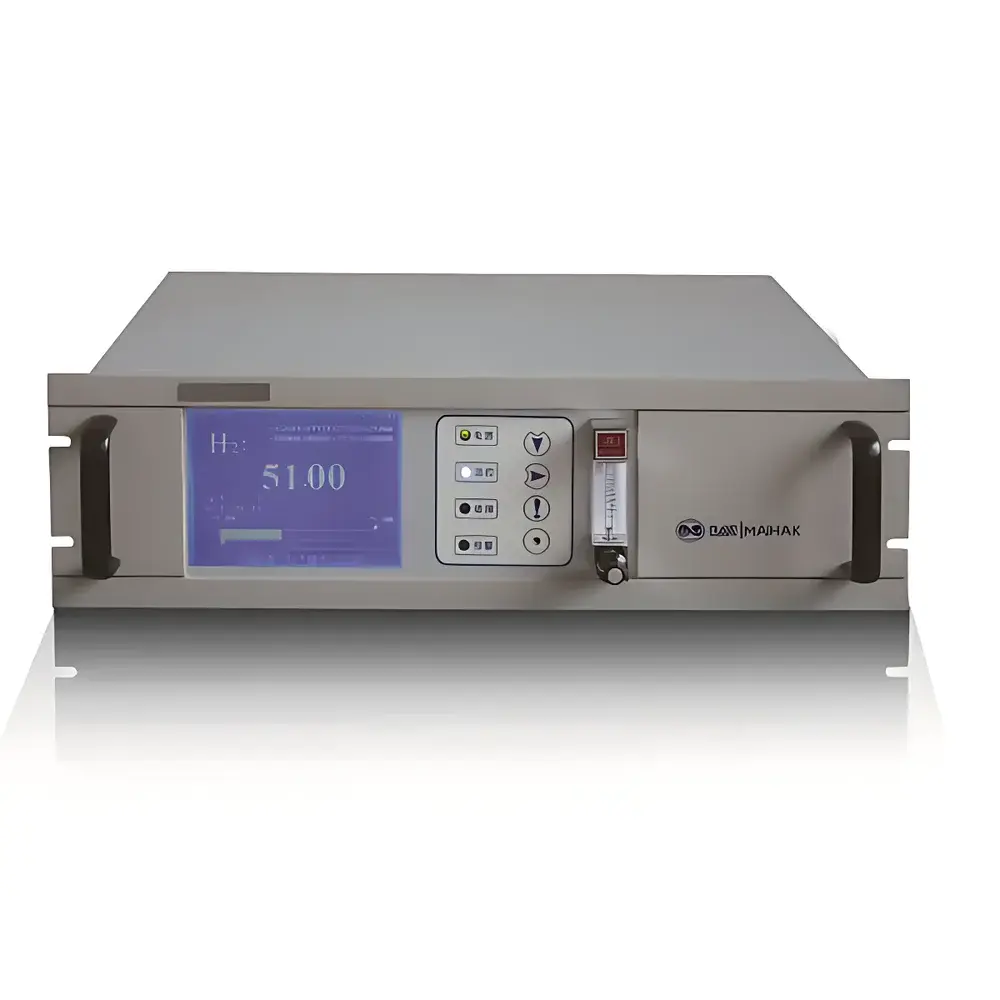
BAIF-MAIHAK QRD-1102C Thermal Conductivity Hydrogen Analyzer
| Brand | BAIF-MAIHAK |
|---|---|
| Model | QRD-1102C |
| Detection Principle | Thermal Conductivity Differential Measurement |
| Target Gases | H₂, Ar, and other binary/multicomponent gas mixtures |
| Output Signals | Isolated 4–20 mA (≤400 Ω load), relay status outputs (calibration, fault, alarm, range switching) |
| Communication | RS-232, Modbus-RTU |
| Display | Backlit LCD with Chinese menu interface |
| Construction | All-metal gas path, corrosion-resistant sensor elements |
| Environmental Rating | Industrial-grade housing, pressure-rated flow path |
| Certifications | Compliant with GB/T 13283–2008 (Industrial Process Analyzers), designed for GLP-aligned operation in continuous monitoring environments |
| Power | AC 220 V ±10%, 50 Hz |
| Operating Temperature | 0–40 °C |
| Relative Humidity | ≤90% RH (non-condensing) |
Overview
The BAIF-MAIHAK QRD-1102C Thermal Conductivity Hydrogen Analyzer is a fixed-mount, continuous-process gas analyzer engineered for precise, real-time quantification of hydrogen (H₂) or argon (Ar) concentration in binary and multicomponent gas streams. It operates on the fundamental physical principle of thermal conductivity differential measurement: gases exhibit distinct thermal conductivities—hydrogen (0.1805 W/m·K at 25 °C) and argon (0.0177 W/m·K) differ by over one order of magnitude—enabling selective detection without chemical reaction or consumables. The instrument employs a dual-cell, constant-temperature hot-wire configuration: one cell measures the sample gas, while the reference cell maintains a stable baseline (typically filled with pure N₂ or sealed inert gas). The resistance change across heated filaments—proportional to heat loss and thus to gas composition—is converted into a linear, temperature-compensated output signal. This method delivers inherent stability, zero drift resistance, and immunity to catalytic poisoning, making it especially suitable for harsh industrial environments where optical or electrochemical analyzers may degrade.
Key Features
- High-stability thermal conductivity detector with corrosion-resistant, platinum-coated tungsten filaments optimized for H₂ and Ar selectivity in reactive or humid process streams.
- Hermetically sealed, all-metal gas pathway constructed from 316 stainless steel—rated for up to 1.0 MPa operating pressure and certified leak-tight per ISO 15848-1 for fugitive emission control.
- Digital signal processing architecture with 24-bit ADC resolution, auto-zero tracking, and adaptive temperature compensation algorithms ensuring long-term baseline stability (<±0.5% FS/30 days).
- Integrated watchdog timer and soft-start circuitry eliminate power-on transients and sustain uninterrupted operation during grid fluctuations—validated for >8,000 hours MTBF.
- Isolated analog output (4–20 mA, HART-compatible passive mode) with configurable linear or square-root scaling; galvanically isolated status outputs for calibration mode, fault condition, alarm threshold, and range-switching events.
- RS-232 serial port and industry-standard Modbus-RTU protocol (slave ID configurable) enable seamless integration into DCS, PLC, and SCADA systems without gateway hardware.
Sample Compatibility & Compliance
The QRD-1102C is validated for use with non-corrosive, non-condensing gas matrices including synthesis gas (syngas), nitrogen blankets, air separation unit (ASU) waste streams, and helium/hydrogen coolant loops. It is unsuitable for samples containing condensable vapors (e.g., hydrocarbons >C₃), halogenated compounds, or particulates exceeding 1 µm without upstream filtration. Per design intent, the analyzer meets mechanical and electrical safety requirements outlined in GB/T 13283–2008 and conforms to electromagnetic compatibility standards per GB/T 18268.21–2010 (industrial environment). While not intrinsically safe certified, it supports installation in Zone 2/Class I Division 2 areas when mounted in appropriate enclosures. Data integrity protocols—including timestamped calibration logs and event-driven fault recording—support alignment with GLP documentation practices and internal QA audit trails.
Software & Data Management
Local operation is managed via an embedded 128×64 pixel backlit LCD with intuitive Chinese-language menu navigation, context-sensitive prompts, and step-by-step calibration guidance. All operational parameters—including span gas concentration, zero offset, damping time, and alarm thresholds—are stored in non-volatile memory with write-protection. Remote configuration and diagnostics are supported through ASCII command sets over RS-232 or Modbus register mapping (e.g., holding registers 40001–40050 for analog output scaling, diagnostic flags, and firmware revision). No proprietary PC software is required; standard terminal emulators or Modbus master tools suffice. Audit-ready data logging (optional external SD card module) captures 1-second interval measurements with ISO 8601 timestamps, facilitating compliance with internal quality system requirements for trend analysis and root-cause investigation.
Applications
- Hydrogen monitoring in ammonia synthesis loops (e.g., post-reactor purge gas, where H₂/N₂ ratio directly impacts catalyst efficiency and energy consumption).
- Real-time H₂ concentration tracking in nuclear reactor hydrogen-cooling circuits—critical for thermal management and early detection of coolant degradation.
- Containment atmosphere surveillance in pressurized water reactors (PWRs), detecting hydrogen accumulation above 2.5% LFL to trigger mitigation systems per IAEA SSG-30 guidelines.
- Quality assurance in green hydrogen production facilities—verifying purity (>99.995%) prior to compression and storage per ISO 8573-1 Class 1 specifications.
- Argon purity verification in cryogenic air separation units, ensuring ≥99.999% Ar for semiconductor manufacturing and specialty welding applications.
FAQ
What gases can the QRD-1102C accurately measure?
It is calibrated and validated for quantitative analysis of hydrogen (H₂) and argon (Ar) in binary mixtures (e.g., H₂/N₂, Ar/O₂) and selected ternary blends where background gas thermal conductivity remains stable. Cross-sensitivity to CO₂ or CH₄ requires matrix-specific calibration.
Does the analyzer require periodic consumables or reagents?
No. As a physical-property-based sensor, it operates without catalysts, electrolytes, or optical filters—only routine zero/span verification using certified calibration gases is required.
Can the QRD-1102C be integrated into a DeltaV or Siemens PCS7 system?
Yes. Its native Modbus-RTU implementation allows direct connection to any DCS or PLC supporting standard serial or RS-485 Modbus slave communication, with no additional protocol converters needed.
Is field calibration possible without specialized tools?
Yes. Zero and span adjustments are accessible via front-panel menu navigation using two-point calibration gases; no laptop or service software is mandatory for basic maintenance.
What is the maximum allowable sample pressure and dew point?
Inlet pressure must remain between 0.1–1.0 MPa (gauge); sample gas must be dried to ≤−20 °C dew point to prevent condensation-induced drift or sensor damage.
Related Products