
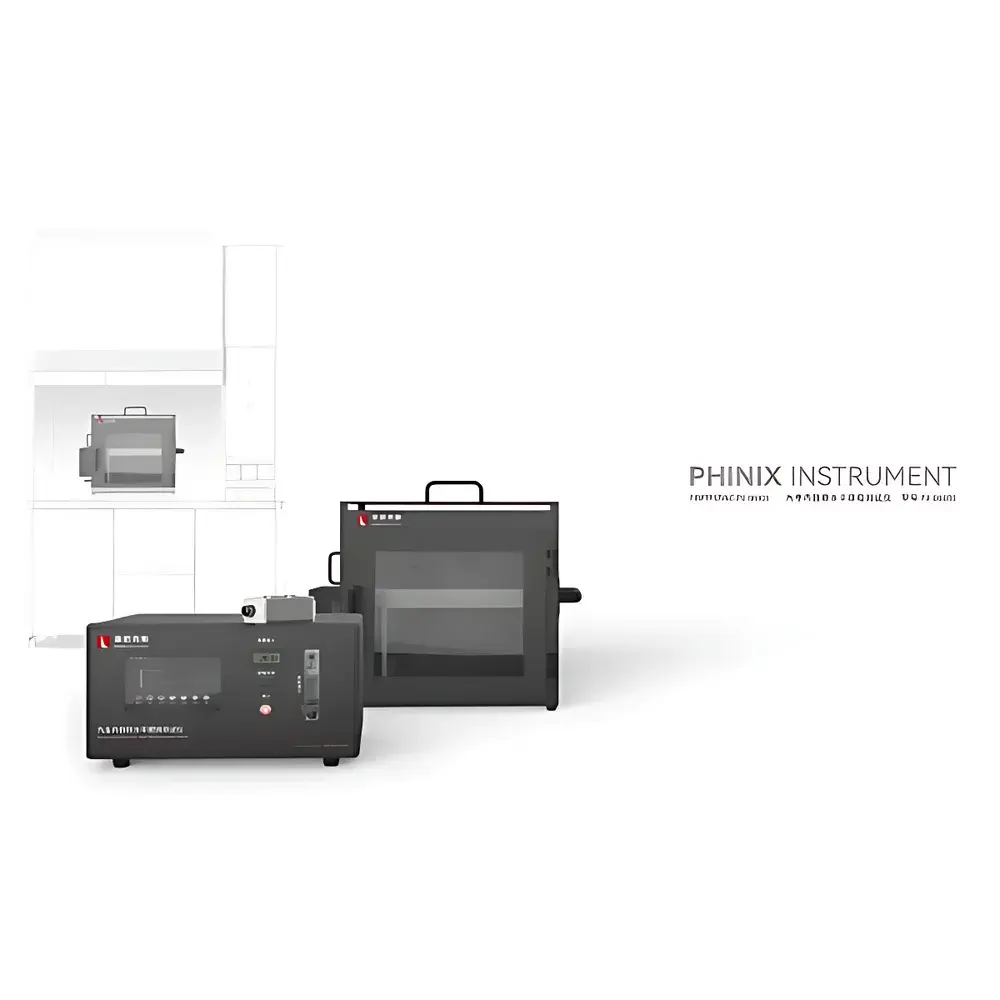
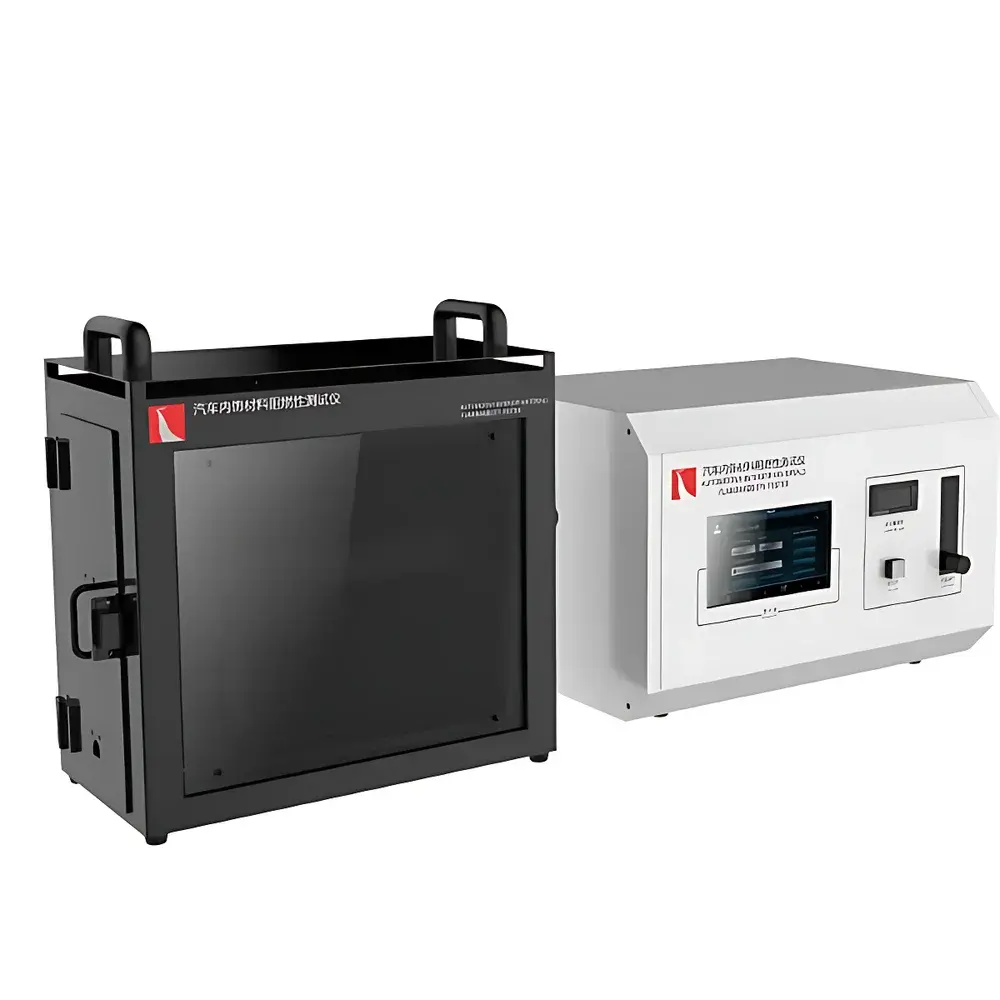
Phinix PX03002 Horizontal & Vertical Combustion Test Chamber for Automotive Interior Materials
| Brand | Phinix |
|---|---|
| Model | PX03002 |
| Standards Compliance | UL 94 HB/V0/V1/V2/5VA/5VB, IEC 60695-11-10/-11-20, ISO 1210/9770/9773, GB/T 2408/5169.17 |
| Chamber Volume | >0.75 m³ |
| Viewing Window | Large tempered glass, interior illumination ≤20 lux |
| Flame Source | HUMBOLDT Trillium burner (ID 9.5±0.3 mm, ASTM D5025 compliant) |
| Flame Orientation | Motorized 0°/20°/45° adjustment |
| Ignition | High-voltage pulse auto-ignition |
| Gas Control | Imported rotameter + differential pressure sensor + precision pressure regulator + solenoid valve |
| Sample Positioning | Motorized linear stage (horizontal/vertical), software-controlled |
| Control System | PLC + industrial touchscreen HMI |
| Safety Features | Auto gas cutoff after 10 min idle, flame duration alert, real-time V (mm/min) calculation and display |
| Optional | 50W/500W flame calibration kit with ±0.1°C certified thermocouples |
| Power | AC 220 V, 50 Hz, 2 A |
| Dimensions (Upper Cabinet) | 1350×700×1000 mm (W×D×H) |
| (Lower Cabinet) | 1350×700×650 mm |
| Weight | ~70 kg |
Overview
The Phinix PX03002 Horizontal & Vertical Combustion Test Chamber is a fully integrated, standards-compliant benchtop system engineered for precise flammability assessment of polymeric and composite materials used in automotive interior applications. It operates on the principle of controlled flame impingement under defined thermal flux conditions, measuring critical fire performance parameters—including burn rate, afterflame time, afterglow time, and drip ignition—per established regulatory test protocols. Designed to meet stringent OEM and Tier-1 supplier requirements, the PX03002 supports both horizontal (UL 94 HB, ISO 1210) and vertical (UL 94 V0–V2, 5VA/5VB, IEC 60695-11-10/-20) combustion configurations within a single, reconfigurable platform. Its chamber volume exceeds 0.75 m³, ensuring adequate air exchange and minimizing boundary effects during flame propagation—critical for reproducible results across heterogeneous substrates such as PVC trim, PU foams, nonwovens, and laminated composites.
Key Features
- Structural integrity: Rigid steel enclosure with dark-finished interior walls (≤20 lux ambient illumination) and large observation window for unobstructed visual monitoring of flame spread and melt behavior.
- Precision flame delivery: U.S.-sourced HUMBOLDT Trillium burner (9.5 ± 0.3 mm orifice diameter), certified per ASTM D5025, capable of generating stable 50 W and 500 W nominal heat fluxes via calibrated propane/butane gas flow.
- Motorized angular positioning: Programmable flame orientation at 0° (horizontal), 20°, or 45° relative to sample surface—actuated via servo motor and synchronized with test method selection in firmware.
- Automated sample handling: Dual-axis motorized stage (horizontal and vertical) with lead-screw actuation enables repeatable placement of specimens per ISO 1210 or UL 94 specimen mounting requirements; no manual repositioning required between test modes.
- Gas management system: High-accuracy imported rotameter, differential pressure transducer, stainless-steel pressure regulator, and fail-safe solenoid valve ensure traceable, stable, and auditable fuel supply—fully compliant with GLP documentation workflows.
- Intelligent control architecture: Industrial-grade PLC coupled with a 7-inch capacitive touchscreen HMI delivers deterministic timing (±0.1 s resolution), real-time linear burn rate (V, mm/min) computation, automatic data logging, and audit-trail-capable event history.
Sample Compatibility & Compliance
The PX03002 accommodates standard test specimens up to 125 mm × 13 mm × thickness ≤13 mm (per UL 94/ISO 1210), including rigid plastics, flexible foams, textiles, and multilayer laminates common in automotive dashboards, door panels, headliners, and seat covers. Optional VTM fixtures extend capability to thin films (<0.1 mm) per UL 94 VTM-0/VTM-1/VTM-2 and ISO 9773. All test sequences adhere to internationally recognized fire safety benchmarks: UL 94 (HB, V, 5V classes), IEC 60695-11 series, ISO 1210, ISO 9770, ISO 9773, GB/T 2408, and GB/T 5169.17. The system’s mechanical design and operational logic are validated against ASTM D5025 (burner specification) and ASTM D5207 (calibration procedures), supporting regulatory submissions under UN ECE R118, FMVSS 302, and EU Directive 2000/53/EC.
Software & Data Management
The embedded control software provides intuitive test method navigation, parameter configuration (e.g., flame application time, specimen orientation, post-ignition dwell), and real-time graphical feedback. Each test generates a timestamped record containing raw sensor data (gas pressure, flame duration, burn length), calculated metrics (V value, afterflame time), operator ID, and environmental metadata. Export formats include CSV and PDF reports compatible with LIMS integration. Audit trail functionality meets FDA 21 CFR Part 11 requirements for electronic records and signatures, with configurable user roles, password protection, and immutable log files. Optional calibration modules support automated flame verification using NIST-traceable thermocouples (±0.1 °C accuracy) and generate ISO/IEC 17025-aligned calibration certificates.
Applications
This instrument serves laboratories performing material qualification for automotive OEMs (e.g., Ford, GM, VW, Toyota), Tier-1 suppliers (BorgWarner, Magna, Faurecia), and third-party testing agencies accredited to ISO/IEC 17025. Typical use cases include pre-production screening of interior polymers, root-cause analysis of flame-retardant formulation failures, comparative evaluation of halogen-free vs. brominated FR systems, and validation of recycled content impact on fire performance. Its modular design also supports R&D investigations into char formation kinetics, dripping behavior under radiant flux, and synergistic effects of intumescent additives—providing quantitative inputs for CFD-based fire modeling.
FAQ
Does the PX03002 support both horizontal and vertical flame tests without hardware modification?
Yes. The motorized burner tilt mechanism and dual-axis specimen stage allow seamless switching between UL 94 HB, V, and 5V test modes via touchscreen interface—no tooling or manual realignment required.
Is the system compliant with ISO/IEC 17025 accreditation requirements?
Yes. All critical subsystems—including gas flow control, flame temperature calibration, timing circuits, and data storage—are designed for metrological traceability; full validation documentation and IQ/OQ protocols are available upon request.
Can test data be exported to external quality management systems?
Yes. CSV and PDF exports include all raw measurements, computed values, timestamps, and operator annotations—structured for direct ingestion into SAP QM, TrackWise, or LabWare LIMS.
What safety interlocks prevent unintended ignition or gas release?
The system features redundant safety layers: hardware-based gas shutoff after 10 minutes of inactivity, flame presence detection via UV sensor, pressure-loss-triggered emergency cutoff, and PLC-monitored door interlock that disables ignition if chamber access is breached.
Is technical support and calibration service available outside China?
Yes. Phinix maintains authorized service partners in Germany, USA, and Japan; remote diagnostics and on-site calibration by ISO 17025-accredited engineers are available under annual support contracts.



