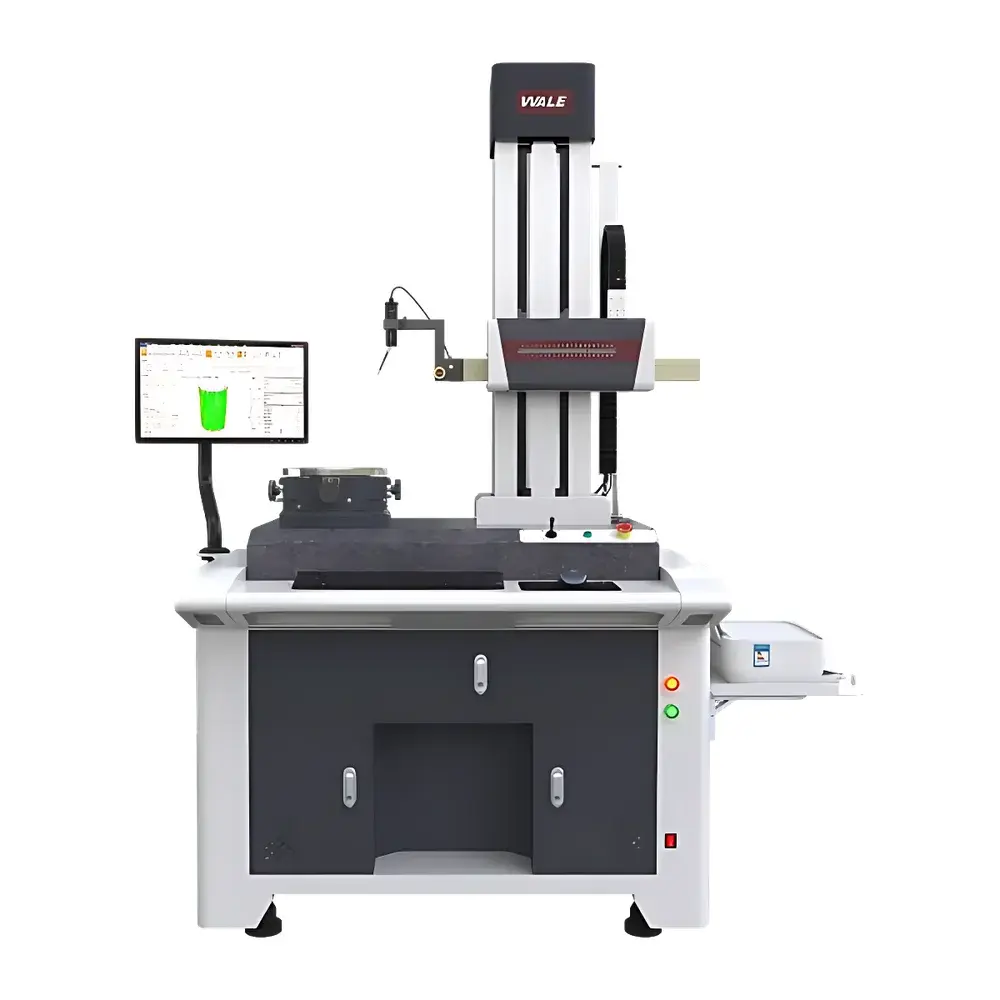
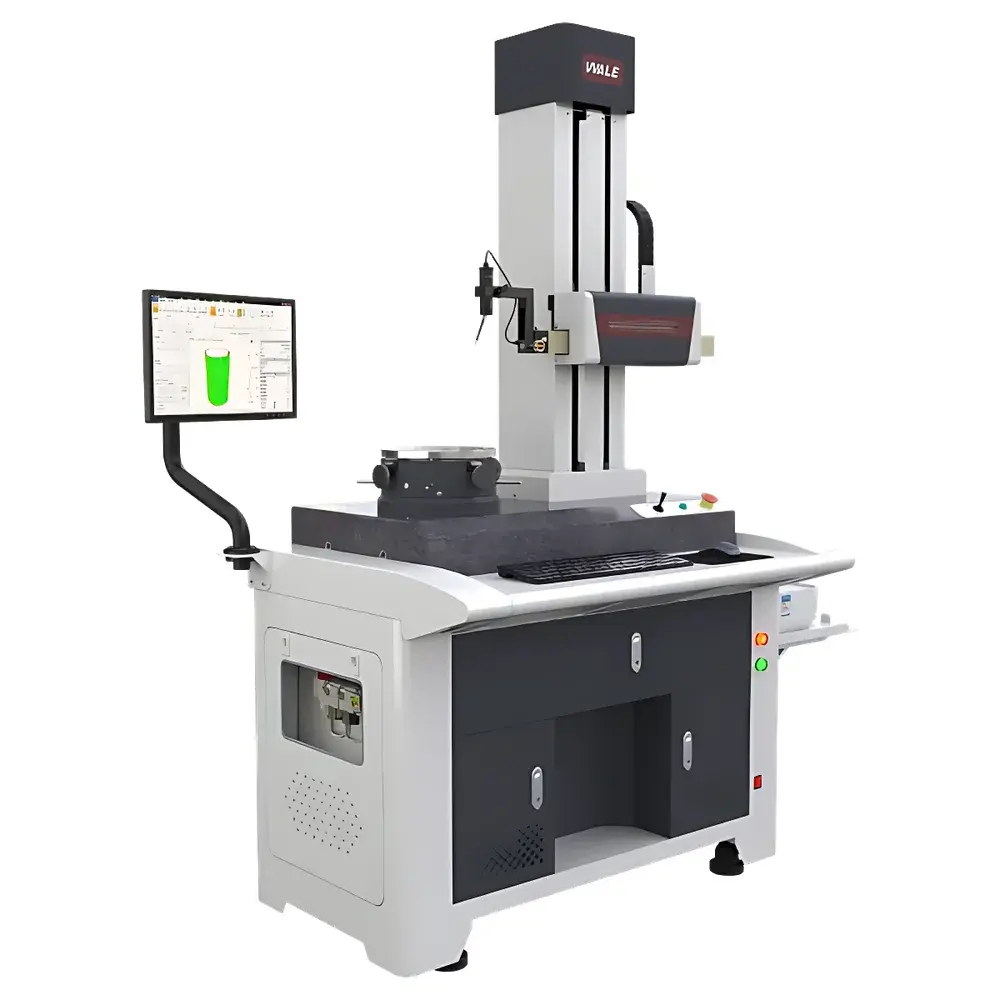
Wil Cylindricity Measuring Instrument CYM Series
| Brand | Wil |
|---|---|
| Origin | Shaanxi, China |
| Manufacturer Type | Manufacturer |
| Product Category | Domestic |
| Model | CYM Series |
| Price Range | USD 14,000 – 42,000 (FOB) |
| Instrument Type | Cylindricity Measuring Instrument |
| Measured Parameters | Roundness, Coaxiality, Concentricity, Flatness, Radial Runout, Parallelism, Perpendicularity |
| Spindle Rotational Accuracy | (0.025 + 6H/10000) µm |
| Bearing Type | Air-bearing Spindle |
| Max. External Diameter Measurement | 300 mm |
| Rotational Speeds | 6, 8, 10 rpm |
Overview
The Wil CYM Series Cylindricity Measuring Instrument is a high-precision, manually operated geometric metrology system engineered for comprehensive form and orientation analysis of rotationally symmetric components. Based on the principle of precision rotational scanning—where the workpiece rotates on an ultra-stable air-bearing spindle while a tactile probe traverses axially along the Z-axis—the instrument captures radial deviation data at thousands of discrete angular and axial positions. This enables full 3D reconstruction of cylindrical surfaces and planar features, supporting rigorous evaluation of ISO 1101 geometric tolerancing specifications. Designed for QC laboratories, precision machining workshops, and R&D facilities handling shafts, bearings, hydraulic components, and aerospace bushings, the CYM Series delivers traceable, repeatable measurements aligned with international standards including ISO 5436-1 (Geometrical Product Specifications – Surface texture), ISO 12181 (Roundness), and ISO 12780 (Straightness and flatness).
Key Features
- Air-bearing spindle with sub-micron rotational accuracy: nominal error of (0.025 + 6H/10000) µm (H = height in mm from base), ensuring minimal motion artifact during high-resolution scanning.
- Manually adjustable horizontal arm and vertical column, both constructed from stress-relieved granite and finished via precision lapping to minimize thermal drift and structural deformation.
- High-resolution optical linear encoders on both R (radial) and Z (vertical) axes, delivering position feedback with ≤0.1 µm resolution and enabling precise probe positioning across full measurement volume.
- Multi-speed motorized rotation: selectable speeds of 6, 8, and 10 rpm—optimized for balancing measurement throughput and signal-to-noise ratio across diverse surface finishes and material stiffnesses.
- Modular probe interface compatible with standard LVDT and strain-gauge-based contact styli (tip radii: 2 µm to 500 µm), supporting both single-point and multi-directional probing configurations.
- Integrated environmental compensation module for ambient temperature (15–30 °C), barometric pressure (86–106 kPa), and relative humidity (30–70 % RH) to maintain dimensional stability per ISO 230-2.
Sample Compatibility & Compliance
The CYM Series accommodates cylindrical parts up to 300 mm in external diameter and variable height (dependent on Z-axis travel configuration). Workpieces may be clamped using standard three-jaw chucks, precision collets, or custom fixtures—ensuring secure, concentric holding without distortion. The system supports measurement of hardened steels, aluminum alloys, ceramics, and polymer composites, provided surface roughness remains within Ra ≤ 6.3 µm for optimal stylus tracking fidelity. All measurement algorithms adhere to ISO 1101 Annex B conventions for least-squares, minimum-zone, and maximum-inscribed-circle evaluation methods. Calibration traceability is maintained through NIST-traceable master cylinders and flat reference plates, with documented uncertainty budgets compliant with ISO/IEC 17025 requirements for accredited calibration laboratories.
Software & Data Management
Bundled with WilGeo-Metro v4.2 software, the CYM Series provides intuitive graphical workflow management—from setup wizard and probe calibration to automated report generation. The software implements full audit trail functionality per FDA 21 CFR Part 11 requirements, including electronic signatures, user-level access control, and immutable log files for all measurement sessions, parameter changes, and result exports. Data output formats include ASCII (.txt), CSV, XML (ISO 10303-21 STEP AP210), and PDF reports with embedded GD&T callouts, color-coded deviation maps, and statistical summaries (Cp/Cpk, Pp/Ppk). Raw point-cloud datasets are exportable for third-party analysis in Metrology Software Suite (MSS), PolyWorks, or MATLAB environments.
Applications
- Verification of automotive crankshaft journals for roundness and coaxiality against SAE J429 and ISO 6413.
- Validation of turbine blade root geometry and hub bore alignment in aerospace MRO facilities.
- Process capability studies for precision-ground hydraulic piston rods (ISO 4287 surface finish correlation).
- Root cause analysis of bearing raceway deformation following fatigue testing per ASTM F2624.
- First-article inspection of medical device components (e.g., orthopedic implant stems) under ISO 13485 quality system mandates.
- Supplier qualification audits requiring full GD&T compliance documentation for Tier-1 OEM contracts.
FAQ
What standards does the CYM Series comply with for roundness and cylindricity evaluation?
The instrument implements algorithms conforming to ISO 12181-1 (roundness), ISO 12780-1 (straightness and flatness), and ISO 1101 (geometrical tolerancing), with configurable evaluation methods including least-squares, minimum-zone, and maximum-inscribed-circle.
Is the air-bearing spindle field-serviceable?
Yes—the air-bearing assembly is modular and designed for on-site maintenance by certified Wil service engineers; periodic cleaning and pressure regulation are recommended every 12 months under normal usage conditions.
Can the system perform multi-layer scanning for tapered or stepped cylinders?
Yes—Z-axis programmable indexing allows sequential scans at user-defined axial positions, enabling layered cylindricity assessment and cross-sectional comparison per ISO 12180-2.
Does the software support automated pass/fail decision logic based on GD&T tolerances?
Yes—tolerance limits can be imported directly from CAD models (STEP or IGES) or entered manually; real-time status indicators and color-coded tolerance bands are displayed during measurement execution.