
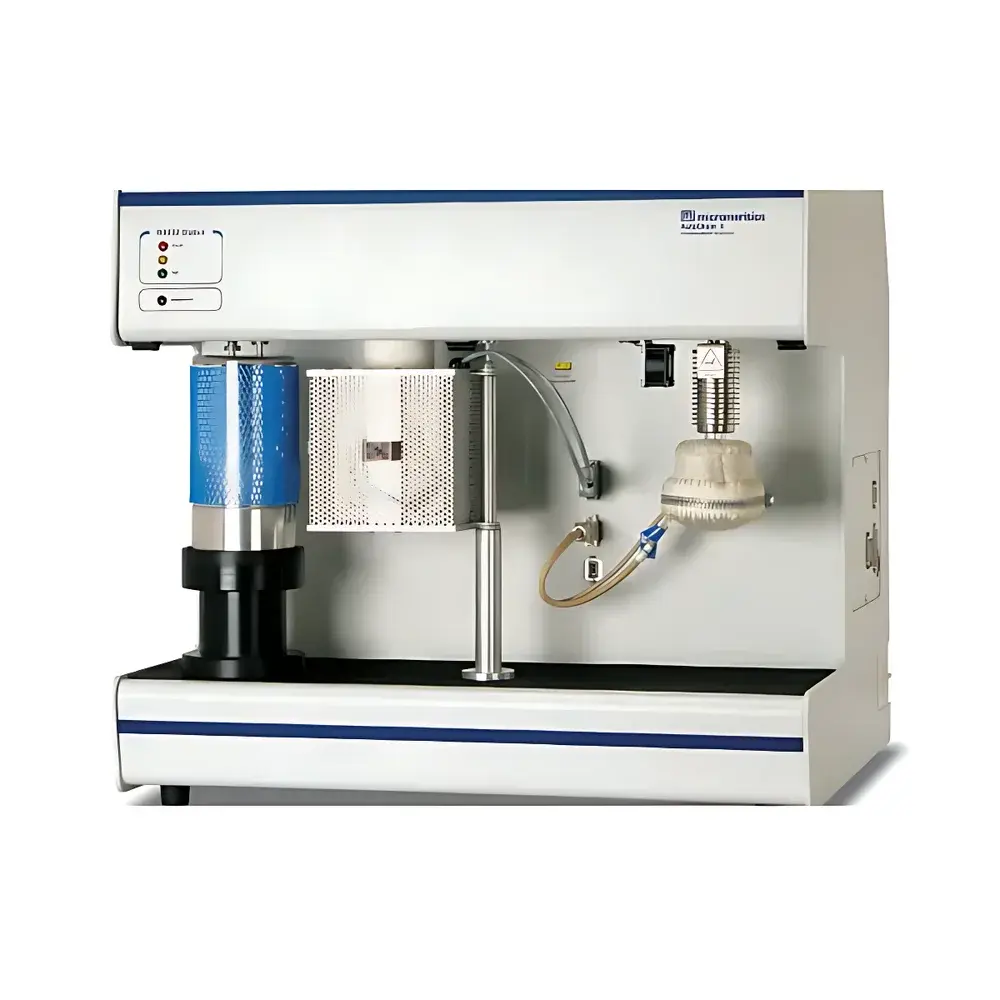
Microtrac MRB AutoChem II 2920 Series Research-Grade Fully Automated Chemisorption Analyzer
| Brand | Microtrac MRB |
|---|---|
| Origin | USA |
| Model | AutoChem II 2920 Series |
| Temperature Range | Ambient to 1100 °C (furnace), –100 °C (CryoCooker), up to 150 °C (gas lines) |
| Detection | High-Linearity TCD with corrosion-resistant filament |
| Gas Control | 12 independent gas inlets, 4 precision mass flow controllers |
| Analytical Modes | Pulse chemisorption, TPR, TPD, TPO, TPRx, vapor-phase adsorption |
| Vapor Capability | Integrated steam generator for pyridine, water, benzene, etc. |
| Cooling | KwikCool rapid furnace cooling system |
| Compliance | Designed for GLP/GMP environments |
Overview
The Microtrac MRB AutoChem II 2920 Series is a research-grade, fully automated chemisorption analyzer engineered for quantitative surface characterization of heterogeneous catalysts, supported metals, and functional materials. It operates on the fundamental principles of gas–solid interaction thermodynamics and kinetics, combining static and dynamic adsorption techniques with temperature-programmed reaction methodologies. By measuring gas uptake, desorption, reduction, oxidation, and surface reaction profiles under precisely controlled thermal and gaseous environments, the system delivers quantitative insights into active metal dispersion, surface acidity distribution (Brønsted vs. Lewis), adsorption enthalpy, site density, and thermal stability. Its architecture adheres to ASTM D7215 (standard test method for metal dispersion in supported catalysts) and ISO 18317 (surface area and porosity by gas adsorption), serving as a primary tool in catalysis R&D, catalyst manufacturing QA/QC, and post-reaction deactivation studies.
Key Features
- Four independently controlled temperature zones: furnace (up to 1100 °C), transfer lines (up to 150 °C), detector block, and sample introduction zone — eliminating condensation artifacts and enabling robust vapor-phase experiments.
- High-sensitivity linear thermal conductivity detector (TCD) with corrosion-resistant tungsten–rhenium filament, compatible with H₂, CO, NH₃, O₂, NO, SO₂, Cl₂, and other reactive or corrosive gases without signal drift.
- Four high-accuracy mass flow controllers (MFCs) delivering ±0.5% full-scale repeatability and programmable stepwise or ramped gas delivery for precise pulse chemisorption and multi-step TPR/TPO sequences.
- KwikCool active furnace cooling system reduces furnace temperature from 1100 °C to ambient in under 15 minutes, increasing daily throughput by up to 40% compared to passive-cooled systems.
- CryoCooker low-temperature module enables controlled reactions starting at –100 °C — critical for studying low-temperature CO oxidation, selective hydrogenation, or cryo-adsorption of weakly bound species on Pt, Pd, or Rh catalysts.
- Integrated vapor generator with temperature-stabilized saturator and inert carrier dilution, supporting quantitative adsorption/desorption studies of pyridine, water, benzene, methanol, and other condensable vapors under isothermal or temperature-ramped conditions.
Sample Compatibility & Compliance
The AutoChem II 2920 accommodates standard quartz U-tube or micro-reactor cartridges (3–6 mm ID), accommodating powder, extrudates, pellets, and monolith fragments. Sample mass range: 0.01–2.0 g. All wetted surfaces are electropolished stainless steel or fused silica, ensuring compatibility with halogenated, sulfur-containing, and nitrogenous feedstocks. The system meets mechanical and electrical safety requirements per UL 61010-1 and IEC 61000-6-3. When operated with Microtrac’s CatalystPro Suite v5.2+ and optional electronic signature modules, it supports audit-trail generation, user access control, and electronic record retention compliant with FDA 21 CFR Part 11 and EU Annex 11 for regulated laboratories.
Software & Data Management
CatalystPro software provides instrument control, real-time data visualization, peak integration (tangent skim, Gaussian deconvolution), and kinetic modeling (e.g., Redhead analysis, Arrhenius fitting, Langmuir–Hinshelwood parameter extraction). Raw chromatograms, temperature ramps, and gas flow logs are stored in vendor-neutral HDF5 format with embedded metadata (operator, timestamp, method ID, calibration history). Batch processing tools enable comparative analysis across multiple samples — e.g., dispersion trends across calcination temperatures or acid site distribution shifts after hydrothermal aging. Export options include CSV, Excel, and PDF reports with customizable templates aligned with internal SOPs or journal submission standards.
Applications
- Quantification of active metal surface area and dispersion in Pt/Al₂O₃, Ni/SiO₂, Co/Mo/Al₂O₃ hydrotreating catalysts via H₂ or CO pulse chemisorption.
- Acid site typing and strength distribution mapping using NH₃-TPD and pyridine-FTIR–TPD coupling (via external IR interface port).
- Redox behavior assessment of CeO₂–ZrO₂ mixed oxides and perovskite-type oxides via H₂-TPR and O₂-TPO.
- Vapor-phase adsorption isotherms and hysteresis analysis for hydrophobic/hydrophilic balance evaluation in MOF-based CO₂ capture sorbents.
- Deactivation mechanism studies — e.g., sulfur poisoning kinetics on Pd/C via sequential H₂S dosing and H₂-TPD recovery scans.
FAQ
What types of catalysts can be analyzed on the AutoChem II 2920?
It supports transition metals (Pt, Pd, Ni, Co, Fe), metal oxides (V₂O₅, MoO₃, WO₃), zeolites (HZSM-5, HY), supported sulfides, carbides, nitrides, and emerging single-atom catalysts — provided they are thermally stable below 1100 °C in the chosen gas environment.
Can the system perform simultaneous TCD and MS detection?
Yes — a dedicated quadrupole mass spectrometer (QMS) port is integrated downstream of the TCD, allowing concurrent detection of m/z signals (e.g., H₂, H₂O, CO₂, NH₃) alongside thermal conductivity responses for cross-validated speciation.
Is calibration traceable to NIST standards?
Gas flow calibration uses certified reference gases (NIST-traceable H₂ in Ar, CO in He) and gravimetrically calibrated pulse volumes; temperature calibration is performed with Pt–Rh thermocouples certified to ASTM E230.
How is data integrity ensured during long-duration TPD experiments?
The system logs all hardware states (valve positions, MFC setpoints, furnace PID parameters) at 100 ms intervals; raw detector voltage and thermocouple readings are sampled at 10 Hz and archived with SHA-256 checksums to prevent tampering.
Does the software support custom reaction mechanism modeling?
CatalystPro includes built-in libraries for Langmuir, Eley–Rideal, and Mars–van Krevelen mechanisms; users may define custom rate equations via Python scripting interface (requires Developer License add-on).



