
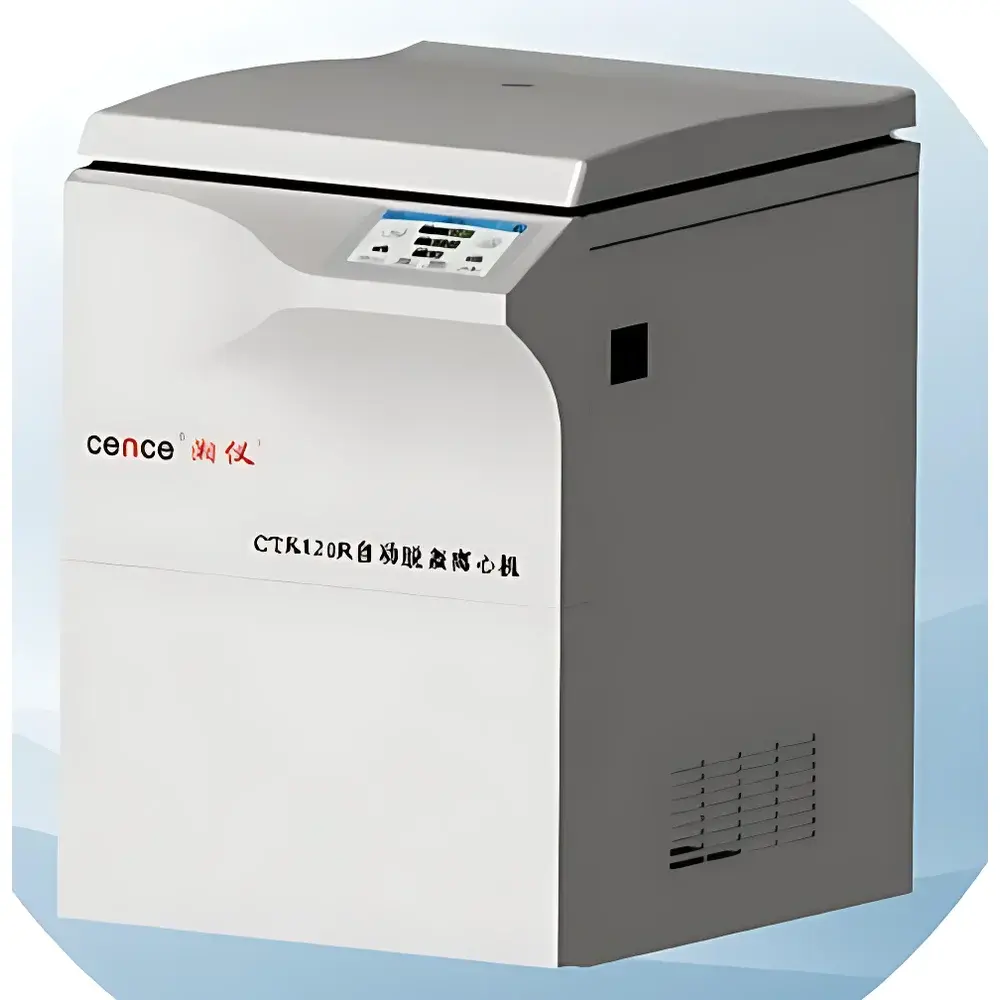
Xiangyi CTK120R Automated Cap-Removal Refrigerated Centrifuge
| Brand | Xiangyi |
|---|---|
| Origin | Hunan, China |
| Manufacturer Type | Direct Manufacturer |
| Product Category | Domestic |
| Model | CTK120R |
| Instrument Type | Floor-Standing Centrifuge |
| Speed Class | Low-Speed Centrifuge (max. 4000 rpm) |
| Function | Refrigerated Centrifuge |
| Configuration | Horizontal Rotor Centrifuge |
| Separation Tier | Large Organelles / Viruses |
| Max Capacity | 120 × vacuum blood collection tubes (13 mm × 75 mm or 100 mm) |
| Max Speed | 4000 rpm |
| Max RCF | 3370 × g |
| Dimensions | 565 × 670 × 850 mm |
Overview
The Xiangyi CTK120R Automated Cap-Removal Refrigerated Centrifuge is an integrated laboratory solution engineered for high-throughput clinical hematology workflows where vacuum blood collection tubes (e.g., EDTA, heparin, serum separator tubes) are routinely processed. Unlike conventional refrigerated centrifuges requiring manual cap removal post-spin—introducing variability, re-mixing risk, and biosafety exposure—the CTK120R incorporates a precision electromechanical cap-removal module synchronized with rotor deceleration and temperature-stabilized chamber operation. It operates on the principle of controlled horizontal rotor sedimentation under refrigerated conditions (typically 4 °C ±2 °C), enabling consistent phase separation of whole blood into plasma/serum and cellular fractions while preserving analyte integrity. Designed for compliance with ISO 15189 pre-analytical requirements and CLSI H26-A3 guidelines for specimen processing, the system supports traceable, operator-independent handling of up to 120 tubes per run—making it suitable for core labs, hospital central laboratories, and blood bank processing units.
Key Features
- Automated cap-removal mechanism with >90% success rate across two standard tube lengths (75 mm and 100 mm), minimizing manual intervention and reducing biosafety risks associated with aerosol generation and needlestick exposure.
- Refrigerated chamber maintaining stable 4 °C operation during and after centrifugation; compressor-based cooling system with PID-controlled thermal regulation ensures minimal temperature drift (<±0.5 °C at steady state).
- Horizontal swing-out rotor configuration optimized for vacuum tube geometry, supporting standardized 13 mm diameter tubes in fixed-angle or bucket-style carriers compliant with IEC 61010-2-020 safety standards.
- AC brushless frequency-controlled motor delivering precise speed control (±10 rpm accuracy), rapid acceleration (0–4000 rpm in ≤15 s) and deceleration (full stop in ≤25 s), reducing total cycle time without compromising sedimentation integrity.
- Integrated RCF (Relative Centrifugal Force) calculator automatically displaying real-time g-force based on selected rotor radius and rotational speed; eliminates manual conversion errors during protocol setup.
- Passive vibration damping system with dual-stage rubber-isolated base and dynamically balanced rotor assembly, achieving <5 µm peak-to-peak displacement at maximum speed—critical for maintaining tube integrity and preventing gel barrier disruption in SST tubes.
- Electronically interlocked safety door with redundant position sensors: centrifuge remains inert if lid is not fully engaged; immediate motor cutoff and brake activation occur upon unauthorized opening during operation.
Sample Compatibility & Compliance
The CTK120R accommodates all major vacuum blood collection tube formats meeting ISO 6710 specifications—including BD Vacutainer®, Greiner Bio-One Vacuette®, and Sarstedt Monovette®—with nominal diameters of 13 mm and lengths of 75 mm or 100 mm. Its rotor geometry and cap-removal stroke depth are validated for tubes containing clot activators, anticoagulants (EDTA-K2/K3, sodium citrate, lithium heparin), and serum separator gels. The instrument conforms to IEC 61010-1 (Safety Requirements for Electrical Equipment for Measurement, Control, and Laboratory Use) and IEC 61326-1 (EMC for Laboratory Equipment). Software logs meet ALCOA+ principles for data integrity, supporting GLP/GMP-aligned environments when paired with optional audit trail modules.
Software & Data Management
The CTK120R features a 7-inch capacitive touchscreen interface running embedded Linux OS with intuitive icon-driven navigation. All protocols—including speed, time, temperature, acceleration/deceleration profiles, and cap-removal sequence—are programmable and storable (up to 99 user-defined methods). System event logs record start/stop timestamps, rotor ID, actual RCF, chamber temperature history, door status transitions, and cap-removal attempt outcomes—exportable via USB 2.0 as CSV files. Optional RS-232 or Ethernet connectivity enables integration into LIS/HIS platforms using ASTM E1384 or HL7 v2.5 messaging protocols. Audit trail functionality complies with FDA 21 CFR Part 11 requirements when configured with role-based access control and electronic signature modules.
Applications
- Routine serum/plasma separation in clinical chemistry and immunoassay workflows.
- Preparation of platelet-poor plasma (PPP) for coagulation testing (PT, APTT, fibrinogen).
- Processing of whole blood for flow cytometry, molecular diagnostics, and biobanking.
- Centrifugal clarification of viral transport media prior to nucleic acid extraction.
- High-volume outpatient lab specimen batching with minimized hands-on time and standardized turnaround.
FAQ
What tube sizes does the CTK120R support for automated cap removal?
It is validated for 13 mm diameter vacuum tubes with lengths of either 75 mm or 100 mm, covering all common clinical blood collection formats.
Does the instrument maintain temperature stability during the cap-removal phase?
Yes—the refrigeration system remains active throughout the entire cycle, including deceleration and post-spin cap removal, ensuring continuous 4 °C thermal environment.
Is rotor imbalance detection automatic?
The system performs dynamic imbalance assessment during acceleration and will halt operation if vibration exceeds preset ISO 1940 G2.5 thresholds.
Can the CTK120R be integrated into a laboratory automation track?
While not natively track-compatible, its programmable I/O ports and serial communication protocols allow third-party robotic arm synchronization via external PLC control logic.
What maintenance intervals are recommended for the cap-removal actuator?
The electromechanical cap-removal module requires lubrication and mechanical inspection every 10,000 cycles or annually—whichever occurs first—as documented in the service manual.



