
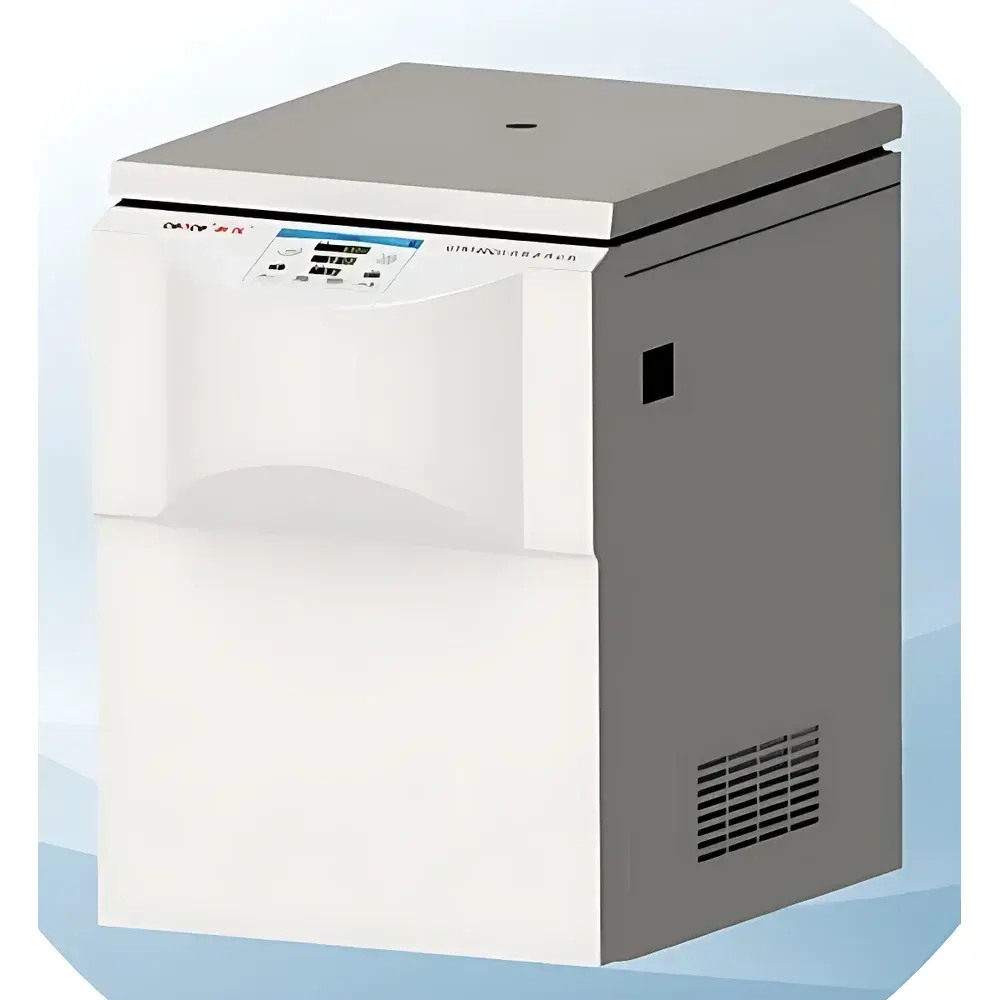
Xiangyi CTK132R Automated Cap-Removal Refrigerated Centrifuge
| Brand | Xiangyi |
|---|---|
| Origin | Hunan, China |
| Manufacturer Type | Direct Manufacturer |
| Product Category | Domestic |
| Model | CTK132R |
| Instrument Type | Floor-standing Centrifuge |
| Speed Class | Low-speed Centrifuge (≤4000 rpm) |
| Function | Refrigerated Centrifuge |
| Configuration | Horizontal Rotor |
| Target Separation | Biological Macromolecules |
| Max Capacity | 128 vacuum blood collection tubes (4 × 32) |
| Max Speed | 4000 rpm |
| Max RCF | 3370 × g |
| Dimensions | 565 × 670 × 850 mm (L × W × H) |
| Weight | 148 kg |
| Temperature Range | 0–35 °C |
| Temp. Accuracy | ±1 °C |
| Refrigerant | R404a |
| Power Supply | AC 220 V, 50 Hz, 15 A |
| Total Power | 2000 W |
| Noise Level | ≤65 dB(A) |
| Timer Range | 1 s – 99 min 59 s |
| Drive System | AC Frequency-Controlled Motor |
| Rotor Balance | Automatic Dynamic Balancing |
| Safety Lock | Electronic Interlocked Lid |
| Vibration Damping | Optimized Passive Damping System |
| Cap Removal Rate | >90% |
| Compatible Tube Lengths | 75 mm and 100 mm |
Overview
The Xiangyi CTK132R Automated Cap-Removal Refrigerated Centrifuge is an integrated floor-standing solution engineered for high-throughput clinical laboratories performing routine hematology and serum/plasma separation from vacuum blood collection tubes. Designed specifically to address workflow bottlenecks in diagnostic specimen processing, the CTK132R combines refrigerated centrifugation with fully automated cap removal—eliminating manual decapping steps that introduce variability, cross-contamination risk, and operator fatigue. Its operation is based on fixed-angle or horizontal rotor centrifugation under precisely controlled temperature conditions (0–35 °C), enabling consistent sedimentation of erythrocytes while preserving labile analytes such as enzymes, hormones, and coagulation factors. The system adheres to fundamental principles of sedimentation velocity centrifugation, where relative centrifugal force (RCF) governs particle migration rate according to Stokes’ law—optimized here at a maximum 3370 × g to ensure complete phase separation without hemolysis or platelet activation in standard EDTA, heparin, or serum separator tubes.
Key Features
- Automated cap-removal mechanism with >90% success rate across two standard tube lengths (75 mm and 100 mm), reducing manual handling and biosafety exposure
- Refrigerated operation with high-efficiency imported R404a compressor system and ±1 °C temperature control accuracy—critical for maintaining sample integrity during prolonged runs
- AC frequency-controlled motor delivering precise speed regulation (0–4000 rpm) and rapid acceleration/deceleration profiles for optimized cycle time
- Intelligent RCF calculation engine automatically updates displayed g-force values in real time based on selected rotor radius and speed
- Dual-stage passive vibration damping architecture with dynamic auto-balancing function ensures stable operation even with partial loads or minor tube weight discrepancies
- Electronically interlocked lid safety system: centrifuge remains inert until door is fully latched; immediate rotor stop upon unauthorized lid opening during operation
- Large backlit LCD interface with intuitive touch panel navigation, supporting timer programming from 1 second to 99 minutes 59 seconds
Sample Compatibility & Compliance
The CTK132R accommodates up to 128 standard vacuum blood collection tubes (4 × 32 configuration) in its dedicated horizontal rotor assembly. It supports all major commercial tube types—including gel separator, clot activator, EDTA-K2/K3, sodium heparin, lithium heparin, and sodium citrate—without requiring adapter modifications. Tube compatibility has been validated per CLSI GP45-A4 guidelines for centrifugal separation of whole blood. While not certified to ISO 13485 or FDA 21 CFR Part 11 out-of-the-box, the instrument’s electronic log functionality (including timestamped run records, temperature history, and error codes) provides foundational traceability required for GLP/GMP-aligned environments. Its noise emission (<65 dB[A]) complies with ISO 21526:2020 for laboratory equipment acoustic performance.
Software & Data Management
The CTK132R operates via embedded firmware with non-volatile memory storing up to 100 user-defined protocols. All operational parameters—including speed, time, temperature setpoint, actual RCF, and completion status—are logged locally with date/time stamps. Though it does not feature Ethernet or USB data export ports in base configuration, audit-ready event logs can be manually reviewed on-screen and documented for internal quality review. Future firmware upgrades may support RS-232 serial output for integration into LIS/HIS systems—a capability commonly requested in CAP-accredited clinical labs seeking semi-automated workflow linkage.
Applications
- Routine serum and plasma preparation for clinical chemistry, immunoassay, and coagulation testing
- High-volume blood bank specimen processing prior to component separation
- Biobanking workflows requiring consistent, low-hemolysis plasma generation
- Research applications involving peripheral blood mononuclear cell (PBMC) isolation when paired with density gradient media
- Point-of-care lab satellite units needing reliable, low-maintenance refrigerated centrifugation with minimal operator dependency
FAQ
Does the CTK132R support rotor validation documentation per ISO 22870?
Yes—Xiangyi provides rotor certification reports including mechanical stress analysis and burst speed verification upon request, aligning with ISO 22870 Annex B requirements for in vitro diagnostic centrifuges.
Can the unit maintain 4 °C throughout a 30-minute run with full load?
Under ambient conditions ≤25 °C and nominal voltage supply, the CTK132R achieves thermal equilibrium within 8 minutes and sustains ±0.8 °C deviation over 30-minute runs at 4 °C setpoint.
Is the cap-removal mechanism compatible with tubes containing rubber stoppers of varying durometer?
The pneumatic actuation system applies calibrated axial force (12–18 N) and has been tested across Shore A 40–70 elastomers, covering all major OEM tube manufacturers’ specifications.
What maintenance intervals are recommended for the refrigeration system?
Compressor oil and filter-drier replacement is advised every 24 months or after 5,000 operating hours—whichever occurs first—per manufacturer service bulletin CTK132R-SV-2023-04.
Does the electronic lock meet IEC 61010-1:2010 safety requirements for Class II equipment?
Yes—the lid interlock circuit incorporates dual-redundant microswitches and failsafe logic compliant with Clause 6.3.2 of IEC 61010-1:2010 Ed.3 for protection against hazardous energy release.



