
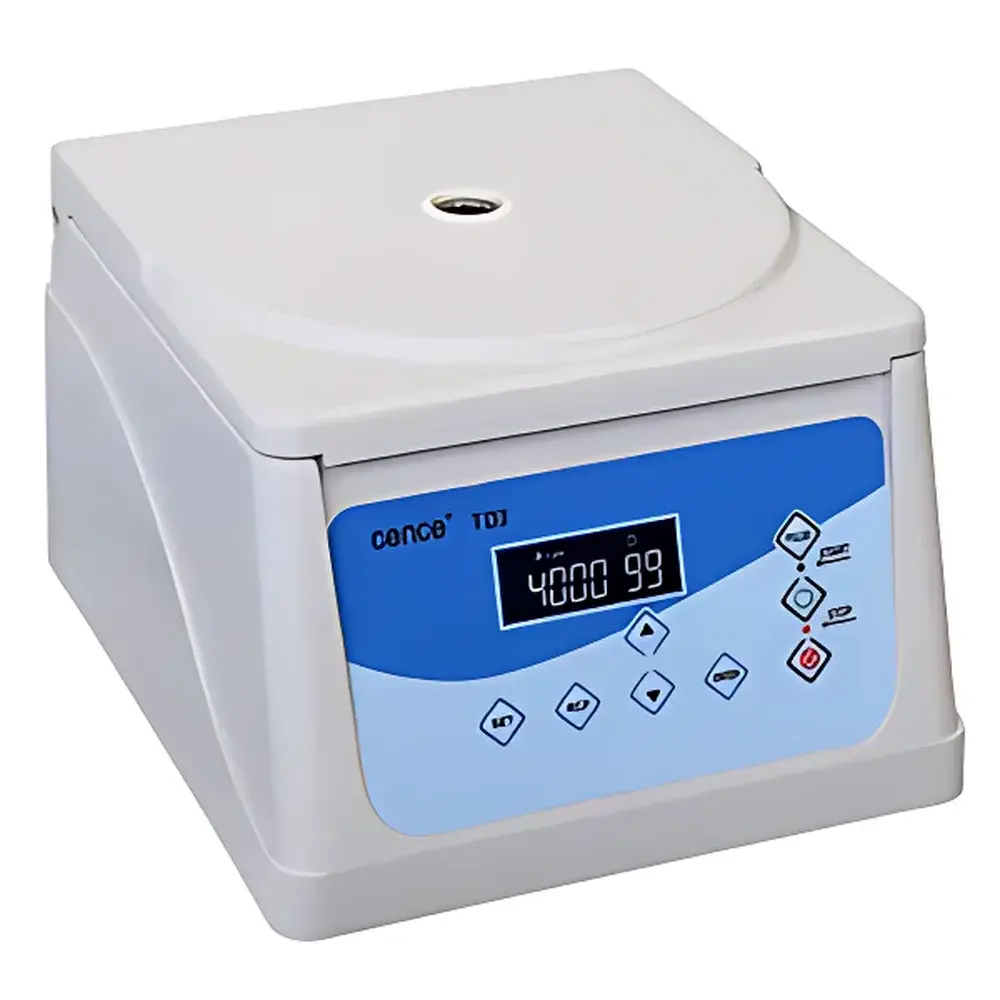
Xiangyi TD3(800B) Low-Speed Benchtop Centrifuge
| Brand | Xiangyi |
|---|---|
| Origin | Hunan, China |
| Manufacturer Type | Direct Manufacturer |
| Product Category | Domestic |
| Model | TD3(800B) |
| Instrument Type | Benchtop Centrifuge |
| Speed Range | Up to 4000 rpm |
| Max RCF | 1980 × g |
| Max Capacity | 8 × 15 mL |
| Rotor Type | Fixed-Angle Rotor |
| Speed Accuracy | ±30 rpm |
| Timer Range | 1–99 min |
| Noise Level | <62 dB(A) |
| Power Supply | AC 220 V ±22 V, 50/60 Hz, 2 A |
| Power Consumption | 100 W |
| Dimensions (L×W×H) | 265 × 305 × 205 mm |
| Net Weight | 7.5 kg |
Overview
The Xiangyi TD3(800B) is a microprocessor-controlled, low-speed benchtop centrifuge engineered for routine sample separation in clinical, academic, and quality control laboratories. It operates on a brushless DC motor drive system, delivering consistent rotational stability, minimal mechanical wear, and ultra-quiet operation—critical for shared lab environments where acoustic comfort and long-term reliability are essential. Unlike high-speed or ultracentrifuge platforms, the TD3(800B) is optimized for gentle sedimentation of cells, precipitates, and particulates in tubes up to 15 mL, with a maximum speed of 4000 rpm and a corresponding relative centrifugal force (RCF) of 1980 × g. Its compact footprint (265 × 305 × 205 mm) and lightweight design (7.5 kg) enable flexible placement on standard lab benches without requiring dedicated floor space or vibration-dampening mounts.
Key Features
- Brushless DC motor technology ensures extended service life, zero carbon brush maintenance, and precise speed regulation across the full operational range (0–4000 rpm).
- Real-time parameter adjustment: Users may modify speed, time, or acceleration/deceleration profiles during active runs—no need to interrupt or restart protocols.
- Intelligent safety architecture includes automatic lid interlock detection, overspeed monitoring, rotor imbalance sensing, and immediate deceleration upon detection of rotational anomalies (e.g., sudden speed loss or phase deviation).
- Dynamic countdown display: When remaining time falls below 60 seconds, the timer switches automatically from minute-based to second-based resolution for improved procedural accuracy.
- Low-noise operation (<62 dB[A]) achieved through balanced rotor housing, optimized airflow ducting, and vibration-absorbing chassis design—compliant with ISO 15703:2019 laboratory noise guidelines.
- Energy-efficient operation (100 W nominal power draw) aligns with IEC 60335-2-41 safety standards for household and similar electrical appliances used in professional settings.
Sample Compatibility & Compliance
The TD3(800B) accepts standard conical-bottom polypropylene or glass centrifuge tubes (15 mL capacity), secured in its fixed-angle rotor (Part No. 809010). This rotor supports eight positions with a 45° tilt angle, ensuring efficient pelleting while minimizing tube deformation under load. The instrument meets GB/T 13991–2021 (Chinese national standard for centrifuges), and its electrical safety design conforms to IEC 61010-1:2010 (Safety Requirements for Electrical Equipment for Measurement, Control, and Laboratory Use). While not certified for GLP/GMP production environments, its robust construction, traceable calibration points, and fault-logging capability support documentation requirements for ISO/IEC 17025-accredited testing labs performing routine sample preparation prior to downstream analysis (e.g., HPLC, ELISA, or spectrophotometry).
Software & Data Management
The TD3(800B) features an embedded microcontroller-based interface with LED digital display and tactile membrane keypad—designed for intuitive, glove-compatible operation without reliance on external PCs or proprietary software. All operational parameters (set speed, elapsed time, error codes) are retained in non-volatile memory and accessible via diagnostic mode. Though it lacks USB or Ethernet connectivity, its timer accuracy (±30 rpm speed tolerance, ±1% time deviation over full 99-min range) enables reproducible protocol execution suitable for SOP-driven workflows. For labs requiring electronic records, manual entry into LIMS or ELN systems is supported by printed log sheets generated per run using optional external thermal label printers (not included).
Applications
- Clinical specimen processing: Separation of serum, plasma, or urine sediments from whole blood or biological fluids.
- Cell culture harvest: Pellet recovery of adherent or suspension mammalian cells at sub-lytic g-forces.
- Environmental sample prep: Clarification of water extracts, soil leachates, or microbial suspensions prior to filtration or analysis.
- Pharmaceutical QC: Routine centrifugation of excipient blends, suspension formulations, or dissolution media samples.
- Educational use: Demonstrating sedimentation kinetics, density gradient principles, and rotor dynamics in undergraduate biophysics or analytical chemistry labs.
FAQ
Is the TD3(800B) compatible with swing-bucket rotors?
No—this model is configured exclusively for the fixed-angle rotor (809010, 8 × 15 mL). Swinging bucket configurations are not supported due to mechanical and control architecture constraints.
Does the centrifuge support programmable ramp rates?
Yes—acceleration and deceleration profiles are pre-set but non-adjustable; the unit employs smooth, linear ramping to minimize sample disturbance during spin-up and coast-down phases.
What maintenance intervals are recommended?
Routine cleaning of the rotor chamber and lid seal is advised after each use. Annual inspection of motor bearings and calibration verification (using certified tachometer) is recommended per GB/T 13991–2021 maintenance guidelines.
Can this centrifuge be used in cold rooms?
Operation is rated for ambient temperatures between 10 °C and 35 °C and relative humidity ≤80% non-condensing. Prolonged use below 15 °C may affect LCD responsiveness and rotor material ductility.
Is rotor balancing mandatory before every run?
Yes—the auto-balance function compensates only for minor mass asymmetry (<±0.5 g per tube); users must still ensure symmetrical tube loading and matched tube weights to prevent excessive vibration or premature bearing wear.



