
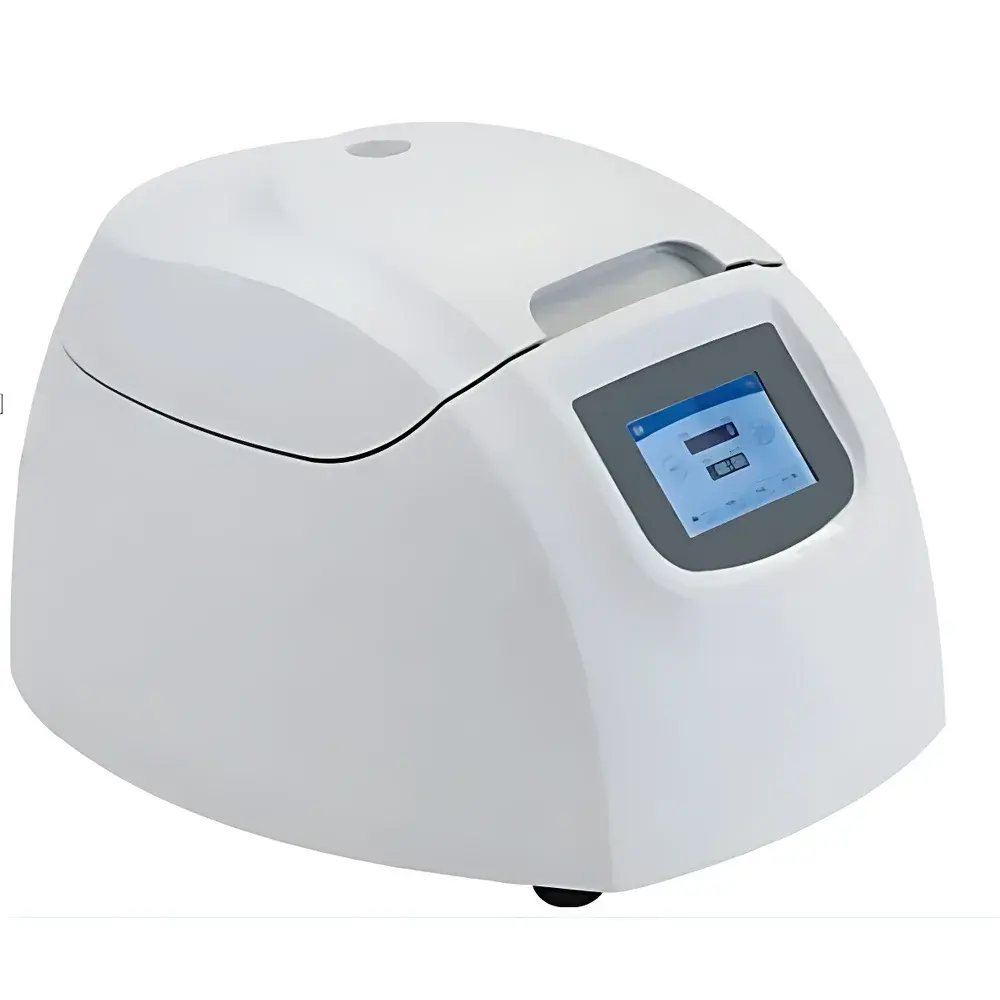
Xiangyi H1650K Benchtop High-Speed Centrifuge
| Brand | Xiangyi |
|---|---|
| Origin | Hunan, China |
| Manufacturer Type | Direct Manufacturer |
| Instrument Type | Benchtop Centrifuge |
| Speed Range | 200–16,500 rpm |
| Max RCF | 18,360 × g |
| Max Capacity | 12 × 5 mL |
| Rotor Compatibility | Fixed-angle rotors (7 models available) |
| Drive System | Brushless DC Motor |
| Control Interface | 3.5-inch high-sensitivity capacitive touchscreen |
| Programmability | Up to 50 user-defined protocols with custom naming |
| Acceleration/Deceleration | 10 acceleration steps, 11 deceleration steps |
| Safety Features | Electronic lid lock, automatic rotor recognition (optional), overspeed protection, imbalance detection, door interlock |
| Dimensions (W×D×H) | 320 × 370 × 235 mm |
| Compliance | Designed per IEC 61010-1:2010 for laboratory electrical safety |
| Application Class | Biomolecular separation (nucleic acids, proteins, organelles) |
Overview
The Xiangyi H1650K Benchtop High-Speed Centrifuge is an engineered solution for routine and advanced biomolecular separation tasks in academic, clinical, and industrial laboratories. Operating on the principle of sedimentation under controlled centrifugal force, the H1650K delivers precise, reproducible separations of subcellular components—including plasmids, genomic DNA, ribosomes, and membrane vesicles—through optimized rotor dynamics and thermal management. With a maximum rotational speed of 16,500 rpm and a peak relative centrifugal force (RCF) of 18,360 × g, it bridges the performance gap between standard benchtop units and floor-standing ultracentrifuges, enabling high-resolution pelleting without requiring vacuum or refrigeration systems. Its compact footprint (320 × 370 × 235 mm) allows seamless integration into biosafety cabinets, cold rooms, or shared instrumentation benches—critical for labs with spatial constraints yet demanding rigorous sample integrity.
Key Features
- Brushless DC motor architecture ensures zero carbon dust generation, eliminating contamination risk in sensitive molecular workflows and extending service intervals beyond 15,000 operating hours.
- Capacitive 3.5-inch touchscreen interface supports intuitive parameter entry, real-time dual-display of setpoints and actual values (rpm, RCF, time, temperature if equipped), and haptic feedback for gloved operation.
- Programmable protocol storage accommodates up to 50 user-defined methods, each assignable with alphanumeric identifiers (e.g., “DNA_Pellet_4°C”) to support GLP-compliant documentation and audit-ready repeatability.
- Graduated acceleration (10 steps) and deceleration (11 steps) profiles minimize shear-induced resuspension of dense pellets—particularly critical for RNA isolation and mitochondrial fractionation where gradient integrity must be preserved.
- Integrated electronic lid lock enforces mechanical interlock: the drive system remains inert unless the lid is fully seated and latched, preventing accidental activation during rotor loading or maintenance.
- One-piece molded chassis enhances structural rigidity, reduces vibration transmission, and facilitates cleaning—meeting ISO 13485-aligned cleanability requirements for regulated QC environments.
Sample Compatibility & Compliance
The H1650K is validated for use with standard polypropylene and polycarbonate conical tubes (0.2–5 mL), including certified low-binding formats for nucleic acid work. It supports seven interchangeable fixed-angle rotors (sold separately), all dynamically balanced to ISO 1940–1 G2.5 grade. While the base unit operates at ambient temperature, optional rotor-specific calibration certificates are available to verify angular velocity accuracy per ISO 21501-4. The device conforms to IEC 61010-1:2010 for electrical safety in laboratory equipment and includes CE marking for EU markets. Though not refrigerated, its thermal design limits housing surface temperature rise to <12 °C above ambient during continuous 30-minute runs at 16,500 rpm—reducing heat-induced denaturation of thermolabile samples.
Software & Data Management
No proprietary software installation is required; all configuration and operation occur via the embedded touchscreen OS. Protocol data—including timestamped run logs, rotor ID (when RFID-enabled rotors are used), final speed, RCF, duration, and deceleration profile—are stored locally in non-volatile memory for ≥1,000 cycles. Export is supported via USB-A port (FAT32 formatted drive) as CSV files compatible with LIMS platforms (e.g., LabVantage, STARLIMS). Audit trail functionality meets FDA 21 CFR Part 11 foundational requirements for electronic records when paired with institutional access controls and manual signature logging.
Applications
- Purification of plasmid DNA from bacterial lysates using alkaline lysis followed by isopropanol precipitation.
- Isolation of exosomes and microvesicles from cell culture supernatants (3,000 × g pre-clearing → 18,360 × g pelleting).
- Clarification of protein expression lysates prior to affinity chromatography or SDS-PAGE analysis.
- Routine pelleting of PCR products, restriction digests, and labeling reactions for downstream enzymatic processing.
- Separation of hemoglobin variants in clinical hematology screening workflows (e.g., sickle cell trait confirmation).
FAQ
Does the H1650K support refrigerated operation?
No—the H1650K is a non-refrigerated benchtop model. For temperature-sensitive applications, users should pre-chill samples and rotors, and limit run durations to maintain sample integrity.
Are rotor balancing requirements specified in the manual?
Yes—symmetrical loading is mandatory for all fixed-angle rotors. The manual specifies ±0.1 g mass tolerance between opposing tubes and provides torque specifications for rotor nut tightening (25–30 N·m).
Can third-party rotors be used with this centrifuge?
Xiangyi does not validate or warranty performance with non-OEM rotors. Use of unauthorized rotors voids safety certifications and may trigger automatic shutdown due to unrecognized mass/inertia profiles.
What maintenance schedule is recommended?
Visual inspection of lid seal and rotor threads every 50 runs; full rotor calibration and bearing assessment annually or after 1,000 operating hours—whichever occurs first.
Is remote monitoring or network connectivity supported?
No Ethernet or Wi-Fi interfaces are included. Remote status verification requires physical access or integration via external environmental sensors (e.g., digital RPM loggers connected to lab networks).



