
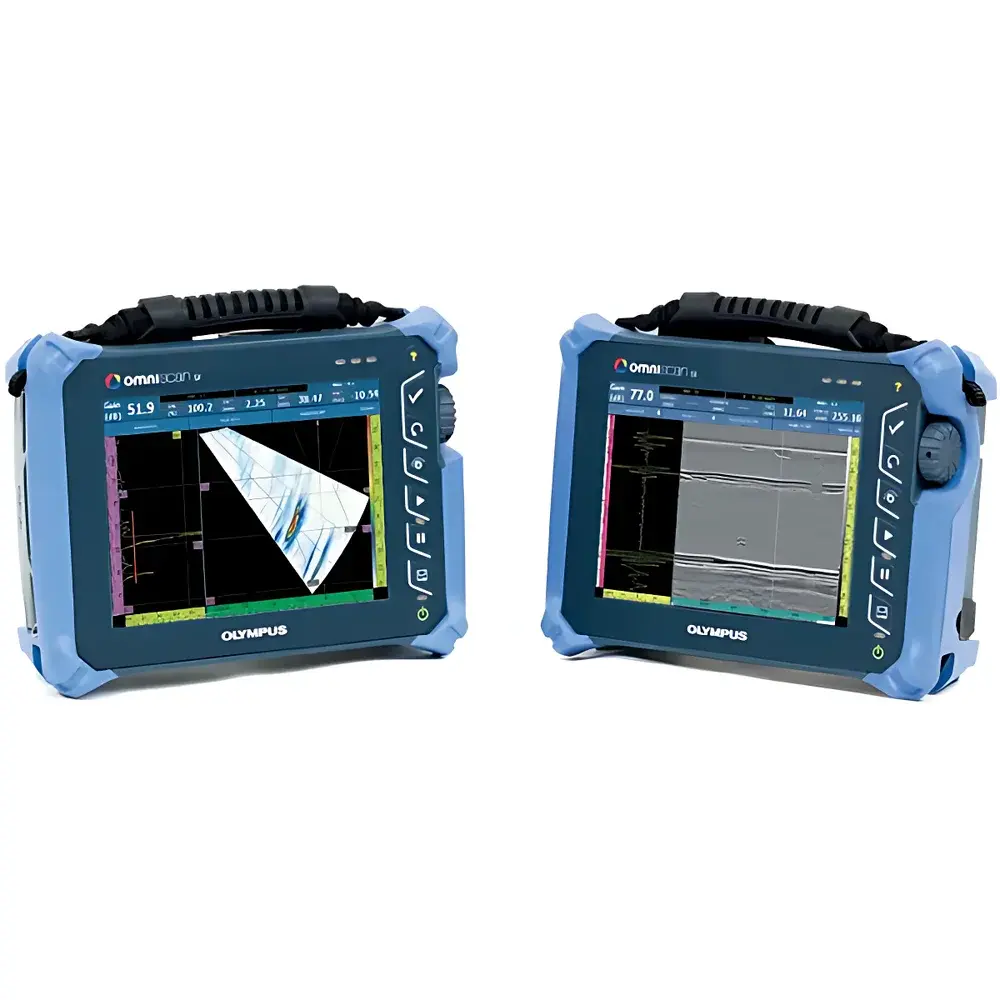
Olympus OmniScan SX Phased Array Ultrasonic Flaw Detector
| Brand | Olympus |
|---|---|
| Origin | USA |
| Model | OmniScan SX |
| Form Factor | Integrated Single-Channel PA/UT Instrument |
| Phased Array Configuration | 16:64 PR |
| UT Channels | 1 (Pulse-Echo, Pitch-Catch, TOFD) |
| Display | 8.4-inch Capacitive Touchscreen |
| Weight | ~3.2 kg (33% lighter than OmniScan MX2) |
| Dimensions | 270 × 195 × 105 mm (50% smaller volume than MX2) |
| Compliance | ASTM E2700, ISO 16810, ISO 2400, EN 12668-1, ASME BPVC Section V, API RP 2X, AWS D1.1/D1.5 |
Overview
The Olympus OmniScan SX is a compact, integrated phased array ultrasonic testing (PAUT) and conventional ultrasonic testing (UT) instrument engineered for field-deployable, high-reliability non-destructive evaluation of welds, corrosion zones, composites, and structural components. Operating on the principle of beam steering and dynamic focusing via time-delayed excitation of piezoelectric element arrays, the OmniScan SX implements full matrix capture (FMC)-compatible acquisition architecture with real-time sectorial and linear scan imaging. Its 16:64 PR (Pulse-Receive) configuration enables simultaneous activation of up to 16 elements for transmission while receiving on all 64 elements—supporting both synthetic aperture focusing technique (SAFT) and time-of-flight diffraction (TOFD) mode acquisition without hardware reconfiguration. Designed explicitly for applications where portability, operational simplicity, and regulatory traceability are critical—including pipeline girth weld inspection, pressure vessel integrity assessment, and aerospace composite screening—the OmniScan SX delivers deterministic ultrasonic data acquisition in accordance with ISO 16810 and ASTM E2700 requirements for equipment performance validation.
Key Features
- Integrated 8.4-inch capacitive touchscreen interface with optimized OmniScan software v5.x, supporting intuitive gesture-based navigation and context-sensitive toolbars for rapid setup of PA, TOFD, and conventional UT configurations.
- Single-unit architecture with no modular expansion required—eliminates inter-module synchronization latency and reduces calibration drift risk inherent in multi-chassis systems.
- Dual-mode operation: native support for pulse-echo, pitch-catch, and TOFD in the same acquisition session; seamless switching between angle-beam phased array scans and normal-incidence zero-degree inspections.
- Onboard encoder interface for dual-axis positional tracking (e.g., wheel encoders or linear slides), enabling fully synchronized C-scan generation and automated defect mapping aligned to physical coordinates.
- Ruggedized magnesium alloy chassis rated IP65 for dust and water resistance; operating temperature range: –10 °C to 50 °C; battery life ≥ 2.5 hours under continuous PA scanning at 60 Hz PRF.
- Firmware-level compliance with FDA 21 CFR Part 11 audit trail requirements—automatic logging of user actions, parameter changes, and report generation timestamps with digital signature support.
Sample Compatibility & Compliance
The OmniScan SX accommodates standard NDT transducer families including PA wedges (0°–70°), TOFD dual-element probes (2.25–10 MHz), and conventional single-element contact/delay-line transducers (1–15 MHz). It supports immersion and surface-contact configurations for ferrous and non-ferrous alloys, austenitic stainless steels, carbon fiber reinforced polymers (CFRP), and cladded piping systems. All measurement workflows adhere to ASME BPVC Section V Article 4 (PAUT), Article 5 (TOFD), and ISO 13588 for automated weld inspection. Data files conform to ASTM E3177-compliant .udx binary format, ensuring interoperability with third-party analysis platforms such as CIVA, GAGE, and R/D Tech’s UltraVision. Instrument calibration verification follows EN 12668-1 procedures using IIW Type II reference blocks and notched aluminum step wedges.
Software & Data Management
OmniScan Software v5.x provides embedded A-scan, S-scan, C-scan, and B-scan visualization with real-time gain compensation, gate-based amplitude thresholding, and depth-encoded color mapping. All acquired datasets include embedded metadata: probe ID, wedge delay, sound path correction factors, and encoded positional offsets. Reports export in PDF/A-1b and XML formats compliant with ISO/IEC 19794-5 for biometric data interchange—adapted here for NDT traceability. Audit logs record every parameter modification, file export, and user login event with SHA-256 hashing. Data encryption at rest uses AES-256; network transfers (when connected via Wi-Fi or Ethernet) enforce TLS 1.2+ handshake protocols. Optional integration with Olympus’ NDT Workbench enables centralized fleet management, firmware version control, and automated compliance reporting for ISO 9001 and AS9100 quality audits.
Applications
- Weld Inspection: Manual and semi-automated PAUT/TOFD assessment of circumferential and longitudinal welds per API 1104 and ASME B31.4/B31.8, including root pass characterization and lack-of-fusion detection in thick-section pipe joints.
- Corrosion Monitoring: High-resolution thickness mapping of tank floors, vessel shells, and offshore risers using zero-degree PA imaging—capable of resolving localized wall loss <0.2 mm with ±0.05 mm repeatability over 50 mm depth range.
- Composite Evaluation: Detection of disbonds, porosity, and delamination in CFRP laminates and honeycomb structures via through-transmission and pitch-catch modes at frequencies up to 7.5 MHz.
- Component Screening: In-service inspection of turbine blades, valve bodies, and pump casings using custom-coded focal laws optimized for complex geometries and variable acoustic impedance interfaces.
- Regulatory Documentation: Generation of ASNT Level II-certified inspection records meeting NRC Regulatory Guide 1.190 and EPRI TR-102302 requirements for nuclear component qualification.
FAQ
Does the OmniScan SX support full matrix capture (FMC) and total focusing method (TFM) processing?
No—the OmniScan SX does not perform onboard TFM reconstruction. It acquires raw channel data compatible with FMC workflows but requires post-processing on external workstations using Olympus’ ProSim or third-party TFM engines.
Can the SX PA model perform TOFD without an additional UT module?
Yes—both SX PA and SX UT variants include one dedicated UT channel configured for TOFD acquisition, requiring only dual-element probes and appropriate wedge alignment.
Is encoder-based C-scan stitching supported in real time?
Yes—dual-axis encoder input enables live C-scan generation during scanning, with automatic image registration and pixel-per-mm scaling based on calibrated encoder resolution.
What standards govern its calibration validity period?
Per ISO 12713 and ASTM E1316, system calibration must be verified prior to each shift and after any hardware change; annual traceable calibration by an ISO/IEC 17025-accredited laboratory is recommended.
How is data integrity ensured during wireless transfer to a secure server?
All Wi-Fi/Ethernet transfers use certificate-pinned TLS 1.2+ connections; file integrity is validated via embedded CRC-32 checksums and SHA-256 hash comparison upon receipt.



