
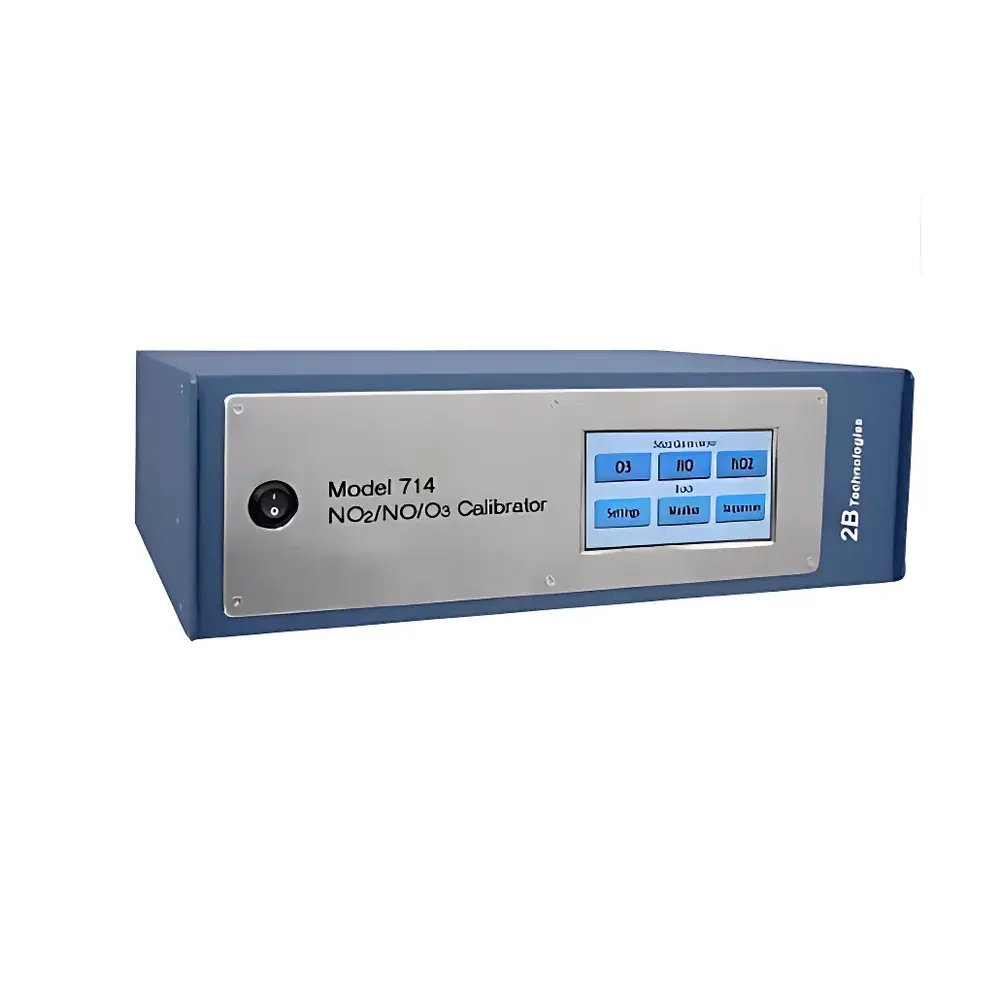
2B Technologies Model 714 NO₂/NO/O₃ Calibration Source
| Brand | 2B Technologies |
|---|---|
| Origin | USA |
| Model | Model 714 |
| NO₂ Range | 0–500 ppb |
| NO Range | 0–1000 ppb |
| O₃ Range | 0–500 ppb |
| Output Flow | 2.0–3.5 L/min (typ. 2.5–3.0 L/min) |
| Accuracy | ±2.0 ppb or ±2.0% of reading (whichever is greater) |
| Response Time to 95% of target concentration | <30 s |
| Power | 12 V DC / 120–240 V AC, 18 W (operational), 42 Wh (max during warm-up) |
| Dimensions (Rack-mount) | 43 cm × 37 cm × 14 cm (17″ × 14.5″ × 5.5″) |
| Weight | 7.0 kg (15.5 lb) |
| Programmable Sequences | Up to 99 stored methods, each with up to 15 steps (NO: up to 1000 ppb |
| NO₂/O₃ | up to 500 ppb) |
| Operating Temp | 0–40 °C |
| Storage Temp | −20–60 °C |
| RH | 0–80% non-condensing |
| Altitude | 0–2000 m |
Overview
The 2B Technologies Model 714 NO₂/NO/O₃ Calibration Source is a NIST-traceable, portable transfer standard engineered for field and laboratory calibration of ambient air monitoring instruments measuring nitrogen dioxide (NO₂), nitric oxide (NO), and ozone (O₃). Unlike conventional calibration systems requiring high-pressure gas cylinders, the Model 714 generates certified concentrations on-demand using photolytic synthesis—eliminating reliance on unstable NO reference gases and enabling direct metrological traceability to the NIST ozone photometer standard. Its core operation relies on vacuum ultraviolet (VUV) photolysis at 185 nm: molecular oxygen (O₂) is photolyzed in a dry, purified air stream to produce O₃; nitrous oxide (N₂O) is similarly photolyzed to yield NO via excited atomic oxygen intermediates; and NO₂ is generated stoichiometrically through gas-phase titration (GPT) of O₃ with excess NO (NO + O₃ → NO₂ + O₂). This fundamental chemical equivalence ensures that NO₂ output concentration equals the input O₃ concentration—providing inherent accuracy without secondary calibration artifacts. Designed for compatibility with U.S. EPA Federal Equivalent Method (FEM) analyzers—including 2B’s own 405 nm NO₂/NO/NOₓ monitors—the Model 714 meets rigorous requirements for regulatory compliance, method validation, and quality assurance in ambient air networks.
Key Features
- Triple-gas capability: Simultaneous or independent generation of NO, NO₂, and O₃ from a single rack-mount instrument (17″ W × 14.5″ D × 5.5″ H).
- NIST-traceable output: All three gases calibrated against primary ozone photometry standards—removing uncertainty associated with NO cylinder stability and aging.
- Zero-cylinder design: Uses disposable, food-grade N₂O cartridges (8 g or 16 g, e.g., Whip-It®-type) instead of pressurized NO cylinders—enhancing portability, safety, and operational simplicity.
- Low-power architecture: Draws only ~18 W during operation (42 Wh peak at startup); supports both 12 V DC (field battery operation) and universal 120–240 V AC input.
- Intuitive touchscreen interface: Full-color LCD with menu-driven programming for calibration sequences, real-time diagnostics, and system status monitoring.
- Programmable multi-step protocols: Stores up to 99 user-defined methods, each supporting up to 15 concentration steps (NO: 0–1000 ppb; NO₂/O₃: 0–500 ppb); individual steps repeatable up to 99 times.
- Rapid dynamic response: Achieves ≥95% of target concentration within <30 seconds—critical for automated multi-point calibrations and drift verification.
- Integrated drying: On-board desiccant dryer reduces humidity impact on O₃ photolysis efficiency, improving reproducibility across variable ambient conditions.
Sample Compatibility & Compliance
The Model 714 is compatible with all common chemiluminescence (CLD), UV absorption (e.g., 405 nm differential optical absorption spectroscopy), and electrochemical NOₓ/O₃ analyzers used in regulatory monitoring networks. Its output flow (2.0–3.5 L/min) interfaces seamlessly with standard 1/4″ PTFE or stainless-steel calibration manifolds. The instrument complies with U.S. EPA requirements for calibration transfer standards under 40 CFR Part 53 and Part 58, and supports adherence to ISO 13964 (ambient air—determination of NO and NO₂) and ISO 13963 (ambient air—determination of ozone). All factory calibrations are documented with NIST-traceable certificates, including uncertainty budgets per ISO/IEC 17025 guidelines. Data integrity is maintained through internal audit logging (time-stamped event records), and optional USB export enables integration into GLP/GMP-compliant QA/QC workflows. While not inherently 21 CFR Part 11 compliant, its deterministic photolytic generation principle and immutable sequence storage support robust electronic record practices when deployed with validated IT infrastructure.
Software & Data Management
The Model 714 operates autonomously via embedded firmware—no external PC required for routine calibration. All sequence definitions, calibration history, lamp intensity logs, and diagnostic flags are stored in non-volatile memory. A USB port enables firmware updates and export of calibration logs (CSV format) for traceability and audit preparation. The included USB drive contains full operator documentation, NIST-traceable calibration reports, and instrument certification data. For networked environments, users may integrate output signals (analog 0–5 V or 4–20 mA optional) into SCADA or LIMS platforms for automated calibration scheduling and result archiving. Internal temperature, pressure, and flow compensation algorithms ensure consistent output across environmental gradients—minimizing need for site-specific recalibration.
Applications
- Ambient air quality monitoring: Primary calibration source for state/local air agencies operating EPA FEM-certified NO₂, NO, and O₃ analyzers.
- Method validation & performance audits: Supporting EPA Performance Evaluation (PE) studies and third-party verification under Appendix A to 40 CFR Part 53.
- Research laboratories: Generating precisely defined, interference-free gas mixtures for kinetic studies, sensor development, and intercomparison campaigns.
- Mobile monitoring platforms: Enabling on-vehicle calibration of compact NOₓ/O₃ sensors without high-pressure gas logistics.
- Calibration service providers: Serving as a transportable reference standard for field verification of commercial gas analyzers across multi-site deployments.
- QA/QC programs: Facilitating daily zero/span checks, multi-point linearity verification, and long-term stability trending per ISO 5725 and ASTM D6789.
FAQ
How is NIST traceability established for NO and NO₂ when only O₃ is directly measured by photometry?
NO₂ concentration is derived stoichiometrically from the photometrically measured O₃ input via gas-phase titration (NO + O₃ → NO₂ + O₂). NO is generated from N₂O photolysis—a process whose quantum yield is well-characterized and stable. Thus, both NO and NO₂ outputs inherit traceability from the primary O₃ standard.
Can the Model 714 be used for span calibration of commercial analyzers?
Yes. Its programmable output supports fixed-concentration spans (e.g., 200 ppb O₃), multi-level ramps, and repetitive cycling—all configurable via touchscreen without external software.
What maintenance is required?
Lamp replacement every 12–18 months (typical), desiccant dryer cartridge every 6 months (or per humidity exposure), and periodic verification of N₂O cartridge seal integrity. No consumables beyond lamps and desiccant.
Is remote control possible?
The instrument does not include Ethernet or Wi-Fi, but analog voltage outputs and RS-232 serial interface (optional) enable integration with programmable logic controllers (PLCs) or custom automation scripts.
Does it meet EPA requirements for RATA (Relative Accuracy Test Audit)?
When operated per manufacturer specifications and supported by current NIST-traceable calibration documentation, the Model 714 satisfies EPA guidance for use as a calibration transfer standard in RATA protocols under 40 CFR Part 60, Appendix B.
Related Products







