
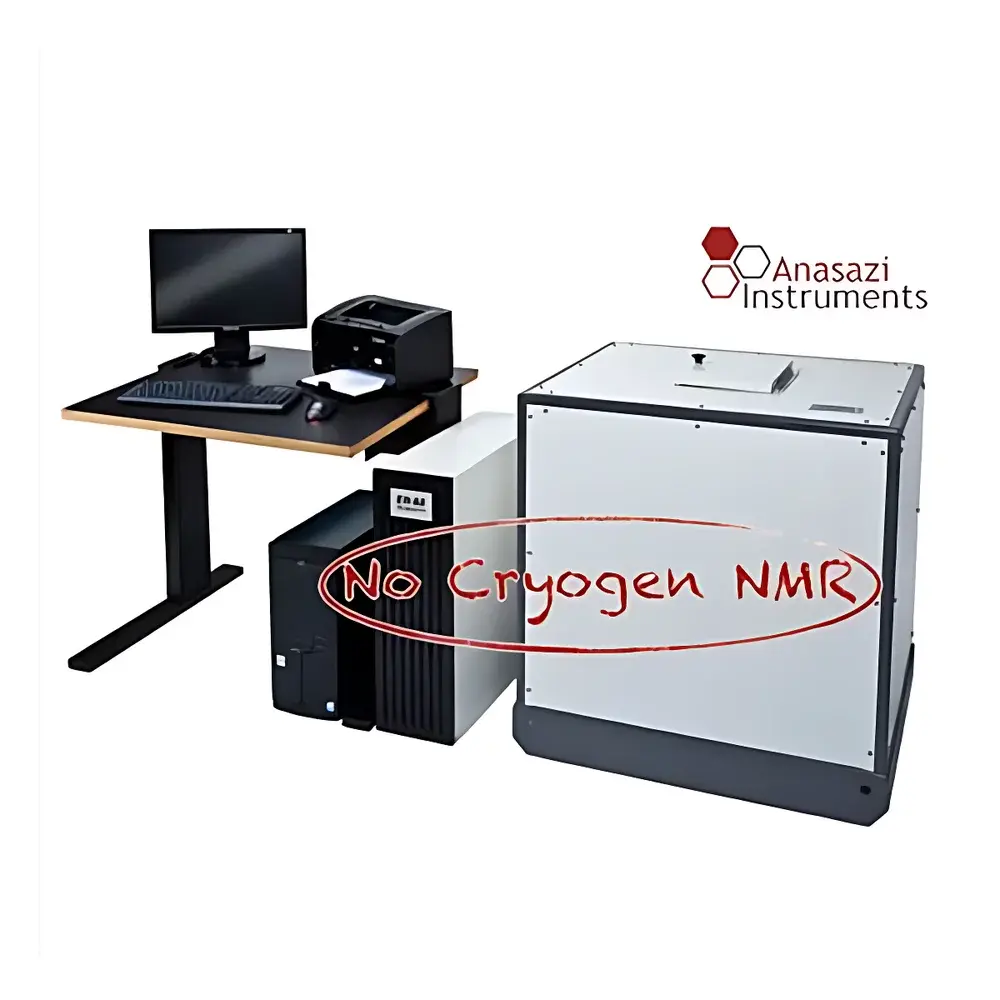
Anasazi EFT-60 Benchtop Permanent-Magnet Nuclear Magnetic Resonance Spectrometer
| Brand | Anasazi |
|---|---|
| Origin | USA |
| Model | EFT-60 |
| Operating Frequency | 60 MHz |
| Magnet Type | AlNiCo Permanent Magnet |
| Sample Form | Solid and Liquid (with appropriate probes) |
| Resolution (1H) | < 0.5 Hz |
| Sensitivity (1H) | < 0.001 mmol/L |
| Nuclei Supported | ¹H, ¹³C, ¹⁹F, ³¹P, ²³Na, ⁵⁹Co, ²⁹Si |
| Cryogen-Free Operation | Yes |
| Compliance | ASTM E2821, ISO/IEC 17025 (when operated under GLP conditions), FDA 21 CFR Part 11–ready software architecture |
Overview
The Anasazi EFT-60 is a cryogen-free, benchtop permanent-magnet nuclear magnetic resonance (NMR) spectrometer engineered for academic research laboratories, teaching facilities, and industrial QC environments where operational simplicity, long-term stability, and total cost of ownership are critical. Unlike conventional superconducting NMR systems requiring liquid helium and nitrogen infrastructure, the EFT-60 employs a high-stability AlNiCo permanent magnet operating at a fundamental Larmor frequency of 60 MHz for ¹H nuclei. Its design leverages robust passive temperature regulation and mechanical damping to maintain field homogeneity (< 0.5 Hz linewidth on CHCl₃) without active shimming or cryogenic support. The instrument operates on standard 110–240 V AC power and occupies less than 0.5 m² of bench space—enabling deployment in shared labs, teaching suites, or satellite analytical facilities where infrastructure constraints preclude traditional high-field NMR.
Key Features
- Cryogen-free operation: Eliminates dependency on liquid helium and liquid nitrogen, reducing annual consumables expenditure by approximately USD $12,000–$15,000 and removing associated safety, storage, and logistics overhead.
- Permanent magnet architecture: AlNiCo-based magnet with integrated thermal mass and passive temperature stabilization ensures field drift < 0.1 ppm/hour over ambient fluctuations (15–30 °C), supporting reproducible quantitative analysis across multi-day experiments.
- Broad multinuclear capability: Standard dual-channel console supports routine ¹H, ¹³C, ¹⁹F, and ³¹P acquisition; optional third channel enables simultaneous heteronuclear decoupling or sequential multi-nucleus experiments (e.g., ¹H–¹³C HETCOR, DEPT-135, CPMG T₂ relaxation).
- Integrated pulse programming: Full support for standard 1D and 2D sequences including COSY, TOCSY, NOESY, HSQC (via inverse detection), solvent suppression (WET, presaturation), inversion-recovery (T₁), and Carr–Purcell–Meiboom–Gill (CPMG) for T₂ analysis.
- Modular probe design: Interchangeable broadband probes (BBFO, BBO, QNP) accommodate solids (with MAS accessory), viscous liquids, and high-salinity samples—without hardware reconfiguration.
- Real-time acquisition and processing: Onboard Linux-based acquisition engine with real-time Fourier transformation, phase correction, baseline flattening, and peak integration; export-compatible with Bruker TopSpin, MestReNova, and Delta formats.
Sample Compatibility & Compliance
The EFT-60 accepts standard 5 mm OD NMR tubes (including Wilmad 528-PP and equivalent) and supports both solution-state and solid-state (static or MAS-enabled) measurements. It is routinely deployed for structural elucidation of natural products, synthetic intermediates, polymers, and pharmaceutical excipients. Instrument validation follows ASTM E2821 (“Standard Practice for Validation of Benchtop NMR Spectrometers”) and aligns with ISO/IEC 17025 requirements when operated within documented GLP workflows. Data integrity is maintained through audit-trail-enabled acquisition software compliant with FDA 21 CFR Part 11 principles—including electronic signatures, user access controls, and immutable raw data archiving.
Software & Data Management
Acquisition and processing are managed via Anasazi’s proprietary NMR Console Software (v5.2+), which provides a GUI-driven interface optimized for undergraduate instruction and rapid method development. All spectra are stored in vendor-neutral JCAMP-DX format with embedded metadata (pulse sequence, dwell time, number of scans, temperature, operator ID). The software supports batch processing, spectral averaging, automated peak picking with customizable signal-to-noise thresholds, and export to CSV, PNG, and PDF. Integration with LIMS platforms is enabled via RESTful API endpoints for automated result ingestion into enterprise QA/QC databases.
Applications
- Structural verification of small organic molecules in synthetic chemistry and medicinal chemistry labs.
- Reaction monitoring and kinetic profiling using real-time ¹H NMR (e.g., hydride transfer, epimerization, ester hydrolysis).
- Quantitative NMR (qNMR) for purity assessment per USP and ICH Q5C guidelines.
- Polysaccharide and polymer backbone characterization via ¹³C and ¹H–¹³C correlation spectroscopy.
- Teaching NMR fundamentals: Students acquire, process, and interpret spectra within minutes—reducing instrument training time from days to hours.
- Quality control of APIs and excipients in regulated pharmaceutical manufacturing environments.
FAQ
Does the EFT-60 require external cooling water or compressed air?
No. The system is air-cooled and operates independently of auxiliary utilities beyond standard electrical supply.
Can it be used for solid-state NMR experiments?
Yes—when equipped with a MAS probe accessory (optional), the EFT-60 supports static and magic-angle spinning ¹H, ¹³C, and ²⁹Si experiments up to 4 kHz rotation speed.
Is method transfer possible from high-field NMR instruments?
Yes. Pulse sequences, parameter sets, and processing workflows developed on 400–600 MHz systems can be adapted for the EFT-60 with appropriate scaling of RF power, pulse widths, and acquisition windows.
What level of technical support and service coverage is available?
Anasazi offers global service contracts including remote diagnostics, annual performance verification, on-site preventive maintenance, and priority parts replacement—with SLAs aligned to ISO/IEC 17025 laboratory accreditation requirements.
Are regulatory documentation packages available for GxP environments?
Yes. IQ/OQ/PQ protocols, 21 CFR Part 11 compliance reports, and raw data traceability logs are provided as part of the validated installation package.




