
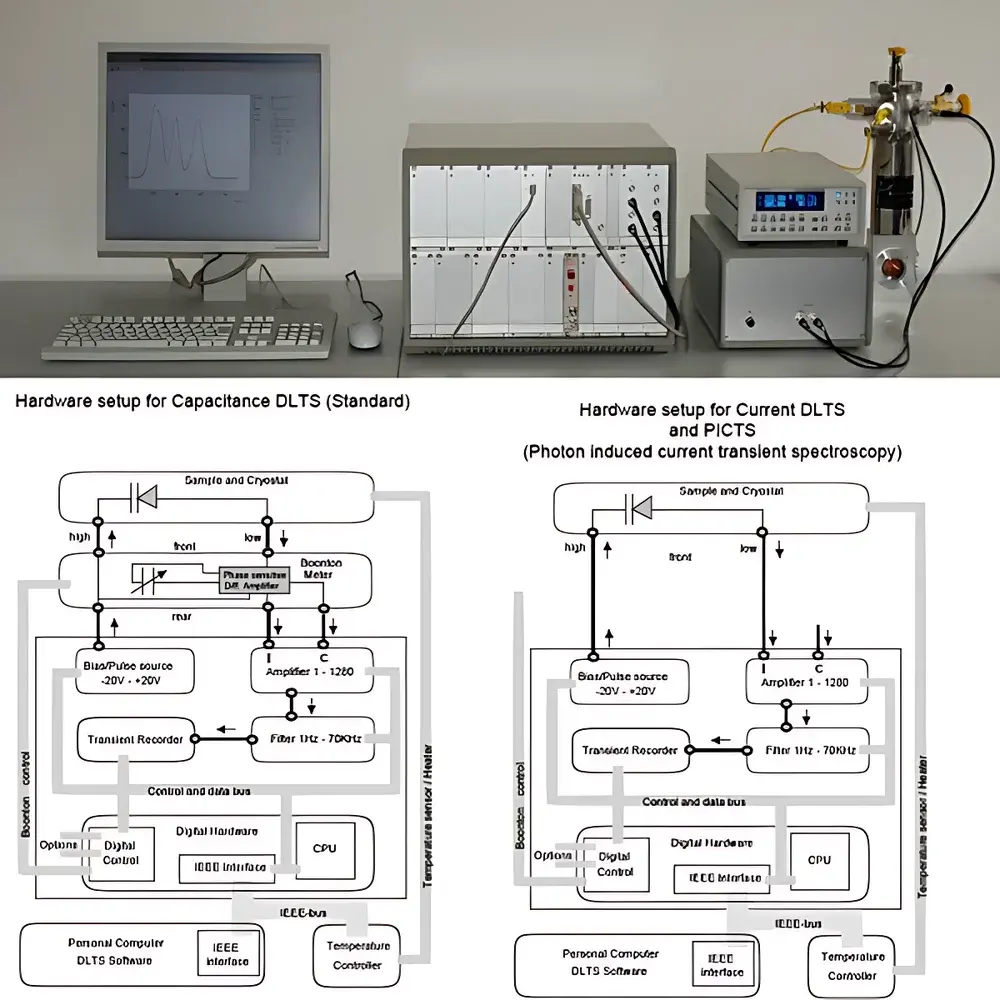
PhysTech FT1030 Deep-Level Transient Spectroscopy (DLTS) System
| Brand | PhysTech |
|---|---|
| Origin | Germany |
| Model | FT1030 |
| Instrument Type | Deep-Level Transient Spectroscopy System |
| Operating Modes | C-DLTS, CC-DLTS, I-DLTS, DD-DLTS, Zerbst-DLTS, O-DLTS, FET-Analysis, MOS-Analysis, ITS, PITS, TSC/TSCAP, DLOS, C/V(T), I/V(T), Richardson Plot, Capture Cross-Section Analysis |
| Key Software Features | 28 simultaneous correlation functions per temperature scan, Fourier-DLTS (F-DLTS), Laplace-DLTS, multi-exponential transient fitting, isothermal transient spectroscopy (ITS), signal overlap deconvolution (temperature-scan & isothermal), automatic contact check, real-time capacitance compensation, three-terminal FET current transient acquisition |
| Cooling Compatibility | Liquid nitrogen, closed-cycle cryocoolers, and programmable temperature controllers (4 K – 500 K typical range) |
| Compliance | Designed for GLP/GMP-aligned semiconductor defect characterization workflows |
Overview
The PhysTech FT1030 Deep-Level Transient Spectroscopy (DLTS) System is a high-precision, research-grade instrument engineered for quantitative identification and energy-resolved profiling of electrically active defects in semiconductor materials and devices. Based on the fundamental principle of thermal emission kinetics—where deep-level traps release carriers upon controlled temperature ramping—the FT1030 captures transient capacitance or current responses following repetitive pulsing of the device under test. Its architecture implements true digital transient acquisition synchronized with high-stability temperature control, enabling measurement of trap activation energies (EC – ET) with sub-meV resolution and capture cross-sections (σ) across eight orders of magnitude. Introduced in 1990 as the first fully digital DLTS platform, the FT1030 has evolved through successive hardware and algorithmic refinements to support both classical single-trap analysis and advanced multi-trap deconvolution strategies—including Laplace-transform inversion and multi-exponential least-squares fitting—without reliance on analog lock-in amplifiers or manual peak tracking.
Key Features
- Digital transient acquisition with 16-bit resolution and up to 1 MS/s sampling rate, ensuring high-fidelity capture of fast emission transients (ns–s range)
- Modular hardware architecture supporting C-DLTS, I-DLTS, CC-DLTS, DD-DLTS, Zerbst-DLTS, and O-DLTS configurations via interchangeable front-end modules
- Integrated three-terminal FET transient measurement capability for direct channel-current analysis in field-effect structures
- Real-time automatic capacitance compensation and contact integrity verification prior to each measurement cycle
- Simultaneous evaluation of up to 28 independent correlation functions during a single temperature scan—enabling parallel extraction of multiple trap parameters without sequential reconfiguration
- Fourier-DLTS (F-DLTS) and Laplace-DLTS processing engines with user-definable windowing, baseline correction, and noise suppression algorithms
- Full support for isothermal transient spectroscopy (ITS), photon-induced transient spectroscopy (PITS), thermally stimulated capacitance (TSCAP), and deep-level optical spectroscopy (DLOS) extensions
Sample Compatibility & Compliance
The FT1030 accommodates standard semiconductor diode structures (p-n, Schottky, MIS, MOS), FETs, HEMTs, and optoelectronic devices (LEDs, photodiodes, solar cells) mounted in vacuum-compatible cryogenic probes. It interfaces seamlessly with commercial cryostats—including liquid nitrogen dewars, closed-cycle refrigerators (4 K–500 K), and resistive heating stages—with PID-controlled temperature stability better than ±0.02 K. All measurement sequences, parameter sets, raw transients, and processed spectra are stored with full metadata (timestamp, operator ID, instrument configuration, calibration history) in a hierarchical HDF5-based file format. When deployed with validated software add-ons, the system meets documentation and traceability requirements aligned with ISO/IEC 17025, ASTM F1876, and IEC 60747-16 for semiconductor defect metrology. Audit trails and electronic signatures comply with FDA 21 CFR Part 11 expectations in regulated R&D and process development environments.
Software & Data Management
PhysTech’s DLTS Control Suite provides a unified interface for experiment design, real-time monitoring, and post-processing. The software includes automated scripting (Python API), batch processing pipelines for multi-sample datasets, and export modules compliant with ASTM E1317 and ISO 14155 data exchange standards. All transient fits include χ² convergence metrics, confidence intervals for activation energy and capture cross-section, and residual error mapping. Raw data files retain full bit-depth fidelity and are non-proprietary in structure—enabling third-party analysis in MATLAB, Python (SciPy), or OriginLab. Version-controlled software updates are distributed via secure HTTPS channels, with change logs documenting algorithmic modifications relevant to ISO 17025 method validation.
Applications
- Quantification of dopant-related and lattice-defect traps in Si, SiC, GaN, GaAs, InP, and emerging wide-bandgap semiconductors
- Interface state density profiling at dielectric/semiconductor boundaries (e.g., SiO2/Si, Al2O3/GaN)
- Reliability assessment of power devices under bias-temperature stress (BTS) and high-temperature reverse bias (HTRB)
- Correlation of DLTS signatures with minority-carrier lifetime (τ), diffusion length, and recombination velocity
- Validation of epitaxial growth quality and ion-implantation damage recovery kinetics
- Defect engineering feedback for radiation-hardened device design and space-grade component qualification
FAQ
What is the minimum detectable trap concentration supported by the FT1030?
Detection limits depend on device geometry and measurement mode but typically reach 1×109 cm−3 for mid-gap traps in 1 mm2 diodes using C-DLTS at optimal pulse conditions.
Does the system support low-temperature operation below 20 K?
Yes—when coupled with a 4 K closed-cycle cryocooler and appropriate thermal anchoring, the FT1030 maintains stable transient acquisition down to 4.2 K with sub-Kelvin temperature resolution.
Can DLTS data be exported for statistical process control (SPC) integration?
All extracted parameters (ET, σ, NT, τ) are exportable in CSV/Excel format with timestamps and measurement IDs, compatible with industry-standard SPC platforms including JMP, Minitab, and custom MES interfaces.
Is training and application support available for new users?
PhysTech provides on-site installation qualification (IQ), operational qualification (OQ), and hands-on application workshops covering trap identification, artifact mitigation, and uncertainty budgeting per GUM (JCGM 100:2018).
Related Products




