
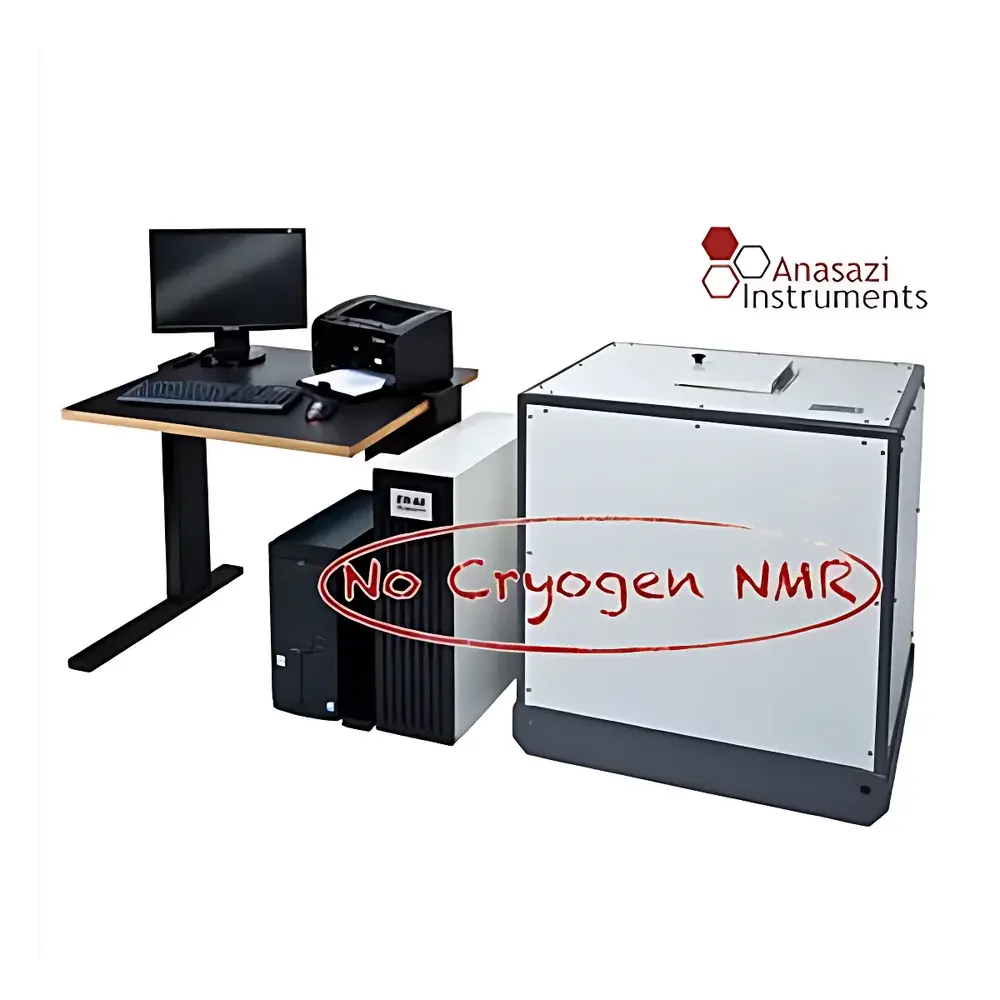
Anasazi EFT-90 Benchtop Permanent-Magnet Nuclear Magnetic Resonance Spectrometer
| Brand | Anasazi |
|---|---|
| Origin | USA |
| Model | EFT-90 |
| Operating Frequency | 90 MHz |
| Sample Type | Solid & Liquid (with appropriate probes) |
| Magnet Type | AlNiCo permanent magnet |
| Resolution | < 0.5 Hz (for 1H at 90 MHz) |
| Sensitivity | < 0.001 mmol/L (for 1H) |
| Cooling | Zero-boil-off, helium-free operation |
| Compliance | Designed for GLP-compliant academic and industrial R&D environments |
| Software | EFT-NMR v5.x with full pulse sequence library and audit trail capability |
Overview
The Anasazi EFT-90 is a compact, helium-free benchtop nuclear magnetic resonance (NMR) spectrometer engineered for high-field performance in resource-constrained laboratory environments. Unlike conventional superconducting NMR systems requiring cryogenic liquid helium and nitrogen infrastructure, the EFT-90 utilizes a high-stability AlNiCo permanent magnet operating at a fixed field strength corresponding to a ¹H Larmor frequency of 90 MHz. This design eliminates dependency on cryogens while maintaining sufficient spectral resolution (< 0.5 Hz linewidth for ¹H in standard conditions) and sensitivity (< 0.001 mmol/L for ¹H) to support structural elucidation, reaction monitoring, and quantitative analysis across academic chemistry, pharmaceutical development, and materials science laboratories. Its robust mechanical architecture—featuring integrated active temperature stabilization and passive vibration damping—ensures operational reliability in shared instrumentation facilities without dedicated RF-shielded rooms or climate-controlled vaults.
Key Features
- Helium-free permanent magnet system: Eliminates recurring cryogen procurement, handling, and disposal costs—reducing annual operational expenditure by approximately USD $14,000 compared to low-field superconducting alternatives.
- Broadband multinuclear capability: Standard configuration supports ¹H, ¹³C, ¹⁹F, ³¹P, ²³Na, ⁵⁹Co, and ²⁹Si detection via interchangeable probe modules; dual-channel operation enables heteronuclear correlation experiments (e.g., HETCOR, DEPT).
- Integrated pulse programming environment: Supports user-defined pulse sequences including inversion-recovery (T₁), CPMG (T₂), solvent suppression (WET, presaturation), and 2D methods (COSY, HSQC-compatible variants).
- Automated shimming and lock-free acquisition: Real-time field homogeneity optimization via gradient-based algorithms; no deuterated solvent lock required for routine ¹H or ¹³C experiments.
- Modular hardware architecture: Swappable RF channels, preamplifiers, and probe interfaces allow future expansion into diffusion-ordered spectroscopy (DOSY), relaxation dispersion, or solid-state MAS configurations (with optional accessories).
Sample Compatibility & Compliance
The EFT-90 accommodates standard 5 mm OD NMR tubes for liquid-phase analysis and supports static solid-state measurements using 4 mm rotors (optional). It meets essential regulatory expectations for research-grade instrumentation: data integrity safeguards include timestamped audit trails, user-level access control, and electronic signature support aligned with FDA 21 CFR Part 11 principles. While not certified for GMP production release testing, its software framework and hardware traceability features facilitate compliance with GLP documentation standards used in university core facilities and contract research organizations. All electromagnetic emissions conform to FCC Class B limits; magnetic fringe field remains below 0.5 mT at 1 m distance from instrument enclosure.
Software & Data Management
EFT-NMR v5.x provides a unified interface for instrument control, real-time spectrum visualization, and post-processing. Raw FID data are stored in vendor-neutral JCAMP-DX format with embedded metadata (pulse sequence, acquisition parameters, sample ID, operator name, timestamp). Batch processing workflows enable automated phasing, baseline correction, integration, and peak picking across multi-sample datasets. The software includes built-in libraries for chemical shift referencing (TMS, DSS, external reference standards), coupling constant analysis, and structure verification tools compatible with ChemDraw and MNova export protocols. Audit logs record all parameter modifications, data deletions, and software updates—retained for ≥36 months unless manually purged under institutional IT policy.
Applications
The EFT-90 serves as a primary analytical platform in undergraduate teaching labs, graduate synthetic chemistry programs, natural product isolation workflows, and polymer characterization studies. Published applications span structural validation of novel heterocycles (J. Med. Chem. 2013, 56, 889), quantification of fluorinated metabolites in biological extracts (Eur. J. Med. Chem. 2012, 54, 113), phosphorus speciation in battery electrolytes (ACS Appl. Mater. Interfaces 2011, 3, 4262), and dynamic covalent bond kinetics in supramolecular systems (Tetrahedron Lett. 2009, 50, 5175). Its rapid turnaround time (< 2 min per ¹H spectrum, 16 scans) supports high-throughput screening of reaction intermediates, while broadband multinuclear capability enables direct observation of paramagnetic species inaccessible to higher-field instruments due to signal broadening.
FAQ
Does the EFT-90 require liquid nitrogen or helium for operation?
No. It operates exclusively with a permanent magnet and requires only standard AC power (100–240 V, 50/60 Hz) and ambient laboratory air cooling.
Can I perform 2D NMR experiments on this system?
Yes. COSY, HETCOR, and DEPT-135 are supported natively; advanced 2D sequences (e.g., HSQC analogues) can be implemented via custom pulse programming.
Is probe tuning automated?
Yes. Automatic impedance matching and frequency tuning are executed prior to each acquisition cycle, minimizing manual intervention.
What sample throughput can be expected in a teaching lab setting?
With autosampler integration (optional), up to 48 samples per 8-hour shift can be processed with minimal supervision—ideal for undergraduate organic chemistry labs.
How is magnetic field stability maintained without cryogenic cooling?
The AlNiCo magnet assembly incorporates passive thermal mass and active air-circulation temperature regulation, achieving field drift < 10 Hz/hour over 24 h under stable ambient conditions (±1°C).





