
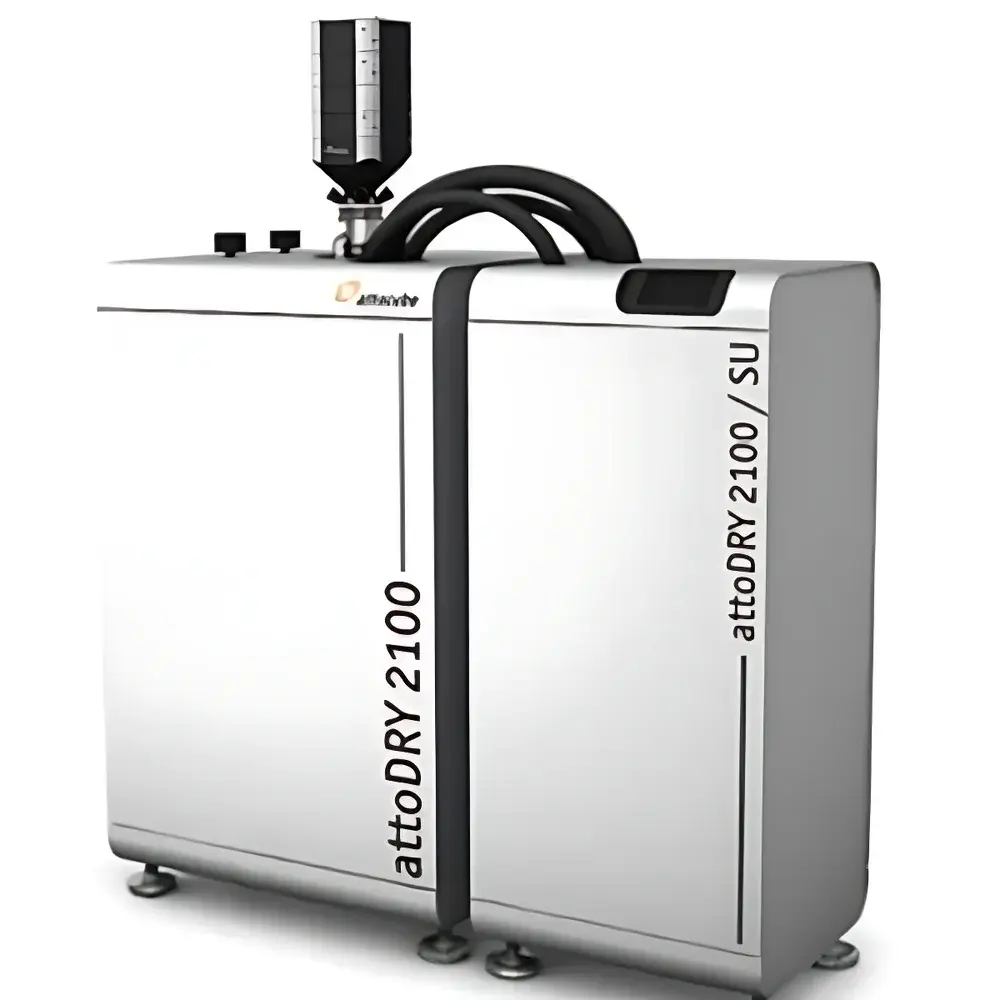
Attocube attoDRY Lab Helium-Free Cryogenic High-Magnetic-Field Scanning Probe Microscope
| Brand | Attocube Systems AG |
|---|---|
| Origin | Germany (manufactured in Germany |
| Instrument Type | Research-grade industrial SPM platform |
| Magnet Strength | Up to 15 T |
| Temperature Range | 1.5 K – 300 K (continuous, closed-cycle) |
| Positioning Noise | < 0.5 nm RMS |
| Sample Dimensions | Max 100 mm × 50 mm × 20 mm |
| XY Scanner Range | 10 µm × 10 µm |
| Vibration Level | 0.12 nm RMS (typical) |
| Compliance | ASTM E2579, ISO/IEC 17025 compatible operation environment |
| Software Control | Integrated touchscreen interface with automated temperature/magnetic field ramping |
Overview
The Attocube attoDRY Lab is a fully integrated, helium-free cryogenic scanning probe microscope engineered for high-resolution surface characterization under extreme conditions—specifically, simultaneous ultra-low temperatures (down to 1.5 K) and high magnetic fields (up to 15 T). Unlike conventional liquid-helium-based systems, the attoDRY Lab employs a closed-cycle pulse-tube cryocooler coupled with a superconducting magnet, eliminating operational dependency on cryogenic liquids while maintaining sub-nanometer mechanical stability. Its core architecture is built around the attoDRY series of ultra-low-vibration cryostats, which achieve a measured vibration floor of 0.12 nm RMS—critical for atomic-scale imaging and spectroscopy in scanning tunneling microscopy (STM), atomic force microscopy (AFM), and related modalities. The system supports interchangeable SPM modules—including AFM, MFM, c-AFM, PRFM, CFM, Raman, and photoluminescence—and is widely deployed in condensed matter physics, quantum materials research, and nanoscale magnetism studies where thermal drift, magnetic interference, and mechanical noise must be rigorously suppressed.
Key Features
- Helium-free operation via closed-cycle refrigeration—enabling continuous, maintenance-light operation without liquid cryogen logistics or refills
- Integrated 15 T superconducting magnet with active shielding and field homogeneity optimization for high-fidelity magnetic imaging
- Sub-nanometer positioning stability: <0.5 nm RMS noise floor over full temperature range (1.5–300 K)
- Modular SPM head design supporting concurrent or sequential deployment of AFM, MFM, conductive-AFM, piezoresponse force microscopy (PRFM), confocal fluorescence (attoCFM), and micro-Raman spectroscopy
- Automated touchscreen control interface for real-time adjustment of temperature setpoints, magnetic field ramps, and scanner parameters
- Quick cooldown capability: sample reaches base temperature (~1.5 K) in approximately 1–2 hours from room temperature
- Compact, vacuum-compatible design with differential pumping stages for UHV-ready integration (optional)
Sample Compatibility & Compliance
The attoDRY Lab accommodates samples up to 100 mm × 50 mm × 20 mm in physical dimensions, with precise alignment facilitated by motorized XYZ stage and optical navigation. Its rigid, low-thermal-expansion sample holder ensures dimensional stability across the full operating temperature range. The system complies with international standards relevant to precision instrumentation in regulated research environments: vibration performance aligns with ASTM E2579 (Standard Guide for Vibration Measurements on Precision Equipment); thermal control repeatability meets requirements for GLP-compliant material property mapping; and data acquisition integrity supports audit trails required under ISO/IEC 17025-accredited laboratories. While not FDA-regulated, its architecture enables 21 CFR Part 11–compliant software add-ons for traceable experimental logging when deployed in pharmaceutical or biomedical nanomaterial characterization workflows.
Software & Data Management
Control and data acquisition are managed through Attocube’s proprietary attoDRY Lab software suite, featuring a responsive touchscreen GUI with intuitive parameter trees for temperature, field, and scanning protocols. All hardware interactions—including piezo actuator voltage sequencing, laser diode modulation, and lock-in amplifier synchronization—are timestamped and logged with nanosecond resolution. Raw datasets (topography, phase, current, magnetic stray field, Raman spectra) are stored in HDF5 format with embedded metadata (temperature, field, date/time, user ID, calibration references). Export options include ASCII, MATLAB .mat, and Python-compatible NumPy arrays. Optional plugins support automated batch analysis of domain structures, vortex lattice identification, and spectral fitting using SciPy-based algorithms. Audit trail functionality records all parameter changes, user logins, and instrument state transitions—essential for reproducibility validation in peer-reviewed publications and collaborative multi-site studies.
Applications
The attoDRY Lab serves as a foundational platform for investigations requiring correlated spatial, electronic, magnetic, and optical information at cryogenic temperatures. Key application domains include: visualization of magnetic skyrmions and vortex lattices in type-II superconductors (e.g., FeSe, NbSe₂); strain-engineered band structure mapping in twisted 2D heterostructures (e.g., MoS₂/WSe₂ moiré superlattices); nanoscale ferroelectric domain dynamics in multiferroic oxides; spin-polarized transport imaging in topological insulator edges; and single-defect photoluminescence spectroscopy in hBN-hosted quantum emitters. Its compatibility with in situ electrical transport measurements (via integrated wiring feedthroughs) further enables concurrent scanning gate microscopy and Hall effect mapping under high magnetic fields—making it indispensable for next-generation quantum device metrology.
FAQ
Does the attoDRY Lab require liquid helium or other cryogens?
No. It operates exclusively via a closed-cycle pulse-tube cryocooler and does not consume liquid helium, nitrogen, or hydrogen.
Can multiple SPM techniques be used simultaneously on the same sample?
Yes—hardware interlocks and synchronized timing allow concurrent AFM topography and MFM imaging, or simultaneous Raman excitation and c-AFM current mapping.
What level of magnetic field homogeneity is achieved at 15 T?
Typical field uniformity is ±0.05% over a 1 mm diameter spherical volume centered at the sample position.
Is remote operation supported?
Yes—Ethernet-based API access enables script-driven automation (Python/LabVIEW) and secure remote monitoring via TLS-encrypted connections.
How is thermal drift compensated during long-duration scans?
Active thermal stabilization circuitry maintains temperature stability within ±1 mK over 24-hour periods, supplemented by real-time drift correction algorithms in post-processing.






