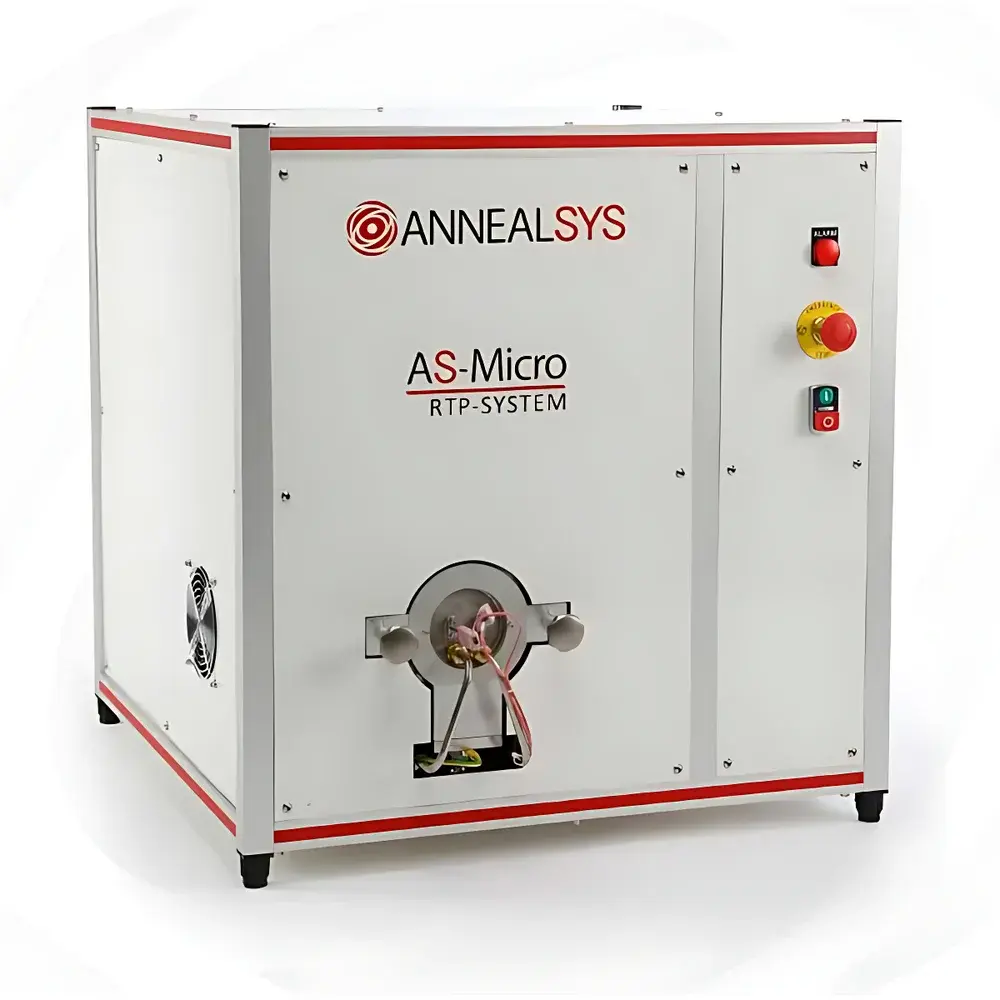
Annealsys AS-Micro High-Vacuum Rapid Thermal Annealing Furnace
| Brand | Annealsys |
|---|---|
| Origin | France |
| Model | AS-Micro |
| Instrument Type | High-Vacuum Rapid Thermal Annealing Furnace |
| Maximum Sample Size | 3-inch (76 mm) diameter or square |
| Temperature Range | Ambient to 1450 °C |
| Max Heating Rate | 150 °C/s |
| Max Cooling Rate | 200 °C/s |
| Temperature Accuracy | ±1 °C |
| Temperature Uniformity | ±1% across wafer surface |
| Vacuum Capability | Compatible with turbomolecular pumping systems |
| Control Interface | Ethernet-connected PC-based software with full programmable ramp/soak profiles |
| Chamber Design | Dual-chamber option available |
| Cooling Method | Forced-air (low-noise, no compressed air required) + water-cooled quartz chamber walls |
| Heating Source | Array of IR halogen lamps with power-controlled (not voltage-controlled) regulation |
| Thermocouple Configuration | Dual N-type thermocouples — center + edge placement for direct wafer-temperature feedback |
| Gas Handling | Up to 3 process gases with digital mass flow controllers (MFCs) and needle-valve purging |
| Optional Accessories | SiC-coated graphite susceptor, molecular pump integration, cold-wall double-chamber architecture |
Overview
The Annealsys AS-Micro is a high-precision, laboratory-scale rapid thermal annealing (RTA) furnace engineered for semiconductor process development, materials science research, and advanced thin-film fabrication. Utilizing infrared halogen lamp arrays with closed-loop power-based heating control—not voltage-based—the system delivers exceptional thermal reproducibility and spatial uniformity over the entire 3-inch (76 mm) substrate area. Its cold-wall, water-cooled quartz chamber design eliminates thermal memory effects, enabling precise thermal cycling between dissimilar processes without cross-contamination or residual heat drift. The furnace supports both atmospheric and high-vacuum environments (down to 10−7 mbar with optional turbomolecular pump), making it suitable for rapid thermal oxidation (RTO), rapid thermal nitridation (RTN), ion implant activation, ohmic contact formation, graphene CVD, and other critical front-end-of-line (FEOL) thermal steps. Temperature is monitored in real time via two calibrated N-type thermocouples—strategically positioned at the wafer center and edge—to ensure accurate feedback control and minimize thermal gradients.
Key Features
- Infrared halogen lamp array with power-regulated heating: maintains consistent irradiance and uniform heating even after lamp aging or partial replacement.
- Cold-wall architecture with water-cooled quartz chamber: enables fast cooldown (up to 200 °C/s), zero thermal hysteresis, and high process repeatability across sequential runs.
- Dual-chamber configuration option: physically isolates pre- and post-process environments to prevent contamination between material systems (e.g., Si vs. III–V compounds).
- Real-time, dual-point temperature monitoring: center + edge N-type thermocouples directly measure wafer surface temperature—not just ambient chamber temperature—for true process-relevant control.
- High-speed digital PID algorithm with overshoot suppression: ensures stable ramp/soak profiles and ±1 °C absolute accuracy across the full 0–1450 °C operating range.
- Modular gas delivery system: supports up to three independent process gases with digitally controlled mass flow controllers (MFCs) and precision needle valves for inert purge, oxidizing, or reactive ambient processing.
- Ethernet-enabled PC interface: provides deterministic communication latency, full logging of all thermal and gas parameters, and compatibility with lab-wide data archiving systems.
- No external compressed air requirement: forced-air cooling operates at <65 dB(A), minimizing facility infrastructure dependencies.
Sample Compatibility & Compliance
The AS-Micro accommodates substrates up to 3 inches (76 mm) in diameter or square format—including silicon, sapphire, SiC, GaN, and flexible polymer foils—on either standard graphite or optional SiC-coated susceptors. Its vacuum-tight quartz chamber meets ISO Class 5 cleanroom compatibility when integrated with appropriate exhaust and filtration. All electrical and thermal subsystems comply with CE marking requirements (EN 61000-6-3, EN 61000-6-4, EN 61010-1). Software logs include timestamped temperature, gas flow, pressure, and lamp power data—fully traceable for GLP/GMP-aligned workflows. When configured with audit-trail-enabled software and electronic signatures, the system supports FDA 21 CFR Part 11 compliance for regulated R&D environments.
Software & Data Management
The AS-Micro is operated via a Windows-based graphical user interface accessible over standard Ethernet (TCP/IP). The software enables creation and storage of multi-step thermal recipes—including ramp rates, dwell times, gas sequencing, and pressure modulation—with version control and user-level access permissions. All operational parameters are logged at ≥1 Hz resolution into CSV- and SQLite-compatible databases. Export functions support direct integration with MATLAB, Python (Pandas), or LIMS platforms. Optional firmware modules provide automated calibration validation reports, MFC drift compensation, and real-time deviation alerts based on user-defined tolerance bands.
Applications
- Rapid thermal annealing (RTA) of ion-implanted dopants in Si, Ge, and compound semiconductors.
- Ohmic contact formation for AlGaN/GaN HEMTs and SiC power devices.
- Rapid thermal oxidation (RTO) for ultra-thin gate dielectrics (≤2 nm SiO2).
- Rapid thermal nitridation (RTN) to engineer interfacial layers in high-k/metal gate stacks.
- Graphene and transition metal dichalcogenide (TMD) synthesis via rapid thermal chemical vapor deposition (RTCVD).
- Post-deposition annealing of ferroelectric oxides (e.g., HfO2-based), perovskites, and memristive thin films.
- Thermal budget optimization studies for low-k dielectric curing and stress relief.
FAQ
What vacuum level can the AS-Micro achieve?
With the optional turbomolecular pumping station, the system reaches base pressures below 1×10⁻⁷ mbar, suitable for oxide-free surface preparation and contamination-sensitive anneals.
Is the temperature uniformity verified across the full 3-inch wafer area?
Yes—uniformity is characterized using calibrated thermal imaging and multi-point thermocouple mapping per ASTM F1935, reporting ±1% variation across the active zone under standard operating conditions.
Can the AS-Micro be integrated into an automated cluster tool environment?
Yes—via SECS/GEM-compliant Ethernet interface and configurable I/O ports (opto-isolated digital in/out), supporting handshake protocols with load-lock and robotic transfer modules.
Does the system support ramp-and-soak profiles with gas switching during temperature transients?
Yes—the software permits synchronized gas flow changes within ±100 ms of thermal setpoint updates, enabling dynamic ambient transitions during ramp phases.
What maintenance intervals are recommended for lamp arrays and thermocouples?
Lamp lifetime exceeds 2,000 hours under typical RTA duty cycles; thermocouples are rated for >5,000 thermal cycles and should be recalibrated annually or after 500 high-temperature (>1200 °C) runs.
Related Products