
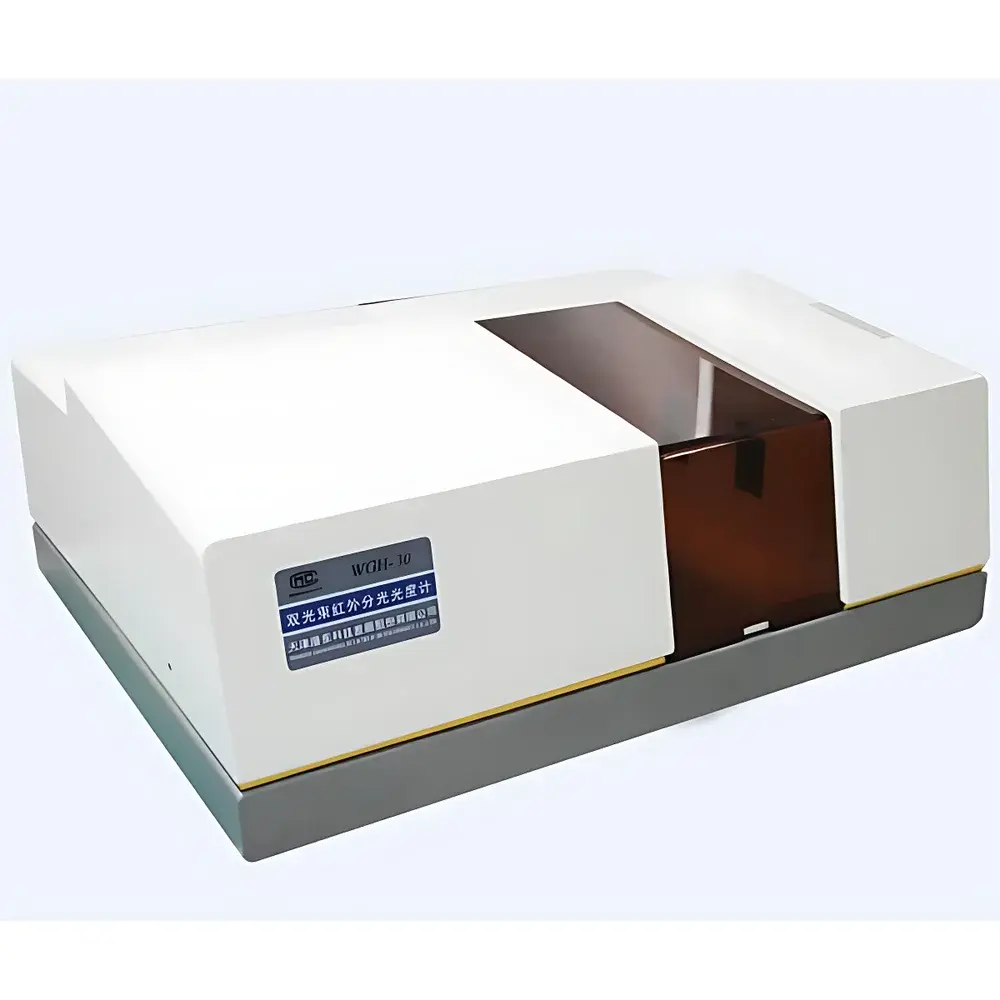
Gangdong WGH-30 Double-Beam Dispersive Infrared Spectrophotometer
| Brand | Gangdong |
|---|---|
| Origin | Tianjin, China |
| Manufacturer Type | Direct Manufacturer |
| Instrument Type | Laboratory Benchtop |
| Spectral Range | 4000–400 cm⁻¹ |
| Spectral Resolution | 2 cm⁻¹ |
| Scan Speed Options | 5 Adjustable Settings (Very Fast, Fast, Normal, Slow, Very Slow) |
| Signal-to-Noise Ratio | 15,000:1 (at 4 cm⁻¹, 1 min scan, DTGS detector) |
| Wavenumber Accuracy | ±4 cm⁻¹ (4000–2000 cm⁻¹), ±2 cm⁻¹ (2000–400 cm⁻¹) |
| Wavenumber Repeatability | ≤2 cm⁻¹ (4000–2000 cm⁻¹), ≤1 cm⁻¹ (2000–400 cm⁻¹) |
| Transmittance Accuracy | ±0.2%T (excluding noise floor) |
| Transmittance Reproducibility | ≤0.5%T (1000–930 cm⁻¹) |
| Baseline Flatness | ≤±0.2%T |
| Stray Light | ≤0.5%T (4000–650 cm⁻¹), ≤1.0%T (650–400 cm⁻¹) |
| Detector | Imported DTGS (Deuterated Triglycine Sulfate) |
| Data Interface | USB 2.0 |
| OS Compatibility | Windows XP, Windows 7 |
Overview
The Gangdong WGH-30 Double-Beam Dispersive Infrared Spectrophotometer is a benchtop Fourier-transform-free infrared (FTIR) instrument engineered for routine qualitative and semi-quantitative analysis in regulated and academic laboratories. Unlike interferometer-based FTIR systems, the WGH-30 employs a classical Czerny–Turner monochromator architecture with a rotating grating dispersion element, delivering robust performance in environments where mechanical stability, thermal resilience, and operational simplicity are prioritized over ultra-high resolution or rapid spectral acquisition. Its optical design features a double-beam configuration that continuously compensates for source drift and environmental fluctuations—enabling stable baseline performance across extended measurement sessions without frequent re-referencing. The instrument operates across the mid-infrared range (4000–400 cm⁻¹), covering fundamental vibrational modes of organic functional groups (e.g., O–H, N–H, C=O, C–O, C–H), making it suitable for pharmaceutical raw material identification, polymer characterization, and quality control of excipients and intermediates.
Key Features
- Imported DTGS Detector: Equipped with a high-stability deuterated triglycine sulfate (DTGS) pyroelectric detector, offering superior long-term signal consistency and low thermal drift compared to domestically sourced alternatives—critical for reproducible transmittance measurements under ambient lab conditions.
- Double-Beam Optical Path: Real-time reference beam correction minimizes errors arising from lamp intensity variation, humidity-induced optical path changes, and minor temperature gradients—enhancing measurement repeatability without manual background recalibration between samples.
- GMP-Compliant Performance Specifications: Meets all mandatory instrumental criteria defined in the Chinese Pharmacopoeia (ChP) 2020 Edition and USP for infrared identification testing—including wavenumber accuracy, resolution verification using polystyrene film, stray light limits, and transmittance linearity—supporting audit-ready validation documentation.
- Five-Step Scan Speed Control: Adjustable scanning rates (Very Fast to Very Slow) allow users to balance throughput and signal fidelity: faster scans for rapid pass/fail screening; slower scans for improved signal averaging and detection of low-intensity bands in dilute or highly scattering samples.
- Robust Mechanical Architecture: Precision-machined aluminum optical housing and sealed grating chamber reduce sensitivity to vibration and dust ingress—enabling reliable operation in shared QC labs without dedicated HVAC or anti-vibration tables.
Sample Compatibility & Compliance
The WGH-30 accommodates standard transmission sampling formats including KBr pellets (13 mm diameter), liquid cells (0.1–1.0 mm pathlength), and solid film mounts. It supports both neat liquid analysis and diluted solutions in IR-transparent solvents (e.g., CHCl₃, CCl₄). All optical components comply with ISO 9022-3 (environmental testing for optical instruments) and meet CE marking requirements for electromagnetic compatibility (EMC Directive 2014/30/EU) and low-voltage safety (LVD Directive 2014/35/EU). Instrument qualification documentation—including Design Qualification (DQ), Installation Qualification (IQ), and Operational Qualification (OQ) protocols—is provided to support 3Q validation per ICH Q5A and WHO TRS 986 Annex 4 guidelines. Full traceability of calibration standards (NIST-traceable polystyrene film) and documented uncertainty budgets are available upon request.
Software & Data Management
Bundled with Gangdong’s proprietary IRSoft v3.2 application (Windows XP/7 compatible), the system provides full GLP-compliant data handling. Key capabilities include: overlay comparison of up to eight spectra with RMS deviation calculation; automated peak search and annotation with customizable threshold settings; batch report generation compliant with 21 CFR Part 11 requirements (user authentication, electronic signatures, and immutable audit trails for all processing steps); spectral library management supporting user-defined metadata tagging (batch ID, operator, date, sample prep method); and integrated pharmacopeial reference search—enabling keyword-driven retrieval of ChP-, USP-, and EP-listed reference spectra. Raw interferogram-free spectral data (.spc format) is exportable to third-party chemometric platforms (e.g., Unscrambler, MATLAB) via ASCII or JCAMP-DX v5.0 interchange files.
Applications
- Pharmaceutical identity testing of APIs and excipients per ChP Section IV and USP Infrared Absorption Spectrophotometry
- Verification of polymer composition and degradation state in medical device packaging materials
- Raw material release testing in fine chemical manufacturing (e.g., ester hydrolysis monitoring, isomer differentiation)
- Educational laboratory instruction on vibrational spectroscopy fundamentals and functional group correlation charts
- QC screening of incoming solvents for water or alcohol contamination using characteristic O–H stretch region analysis (3700–3000 cm⁻¹)
FAQ
Does the WGH-30 require liquid nitrogen cooling?
No. The DTGS detector operates at ambient temperature and does not require cryogenic cooling—reducing operational complexity and consumable costs.
Can the instrument be qualified for GMP-regulated environments?
Yes. Full 3Q documentation packages—including IQ/OQ protocols, calibration certificates, and test records aligned with ASTM E2500 and EU Annex 15—are available as optional service deliverables.
Is spectral resolution adjustable below 2 cm⁻¹?
No. As a fixed-grating dispersive system, the WGH-30 maintains a nominal resolution of 2 cm⁻¹ across its operating range; higher resolution requires an FTIR platform.
What is the maximum number of spectra that can be stored locally?
The software supports unlimited spectral storage on host PC storage; internal instrument memory is not used—data persistence relies on user-managed file directories and backup policies.
Does the system support ATR accessories?
The base configuration is transmission-only; however, optional external ATR modules (ZnSe or diamond crystal) with motorized stage integration are available as field-upgrade kits with recalibrated alignment procedures.





