
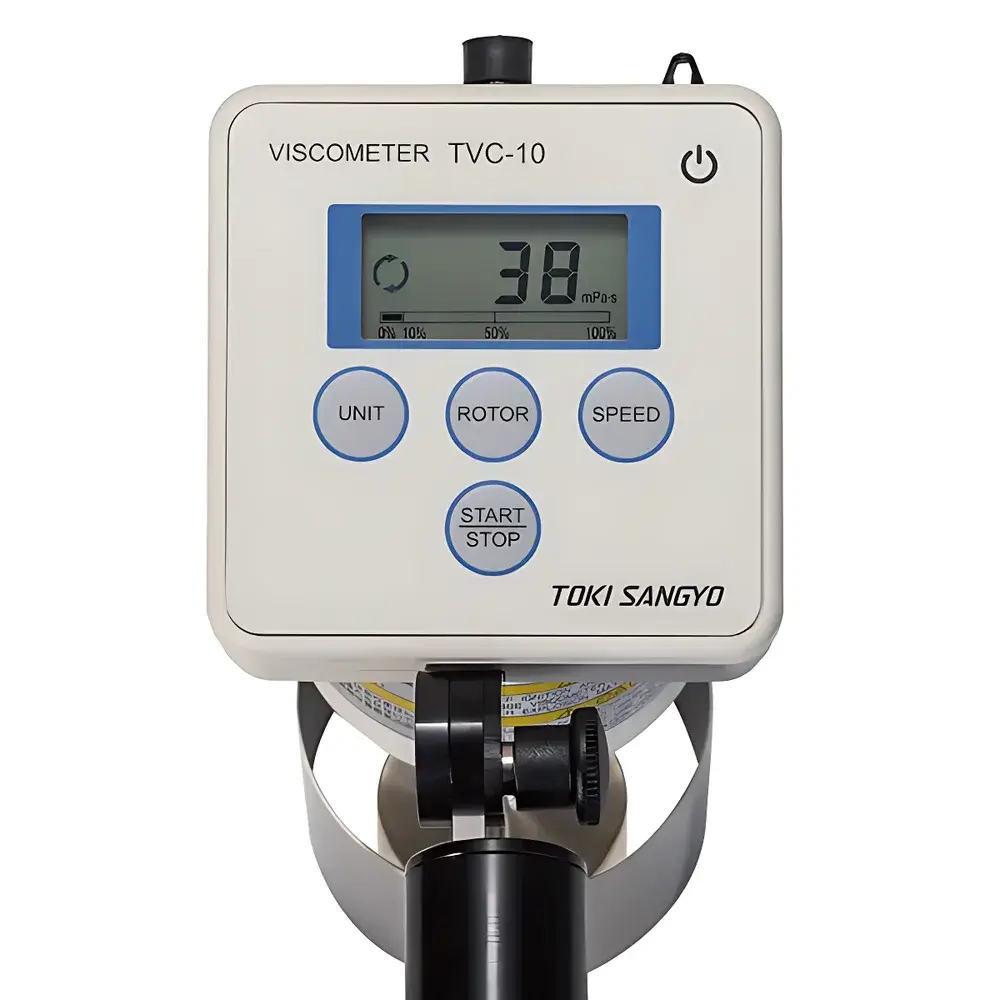
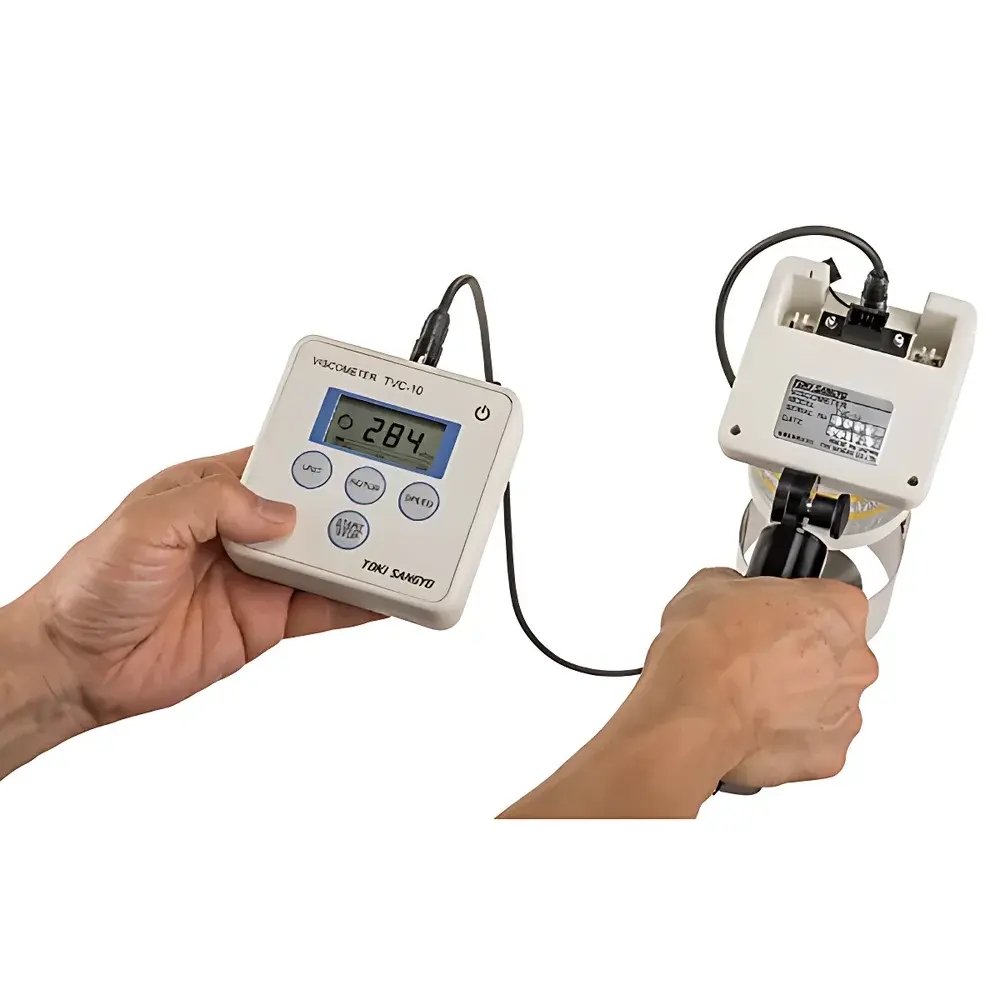
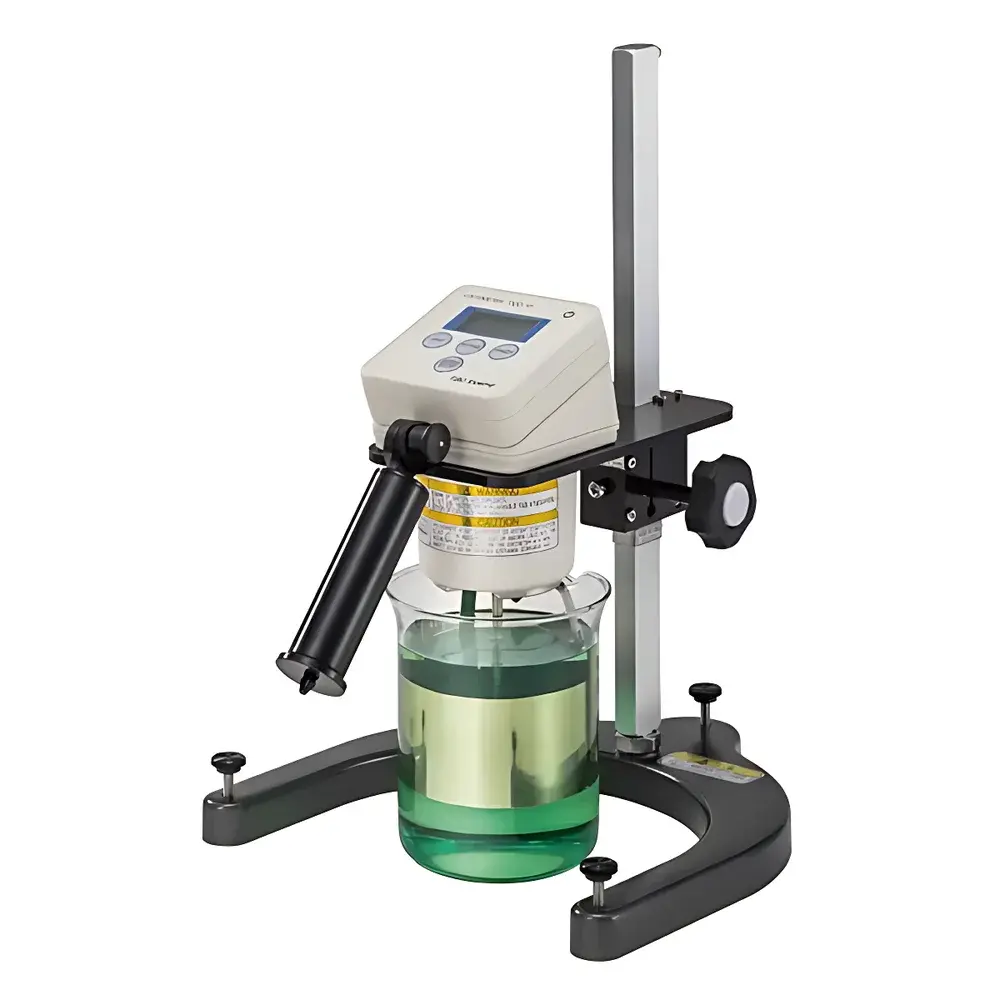
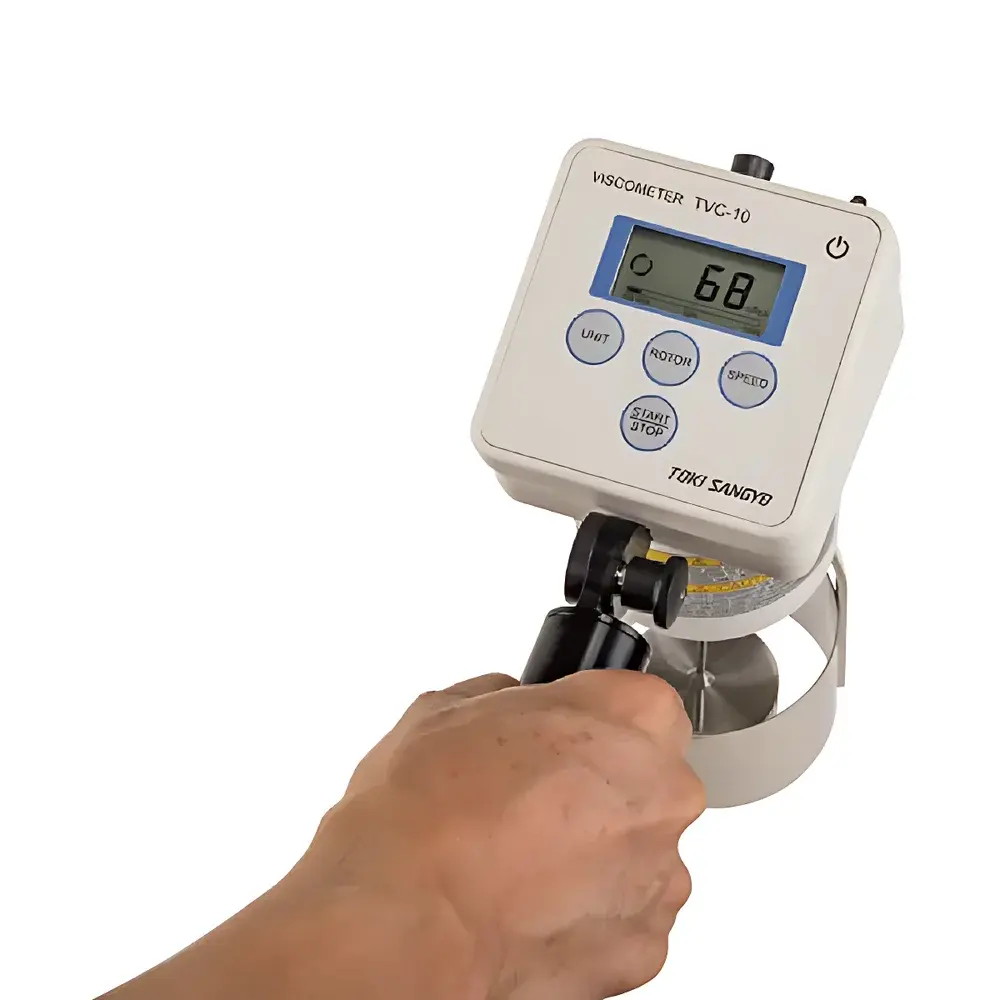
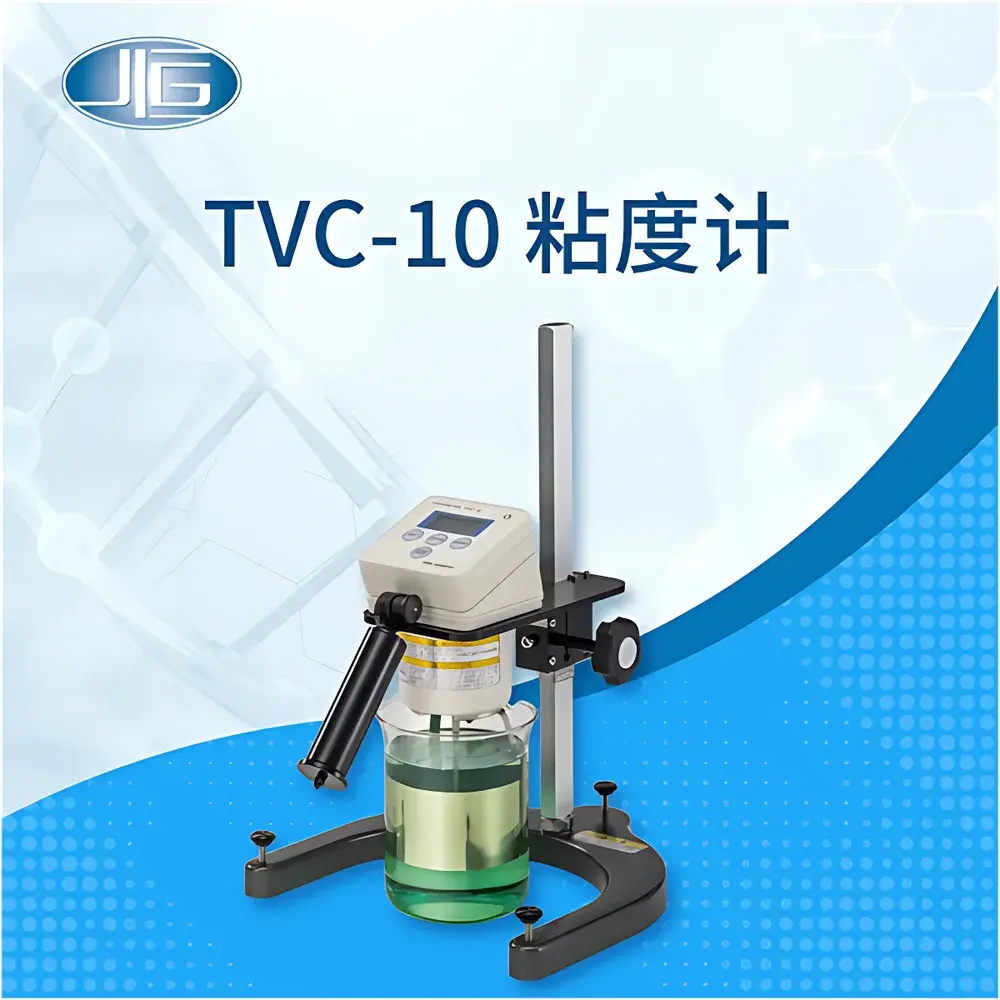
TOKI SANGYO TVC-10 Portable Digital Rotational Viscometer
| Brand | TOKI SANGYO |
|---|---|
| Origin | Japan |
| Model | TVC-10 Portable Rotational Viscometer |
| Viscosity Range | 0–800 Pa·s |
| Instrument Type | Handheld / Portable |
| Operating Environment | Ambient Temperature (15–30 °C) |
| Measurement Principle | Rotational (Coaxial Cylinder, Spring-Deflection Based) |
| Host Unit | TVC-10 Viscometer Main Body |
Overview
The TOKI SANGYO TVC-10 is a compact, battery-powered handheld rotational viscometer engineered for rapid, on-site viscosity assessment of Newtonian and mildly non-Newtonian fluids under ambient conditions. Unlike benchtop rheometers relying on motor-driven spindle rotation and torque transducers, the TVC-10 employs a precision spring-deflection mechanism coupled with a calibrated coaxial cylinder sensor system. As the immersed rotor rotates at a fixed speed (typically 60 rpm), viscous drag induces measurable angular displacement in a torsion spring; this mechanical deflection is converted into a digital viscosity reading via an integrated analog-to-digital converter and microcontroller. Designed for field use in quality control checkpoints, production lines, R&D labs, and maintenance inspections, the TVC-10 delivers repeatable measurements without requiring external power, temperature-controlled baths, or complex calibration routines—making it especially suitable for routine checks of adhesives, coatings, inks, lubricants, food emulsions, and pharmaceutical suspensions where absolute metrological traceability is secondary to operational consistency.
Key Features
- True handheld form factor: Weighs under 450 g with integrated rechargeable Ni-MH battery (up to 8 hours continuous operation)
- Dual-range digital display (LCD) showing viscosity in Pa·s and % torque scale simultaneously
- Single-speed operation at 60 rpm—optimized for rapid screening and comparative trending
- Interchangeable sensor assemblies: Standard L-type rotor (for low-to-mid viscosity) and H-type rotor (for high-viscosity materials up to 800 Pa·s)
- Rugged ABS housing with IP54-rated ingress protection against dust and light splashing
- Zero-point auto-compensation function minimizes drift during extended field use
- No PC interface required—standalone operation ensures reliability in environments lacking IT infrastructure
Sample Compatibility & Compliance
The TVC-10 accommodates samples with volumes as low as 15 mL when using the standard L-rotor configuration. Its coaxial cylinder geometry ensures minimal wall effects for fluids with moderate yield stress or slight thixotropy. While not designed for full ISO 2555 or ASTM D2196 compliance (which require controlled shear rate sweeps and temperature regulation), the instrument meets functional requirements for in-process verification per internal QC protocols aligned with ISO 9001 clause 8.5.1 (Control of production and service provision). It supports GLP-aligned documentation practices through manual logbook recording; however, it does not incorporate FDA 21 CFR Part 11-compliant electronic audit trails or user access controls due to its embedded-only architecture.
Software & Data Management
The TVC-10 operates autonomously without proprietary software dependencies. All measurement data—including timestamp (manual entry), operator ID, sample ID, rotor type, and viscosity value—are recorded manually in standardized lab notebooks or exported via optional Bluetooth-enabled data logger accessories (sold separately). While no native PC synchronization protocol exists, users may integrate readings into LIMS or ELN platforms using CSV import workflows after transcription. Firmware updates are not field-upgradable; calibration constants are factory-set and verified annually per manufacturer’s recommended maintenance schedule.
Applications
- Quick pass/fail checks of batch consistency for paints, varnishes, and industrial coatings prior to canning
- Field verification of grease consistency during equipment servicing in manufacturing plants
- Monitoring thermal stability of edible oils and margarines across storage conditions
- Pre-screening of polymer solutions before detailed rheological characterization on rotational rheometers
- Education and training labs requiring robust, low-cost instruments for introducing viscosity concepts
- Pharmaceutical manufacturing support for semi-solid dosage forms (e.g., ointments, gels) where relative viscosity shifts indicate formulation drift
FAQ
Is the TVC-10 suitable for measuring non-Newtonian fluids?
Yes—within operational limits. It provides apparent viscosity at 60 rpm and is appropriate for qualitative trending of shear-thinning or weakly thixotropic systems, though it cannot resolve shear-rate dependence.
Does the instrument require annual recalibration?
Yes. TOKI SANGYO recommends annual verification against NIST-traceable silicone oil standards (e.g., Cannon N27, N60) by an accredited service provider.
Can the TVC-10 be used in elevated temperature environments?
No. Its specified operating range is 15–30 °C; exposure to temperatures beyond this may affect spring elasticity and LCD response.
What is the minimum sample volume required for accurate measurement?
15 mL with the L-rotor; 30 mL with the H-rotor—to ensure full immersion and eliminate meniscus-related errors.
Is rotor cleaning supported in situ?
Yes. The quick-release rotor coupling allows tool-free disassembly; all wetted parts are stainless steel 316 and compatible with common solvents including acetone, ethanol, and isopropanol.



