
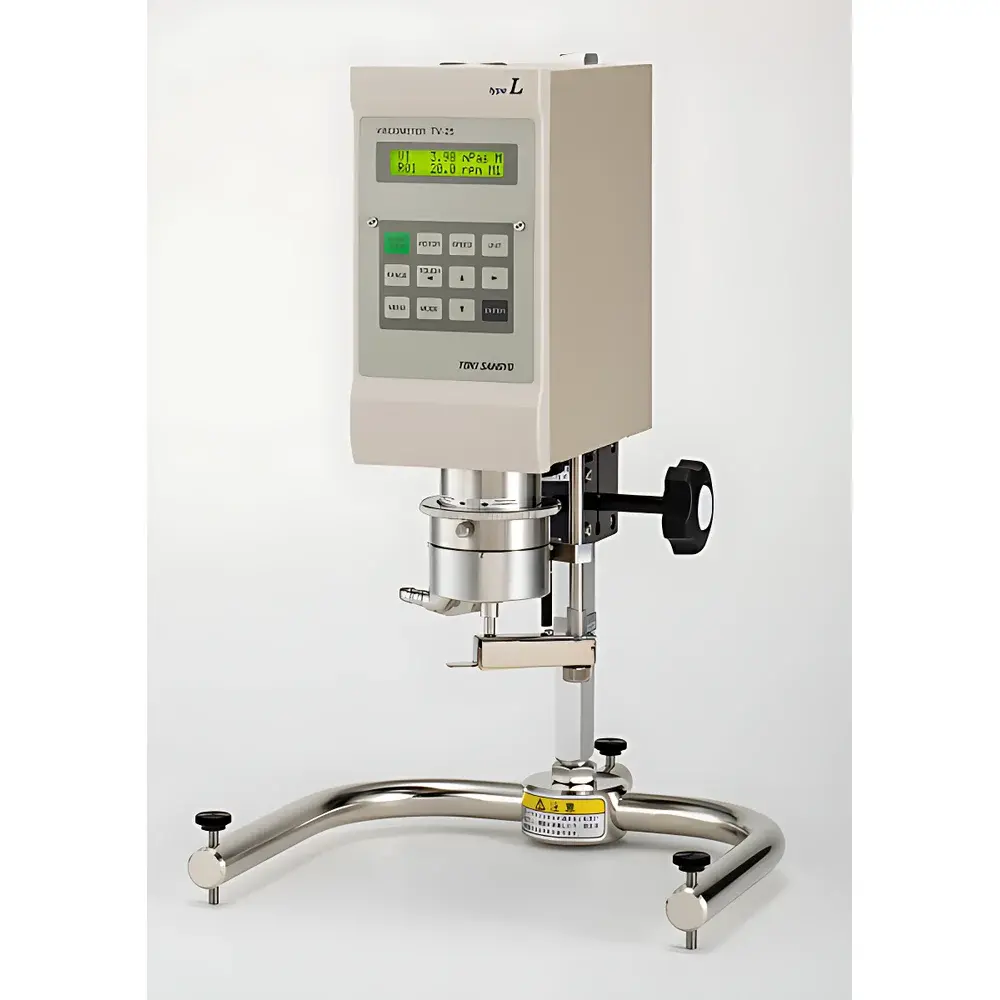
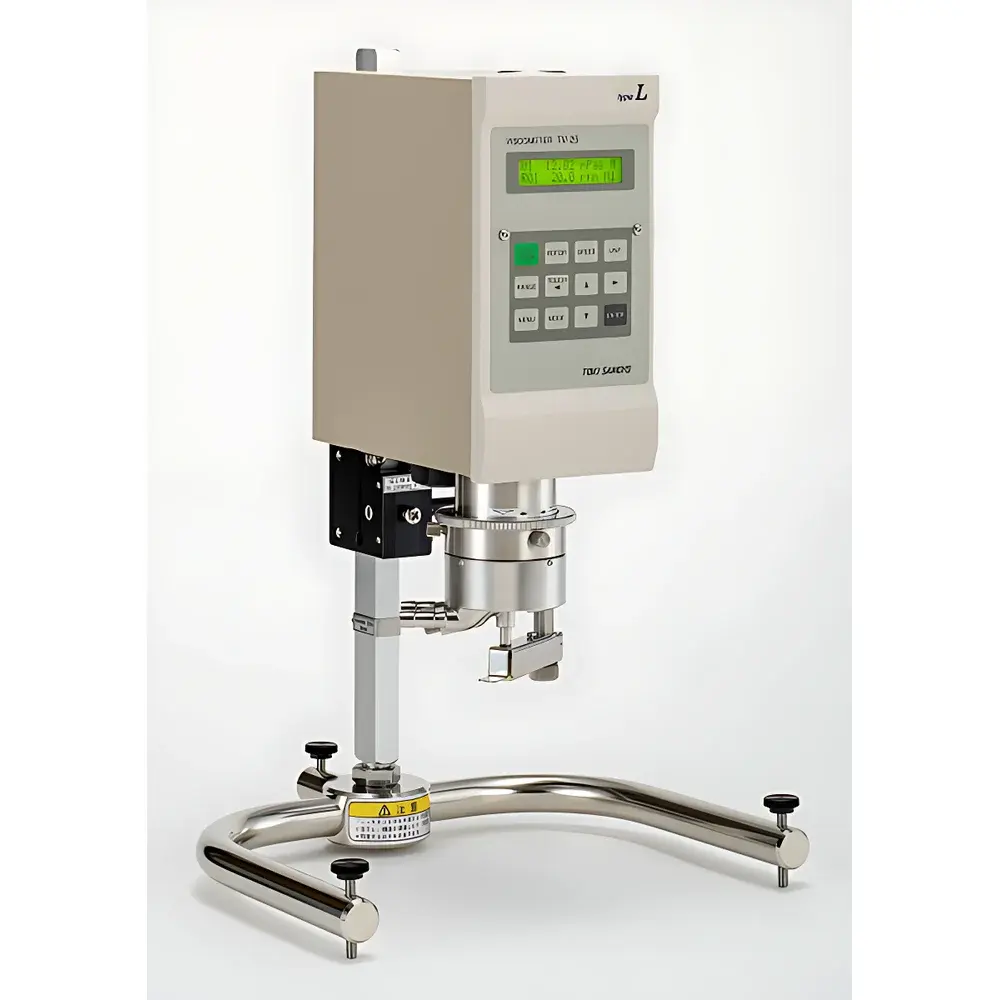
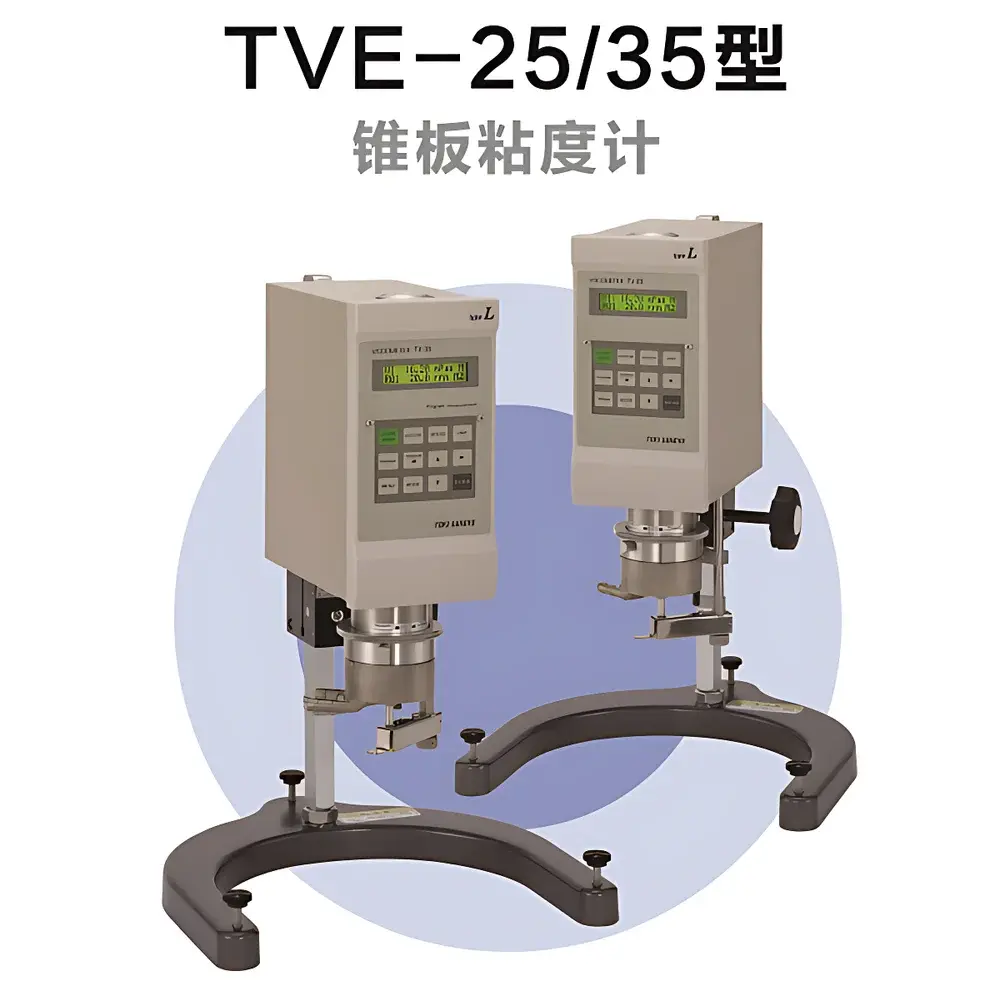
Tokisangyo TVE-25L/TVE-25H/TVE-35L/TVE-35H Cone-Plate Viscometers
| Brand | Tokisangyo |
|---|---|
| Origin | Japan |
| Model Variants | TVE-25L, TVE-25H, TVE-35L, TVE-35H |
| Instrument Type | Fixed-mount rotational viscometer |
| Operating Environment | Ambient temperature |
| Viscosity Range | 0.608 – 518,500 mPa·s (with standard 1°34′ × R24 cone rotor) |
| Torque Range | 7.37 – 5749.6 μN·m |
| Sample Volume | 1 mL |
| Programmable Steps | Up to 40 segments (TVE-35 series only) |
| TI (Thixotropic Index) Calculation | Supported via dual-speed ratio (e.g., 1:10) |
| Pivot-Free Bearing Architecture | Hinge-based suspension system replacing traditional jewel pivot |
Overview
The Tokisangyo TVE-25 and TVE-35 series are precision-engineered cone-plate rotational viscometers designed for high-accuracy, low-volume rheological characterization of Newtonian and non-Newtonian fluids under controlled shear conditions. Based on the fundamental principle of steady-state shear rheometry—where torque generated by fluid resistance to rotation of a precisely angled conical rotor against a flat plate is measured—the instruments deliver reproducible viscosity data across an exceptionally broad dynamic range. Unlike coaxial cylinder (Couette) geometries, the cone-plate configuration ensures uniform shear rate distribution across the entire sample gap, eliminating edge effects and enabling valid determination of apparent viscosity, yield stress (via flow curve analysis), and thixotropic behavior. These instruments are optimized for laboratories requiring regulatory-compliant viscosity validation in quality control, formulation development, and material specification verification—particularly where sample conservation, measurement repeatability, and operational efficiency are critical.
Key Features
- Pivot-free hinge suspension system: Replaces conventional jewel-and-pivot bearing assemblies with a low-hysteresis flexure hinge, eliminating mechanical play, reducing zero-torque drift, and enhancing long-term calibration stability.
- Single-sample-volume operation: Requires only 1 mL of sample per measurement—ideal for high-value, limited-availability, or hazardous materials—without compromising measurement fidelity or thermal equilibration time.
- Auto-ranging torque sensing: Integrated high-resolution torque transducer automatically selects optimal measurement range (up to 8× dynamic expansion) without manual rotor exchange, supporting uninterrupted multi-point flow sweeps.
- Programmable multi-step protocols (TVE-35 only): Supports up to 40 user-defined segments with programmable ramp rates, dwell times, speed sequences, RETURN loops, and REPEAT cycles—enabling automated thixotropy recovery, creep-recovery, and oscillatory pre-shearing routines.
- TI (Thixotropic Index) calculation: Computes the ratio of viscosity values measured at two user-specified rotational speeds (typically 1:10 ratio), providing a standardized metric for time-dependent structural breakdown under shear—widely referenced in coatings, inks, and pharmaceutical suspensions per ASTM D2196 and ISO 3219.
Sample Compatibility & Compliance
The TVE series accommodates a wide spectrum of liquid and semi-fluid samples—including polymer melts, adhesives, paints, cosmetics, food emulsions, and biopharmaceutical buffers—provided they exhibit sufficient cohesion to maintain gap integrity during rotation. Standard cone geometry (1°34′ × R24) ensures compliance with ISO 2555 and ASTM D1084 for cone-plate viscosity testing. Optional cone angles and diameters (e.g., 2°, 4°, R12) are available for specialized applications requiring higher shear rates or reduced normal force sensitivity. All models support GLP/GMP-aligned operation through traceable calibration certificates (NIST-traceable torque and angular velocity standards), and firmware logs include timestamped audit trails for instrument status, parameter changes, and measurement events—facilitating FDA 21 CFR Part 11 readiness when paired with compliant LIMS integration.
Software & Data Management
Instrument control and data acquisition are managed via Tokisangyo’s proprietary Windows-based software, offering real-time torque/viscosity plotting, automatic curve fitting (Power Law, Bingham, Herschel-Bulkley), and export to CSV, Excel, or PDF formats. Raw data files retain full metadata—including ambient temperature, rotor ID, gap setting, and calibration coefficients—ensuring full traceability. The software supports batch report generation with customizable templates aligned with internal SOPs or external regulatory submissions (e.g., USP , EP 2.9.35). For enterprise environments, OPC UA-compatible drivers enable seamless integration into centralized SCADA or MES platforms without third-party middleware.
Applications
- Quality assurance of industrial lubricants and greases per ASTM D2983 and ISO 6743
- Rheological profiling of topical pharmaceutical gels and ointments under USP guidelines
- Formulation optimization of waterborne architectural coatings (shear-thinning index, sag resistance)
- Process validation of inkjet inks and screen printing pastes
- Stability assessment of nanoparticle dispersions and colloidal suspensions
- Batch release testing of food-grade starch thickeners and hydrocolloid blends
FAQ
What sample volume is required for accurate measurement?
A minimum of 1.0 mL is required to fully cover the cone-plate gap and ensure laminar flow conditions—no additional solvent or dilution is necessary.
Can the instrument measure yield stress?
Yes—by conducting controlled shear stress ramps and analyzing the flow curve onset, yield stress can be estimated using the Casson or Herschel-Bulkley model within the software.
Is calibration traceable to international standards?
All factory calibrations are performed using NIST-traceable torque and rotational speed references, with documentation provided per ISO/IEC 17025 requirements.
Does the system support 21 CFR Part 11 compliance?
The instrument itself provides electronic audit trails; full Part 11 compliance requires deployment within a validated software environment with role-based access control and digital signature capability.
What maintenance is required to sustain accuracy?
Annual verification using certified reference oils (e.g., Cannon-Fenske or Brookfield standards) and visual inspection of cone surface finish and plate parallelism are recommended—no routine lubrication or alignment adjustments are needed due to the pivot-free architecture.



