
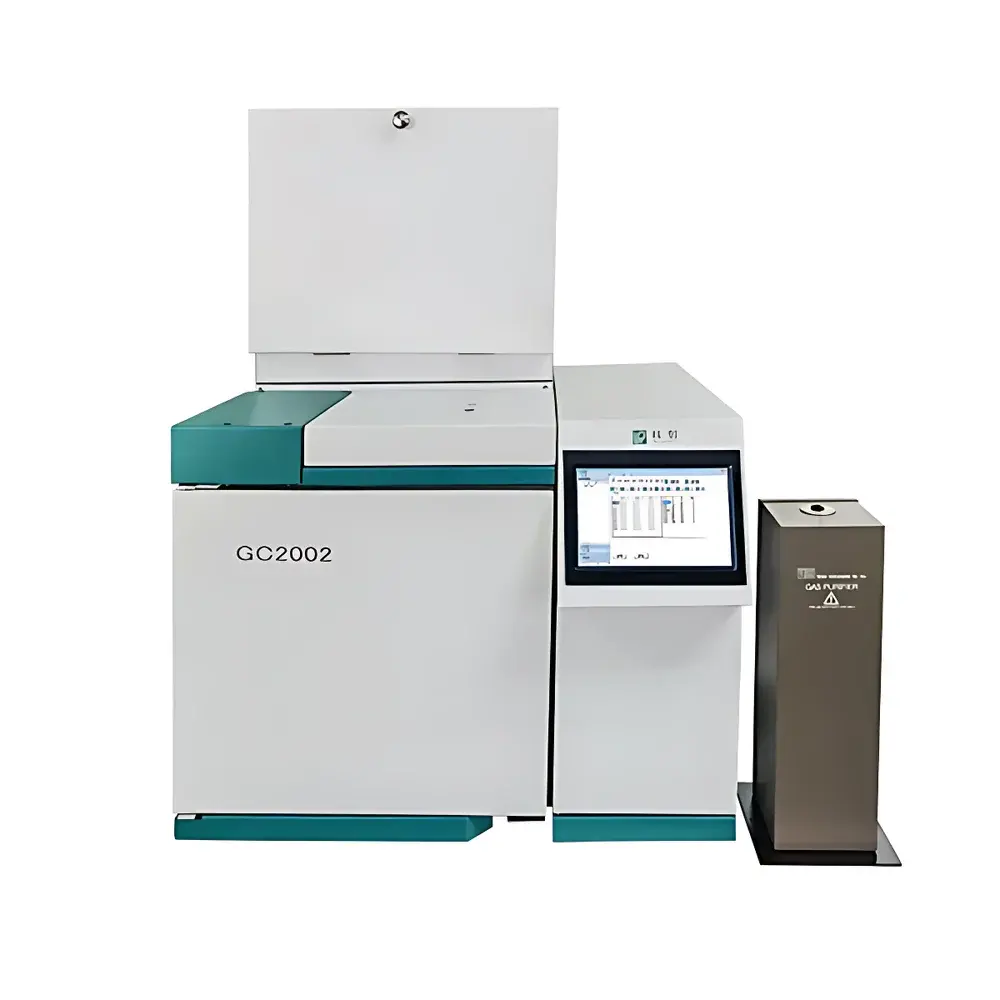
KeChuang GC2002N/PDHID Helium-Ionization Gas Chromatograph for Trace Impurity Analysis in High-Purity and Ultra-High-Purity Helium
| Brand | KeChuang |
|---|---|
| Origin | Shanghai, China |
| Manufacturer Type | Manufacturer |
| Instrument Type | Laboratory Gas Chromatograph |
| Model | GC2002N/PDHID |
| Temperature Control Range | 0–400 °C |
| Oven Ramp Rate | up to 40 °C/min |
| Oven Cool-Down Rate | 60 °C/min (reaching ambient in ≤4 min) |
| Carrier Gas Flow Range | 0–500 mL/min |
| Carrier Gas Pressure Range | 0–0.4 MPa |
| Injector Maximum Temperature | 300 °C |
| Injector Pressure Setting Range | 0–0.4 MPa |
| Injector Total Flow Setting Range | 0–500 mL/min |
| Detection Principle | Pulsed Discharge Helium Ionization Detection (PDHID) |
| Target Applications | High-purity helium (5N/6N) impurity profiling per GB/T 4844–2011 |
Overview
The KeChuang GC2002N/PDHID is a dedicated gas chromatograph engineered for the quantitative determination of trace-level impurities in high-purity (5N, ≥99.999%) and ultra-high-purity (6N, ≥99.9999%) helium matrices. It employs pulsed discharge helium ionization detection (PDHID), a universal, non-destructive, and highly sensitive detection method optimized for permanent gases and light hydrocarbons. Unlike flame ionization or thermal conductivity detectors, PDHID provides consistent response factors across a broad range of analytes—including H₂, O₂, N₂, CH₄, CO, CO₂, and Ne—without requiring individual calibration for each species, thereby enhancing analytical robustness and reducing method development time. The system is fully compliant with Chinese national standard GB/T 4844–2011 for helium purity classification and supports full traceability in regulated environments where reproducibility and long-term stability are critical.
Key Features
- Integrated PDHID detector with low-noise electronics and stable helium plasma generation, enabling sub-ppb-level detection limits for key impurities (e.g., 13 ppb for CO, 24 ppb for O₂+Ar, 26 ppb for CO₂).
- Programmable oven with rapid thermal response: 0–400 °C operating range, ramp rates up to 40 °C/min, and active cooling achieving ambient temperature in ≤4 minutes—critical for high-throughput analysis of multiple helium batches.
- Dual independent pressure and flow control modules for carrier gas (helium) and make-up gas, ensuring precise retention time reproducibility (<0.05% RSD over 24 h).
- High-temperature injector (up to 300 °C) with split/splitless capability and electronic pressure programming (EPP) for optimal peak shape and sensitivity across volatile and semi-volatile impurities.
- Modular column configuration supporting packed and capillary columns; commonly deployed with molecular sieve 5A and Porapak Q for simultaneous separation of permanent gases and C₁–C₂ hydrocarbons.
- Embedded firmware with real-time diagnostics, automatic leak detection, and hardware self-calibration routines to maintain baseline stability and minimize downtime.
Sample Compatibility & Compliance
The GC2002N/PDHID is validated for direct injection of helium gas samples via gas-tight syringe or automated valve-based sampling systems. It meets the analytical requirements specified in GB/T 4844–2011 for both 5N and 6N helium grade certification. Its detection sensitivity and quantification accuracy align with international expectations for high-purity gas analysis, including ISO 8573-5 (compressed air purity classes) and ASTM D1946 (analysis of reformed gas). While not pre-certified for FDA 21 CFR Part 11, the instrument’s data acquisition architecture supports audit-trail-enabled software configurations compatible with GLP/GMP-compliant laboratories when paired with validated third-party chromatography data systems (CDS).
Software & Data Management
The system operates with KeChuang’s proprietary ChromaSoft v3.x workstation, offering intuitive method setup, real-time chromatogram visualization, integrated peak integration (with baseline correction and deconvolution), and customizable report templates. All raw data files (.chd) are stored in a structured binary format with embedded metadata (instrument parameters, user ID, timestamp, sequence ID). Export options include CSV, PDF, and XML for LIMS integration. Software supports multi-point calibration curves, internal standard correction, and uncertainty propagation per ISO/IEC 17025 guidelines. Optional CDS upgrade paths provide electronic signatures, role-based access control, and full 21 CFR Part 11 compliance for regulated pharmaceutical and semiconductor manufacturing facilities.
Applications
- Quality control of helium supply chains—from cryogenic liquid helium dewars to cylinder-filling stations and on-site purification units.
- Verification of helium purity prior to use in semiconductor process tools (e.g., CVD, etching, EUV lithography), where sub-ppb O₂ or H₂O can induce oxide defects or catalyst poisoning.
- Supporting metrology labs in inter-laboratory comparison studies and reference material certification (e.g., NIST-traceable helium standards).
- Monitoring helium recycling systems in MRI facilities and research accelerators, where accumulated N₂ or Ar must be removed to sustain superconducting magnet stability.
- Method development for emerging applications such as helium isotope ratio analysis (³He/⁴He) in geochemical tracer studies, leveraging PDHID’s linear dynamic range (>10⁶) and low drift characteristics.
FAQ
What detection principle does the GC2002N/PDHID use, and why is it preferred for helium matrix analysis?
It uses pulsed discharge helium ionization detection (PDHID), which generates metastable helium ions that efficiently ionize nearly all organic and inorganic compounds except helium itself—making it ideal for detecting trace impurities in helium without matrix interference.
Does the system support automated sample introduction?
Yes—standard configurations include a 10-port gas sampling valve with programmable actuation; optional integration with auto-samplers (e.g., KeChuang AS-2000) enables unattended analysis of up to 48 cylinders per sequence.
How is calibration traceability ensured?
Calibration is performed using certified gas standards traceable to NIM (National Institute of Metrology, China); typical validation includes seven-point linearity assessment, repeatability testing (RSD <2% for all target analytes), and intermediate precision evaluation across operators and days.
Can the GC2002N/PDHID analyze moisture (H₂O) directly?
No—H₂O is not detected by PDHID due to its low ionization efficiency and strong adsorption behavior. For water quantification, coupling with a chilled-mirror hygrometer or FTIR-based moisture analyzer is recommended as a complementary technique.
Is column selection flexible for different impurity profiles?
Yes—the dual-column oven accommodates up to two independently temperature-controlled columns (e.g., 5Å molecular sieve + Plot Al₂O₃/KCl), allowing method optimization for specific regulatory or customer-defined spec sheets.




