
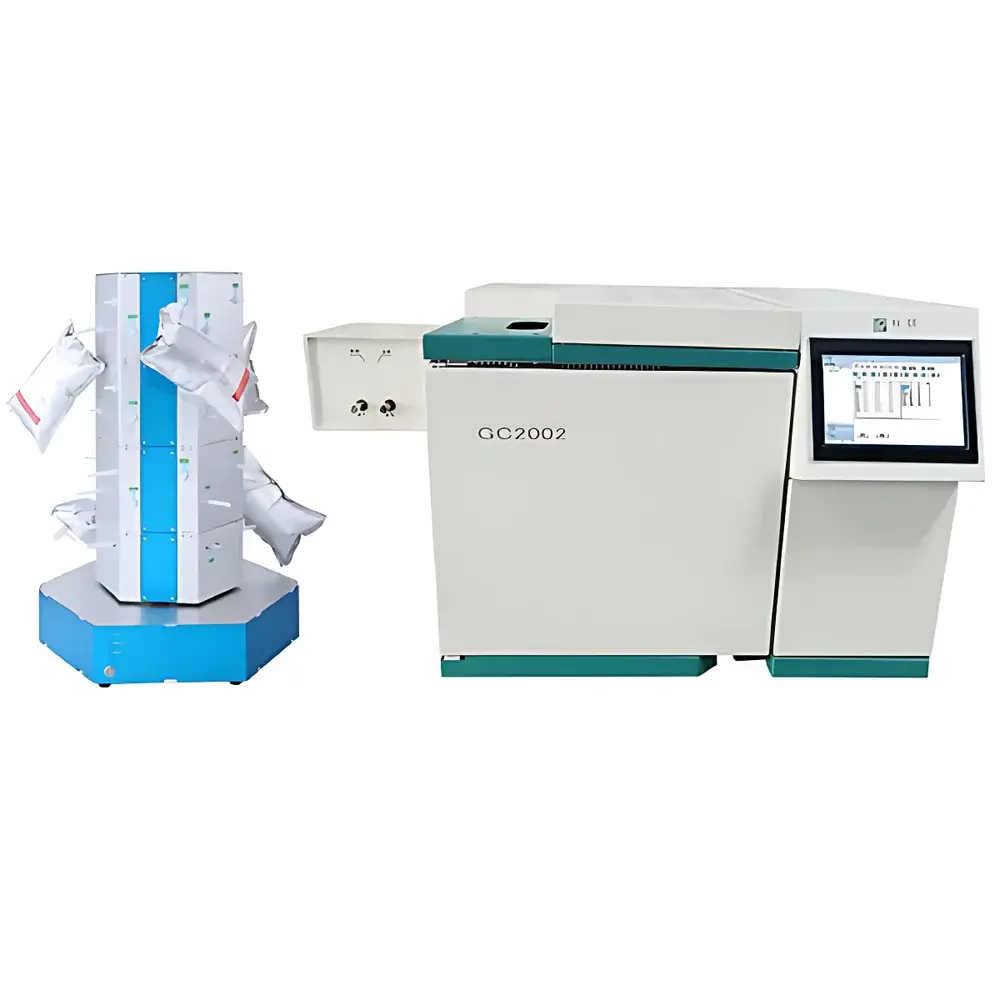
SciTech GC2002-NMHC Environmental Air Total Hydrocarbons & Non-Methane Hydrocarbons Analysis System
| Brand | SciTech |
|---|---|
| Origin | Shanghai, China |
| Manufacturer Type | OEM Manufacturer |
| Category | Laboratory Gas Chromatograph for Environmental Monitoring |
| Model | GC2002 Networked GC + KC Series Automated Gas Sampler |
| Temperature Control Range | Ambient +5°C to 450°C |
| Oven Ramp Rate | 0–40°C/min |
| Cooling Time | ≤4 min (from 450°C to 50°C) |
| Carrier Gas Flow Range & Control | 0–1200 mL/min |
| Carrier Gas Pressure Range & Control | 0–970 kPa |
| Injector Max Operating Temperature | 450°C |
| Injector Pressure Setting Range | 0–970 kPa |
| Injector Total Flow Setting Range | 0–1200 mL/min |
| Detector | FID with Detection Limit ≤3.0×10⁻¹² g/s (n-Hexadecane), Baseline Noise ≤1.0×10⁻¹³ A, Drift ≤5.0×10⁻¹³ A (30 min), Linear Range 10⁷ |
| Sample Capacity | 16–85 positions (field-upgradable) |
| Injection Precision | RSD <0.5% (n=10, total hydrocarbons & methane peak areas) |
| Injection Volume Options | 1, 2, or 3 mL quantitative loop |
| Sampling Pump | Max flow 10 L/min, ultimate vacuum –80 kPa |
| Tubing Material | PTFE |
| Calibration Function | Automated 8-point standard curve generation |
Overview
The SciTech GC2002-NMHC Environmental Air Total Hydrocarbons & Non-Methane Hydrocarbons Analysis System is a purpose-built, regulatory-compliant gas chromatographic platform engineered for precise, high-throughput quantification of total hydrocarbons (THC), methane (CH4), and non-methane hydrocarbons (NMHC) in ambient air and stack emissions. It implements the dual-column, dual-detection principle per HJ 604–2017 and HJ/T 38–2017—China’s national environmental standards aligned with international GC-based NMHC methodologies. The system integrates a networked laboratory GC (GC2002) with a dedicated KC-series automated gas sampler, enabling direct, valve-switched injection into parallel packed columns without manual intervention. This architecture eliminates sample splitting errors and ensures co-elution-free separation: THC elutes first on a GDX-502 or GDX-104 column, while CH4 is resolved on a silanized glass bead column—both detected simultaneously by a flame ionization detector (FID). Quantification is performed via external calibration using pre-configured multi-point standard curves; results are reported directly in mg/m³ (dry air, standard temperature and pressure), fully traceable to NIST-traceable hydrocarbon standards.
Key Features
- Regulatory-ready configuration compliant with HJ 604–2017 (ambient air) and HJ/T 38–2017 (stationary source emissions), supporting both grab sampling and continuous monitoring workflows.
- Dual-column, dual-valve manifold design: single injection delivers concurrent THC and CH4 chromatograms on one acquisition—eliminating inter-run variability and manual peak integration.
- Network-enabled GC2002 chassis with RJ45 Ethernet interface: supports remote instrument control, real-time data streaming, and centralized fleet management (up to 253 units per subnet).
- Eight-stage programmable oven with ±0.1°C thermal stability and ≤0.5% ramp reproducibility; auto-backdoor cooling achieves ≤4-minute cooldown from 450°C to 50°C.
- KC-series sampler with modular carousel (16/28/40/64 positions, field-expandable to ≥85), PTFE fluidic path, and integrated vacuum pump (–80 kPa, 10 L/min) for robust sampling of low-concentration ambient matrices.
- FID optimized for hydrocarbon detection: linear dynamic range of 10⁷, sub-pg/s sensitivity, and baseline stability meeting ISO 8573-1 Class 2 purity requirements for carrier gas systems.
- Embedded 8-inch touchscreen interface with intuitive workflow navigation; onboard data buffering ensures continuity during network latency or temporary disconnection.
Sample Compatibility & Compliance
The system is validated for gaseous samples collected in evacuated canisters (SUMMA®-type), Tedlar® bags, or online via heated sampling lines (optional). It accommodates ambient air, urban background air, industrial fence-line air, and flue gas after appropriate dilution and moisture removal. Column selection (GDX-502, GDX-104, or silanized glass beads) is user-selectable based on target analyte volatility and matrix complexity. All hardware and software modules conform to GLP/GMP documentation requirements: audit trails, electronic signatures, and full data integrity logging are embedded in the native workstation. While not FDA 21 CFR Part 11-certified out-of-the-box, the architecture supports validation packages for regulated laboratories requiring 21 CFR Part 11 compliance—including secure user roles, immutable raw data archives, and change-controlled method versions.
Software & Data Management
The proprietary SciTech NMHC Workstation provides method-driven acquisition, automated peak identification (THC and CH4 retention time windows), and direct NMHC calculation (NMHC = THC − CH4) with uncertainty propagation per ISO/IEC 17025:2017 Annex A. Raw chromatograms (.scd binary format) and processed reports (.pdf/.xlsx) are stored with metadata including instrument ID, operator, calibration date, and environmental conditions (T/P/RH). Batch processing supports up to 999 samples per queue; QC flags trigger automatic re-injection for outliers exceeding user-defined RSD thresholds. Data export complies with ASTM D6348–21 and EU EN 13649–2 interchange formats for third-party LIMS integration. Remote diagnostics and firmware updates are delivered over HTTPS-secured channels.
Applications
- Ambient air quality monitoring networks (e.g., national EPA stations, urban AQMS)
- Industrial emission compliance testing at petrochemical plants, refineries, and coating facilities
- Landfill and biogas facility fugitive emission screening
- Method development and validation labs supporting ISO 11843-7 and EPA Method 25A equivalents
- Research on atmospheric VOC speciation and ozone formation potential (OFP) modeling
- Calibration laboratory traceability services for NMHC reference gases (ppb–ppm range)
FAQ
Does the system support unattended overnight operation?
Yes—the KC-series sampler and GC2002 are designed for 24/7 autonomous runs. The workstation includes auto-shutdown, leak detection alerts, and priority-based sample queue management.
Can I use this system for stack gas analysis without dilution?
For high-concentration sources (>100 ppm THC), optional inline dilution modules (1:10 to 1:1000) are available to maintain linearity and prevent FID saturation.
Is column switching automated within a single run?
No—columns are fixed in parallel configuration; valve sequencing is pre-programmed per method, eliminating mechanical wear associated with active column switching.
What maintenance intervals are recommended for routine operation?
FID jet cleaning every 200 injections; GC inlet liner replacement every 500 injections; carrier gas filter replacement quarterly; annual oven insulation and detector alignment verification.
Are certified reference materials included with the system?
No—CRM procurement is site-specific and must comply with local metrological regulations; however, the software includes templates for NIST SRM 1860, 1861, and custom mixtures.





