
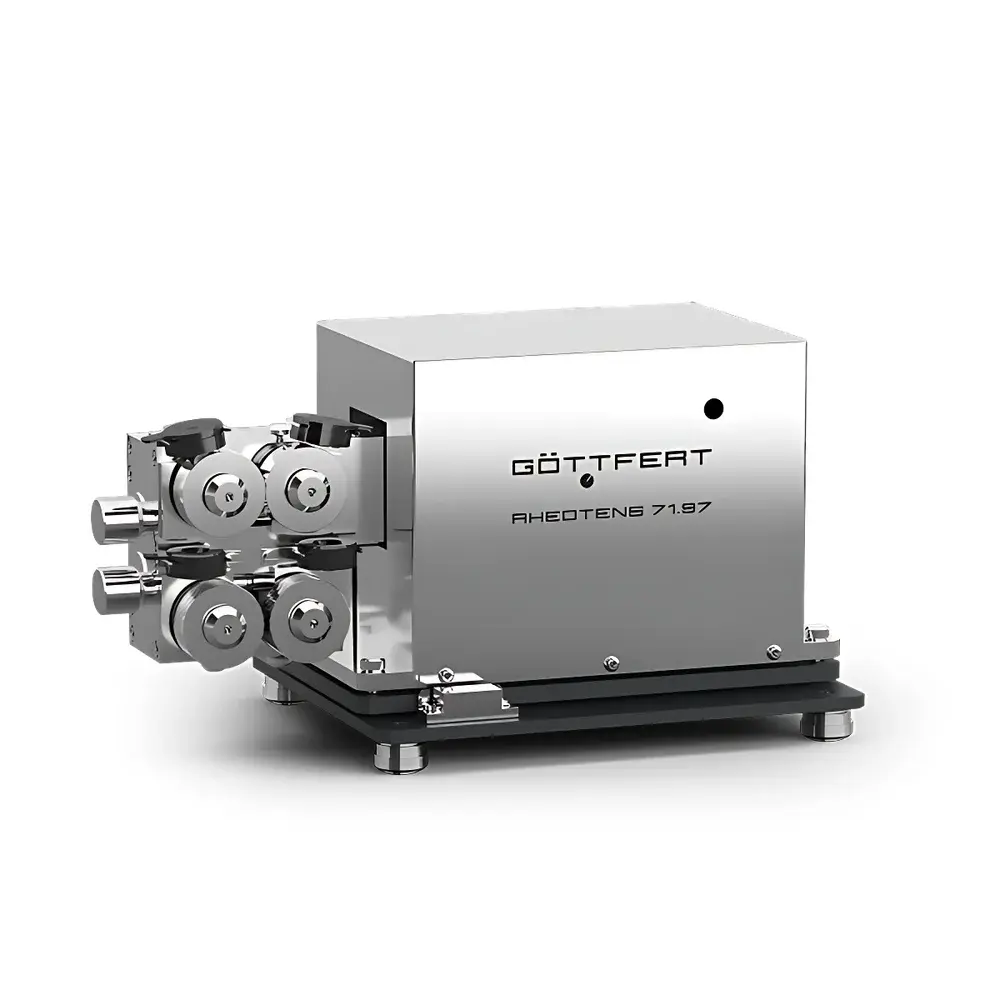
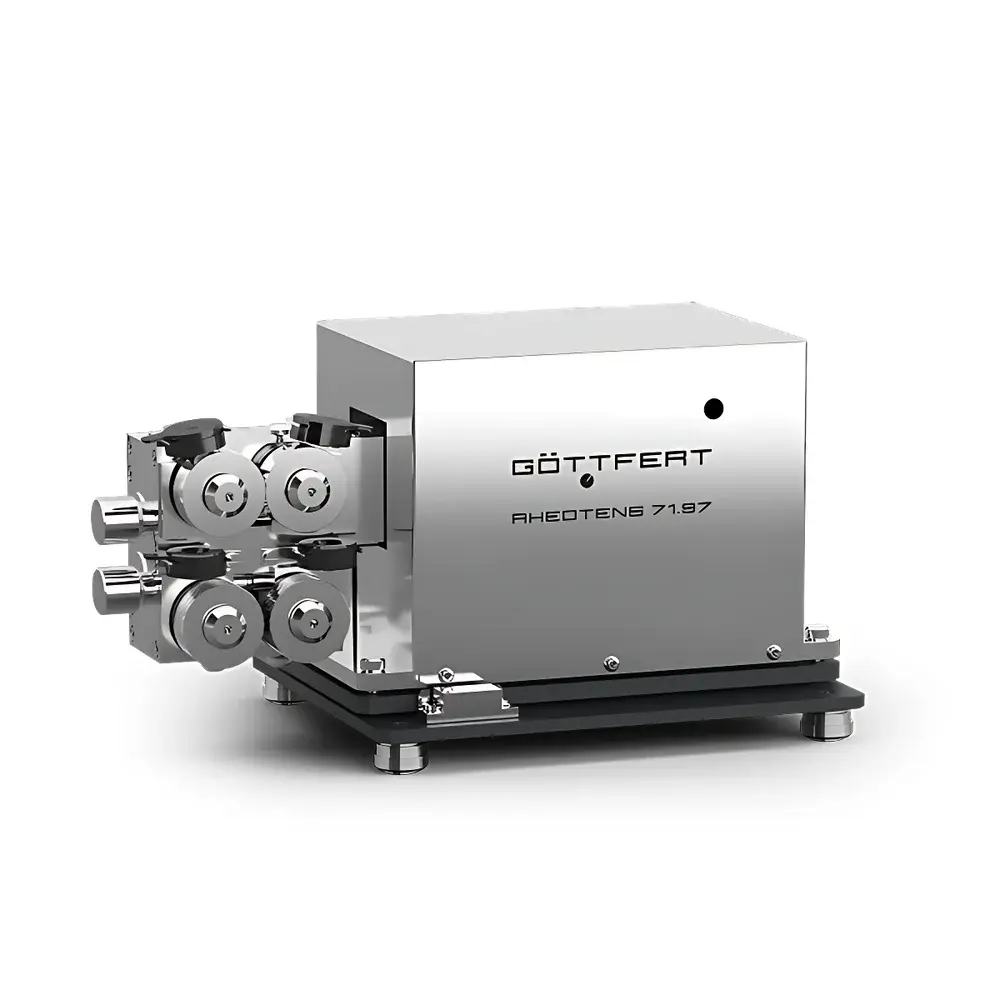
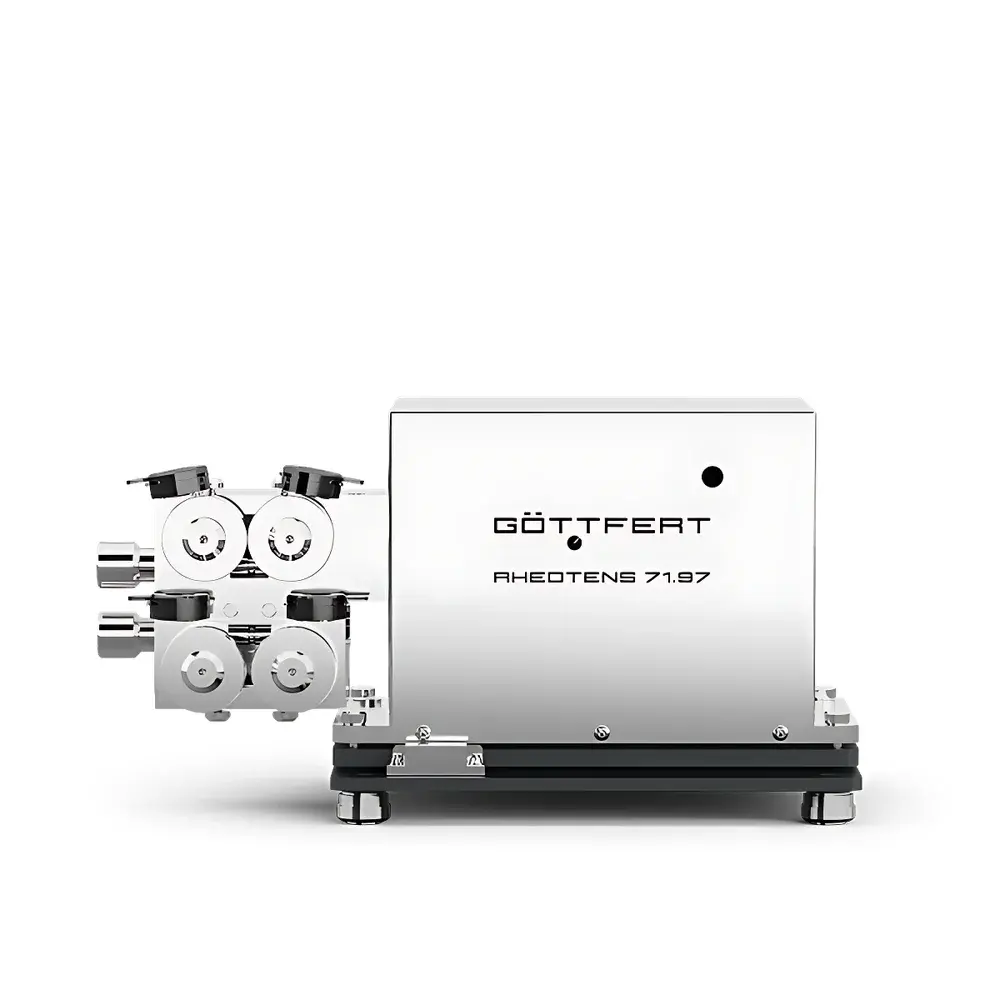
Goettfert RHEOTENS 71.97 Melt Extensional Rheometer
| Brand | Goettfert |
|---|---|
| Origin | Germany |
| Model | RHEOTENS 71.97 |
| Speed Range | 0–190 cm/s (0–114 m/min) |
| Force Range | 0–2.0 N |
| Force Resolution | 1 mN |
| Acceleration Modes | Linear or Exponential |
| Dimensions (L×W×H) | 320 × 205 × 195 mm |
| Weight | 20 kg |
| Roller Configuration | Dual traction rollers |
| Compliance | ASTM D3835, ISO 11443, DIN 53736, ISO 25277-1 |
Overview
The Goettfert RHEOTENS 71.97 is a precision-engineered melt extensional rheometer designed for the quantitative characterization of polymer melts under uniaxial extensional deformation. Unlike rotational or capillary-based rheometers—which primarily probe shear response—the RHEOTENS operates on the principle of controlled melt filament stretching between two counter-rotating traction rollers. This configuration subjects the extrudate to well-defined, time-dependent tensile stress while maintaining continuous melt contact without solidification, enabling direct measurement of extensional viscosity, melt strength, strain hardening behavior, and drawability. Its patented roller geometry and high-resolution force transduction system allow for stable filament elongation at strain rates ranging from 0.01 s⁻¹ to >10 s⁻¹—critical for evaluating processing-relevant behaviors in fiber spinning, film blowing, blow molding, and thermoforming operations.
Key Features
- True extensional deformation mode: Measures intrinsic melt strength and extensional viscosity without wall slip or end effects inherent in capillary or rotational geometries.
- Dual-traction roller system: Minimizes sample adhesion and slippage; enables reproducible filament formation across diverse thermoplastic and elastomeric melts.
- Adjustable acceleration profiles: Supports both linear and exponential acceleration modes to simulate realistic processing strain histories (e.g., constant strain rate vs. transient draw resonance).
- High-resolution force detection: 0–2.0 N load cell with 1 mN resolution ensures accurate capture of subtle yield points, strain hardening onset, and necking instabilities.
- Wide operational speed range: 0–190 cm/s (0–114 m/min), facilitating testing from low-draw-ratio extrusion conditions to high-speed fiber spinning regimes.
- Compact benchtop architecture: Footprint of 320 × 205 × 195 mm and mass of 20 kg enable integration into standard lab environments alongside twin-screw extruders or capillary rheometers.
Sample Compatibility & Compliance
The RHEOTENS 71.97 accommodates a broad spectrum of thermoplastic melts—including polyolefins (PP, PE), engineering plastics (PA6, PC, PBT), biopolymers (PLA, PHA), and thermoplastic elastomers—provided they exhibit sufficient melt elasticity and spinnability. It is routinely deployed in accordance with international standards governing extensional rheology: ASTM D3835 (for extrusion-related melt properties), ISO 11443 (determination of melt strength), DIN 53736 (melt fracture and draw resonance analysis), and ISO 25277-1 (extensional viscosity measurement of polymer melts). The instrument’s mechanical design and calibration traceability support GLP-compliant data generation, and its force/time output format is compatible with audit-ready reporting frameworks required under FDA 21 CFR Part 11 when integrated with validated software environments.
Software & Data Management
Data acquisition is managed via Goettfert’s proprietary WinRHEO software, which provides real-time visualization of force, velocity, strain, strain rate, and extensional viscosity versus time or Hencky strain. The software supports automated test sequencing, parameter scripting (e.g., ramp-and-hold acceleration profiles), and export of ASCII-compatible datasets for post-processing in MATLAB, Python, or commercial rheological modeling tools (e.g., POLYFLOW, Ansys Polyflow). All raw measurements are timestamped and logged with hardware ID and environmental metadata, fulfilling minimum ALCOA+ criteria (Attributable, Legible, Contemporaneous, Original, Accurate) for regulated laboratories. Optional digital I/O interfaces permit synchronized triggering with upstream extrusion systems or pressure transducers for closed-loop process correlation studies.
Applications
- Quantifying melt strength and strain hardening ratio to predict sag resistance in extrusion coating and parison stability in blow molding.
- Evaluating draw resonance thresholds during fiber spinning simulations to optimize take-up velocity and reduce breakage frequency.
- Comparing molecular architecture effects—e.g., long-chain branching (LCB) content in metallocene-catalyzed polyethylenes—via extensional viscosity master curves.
- Validating constitutive models (e.g., K-BKZ, Giesekus, Pom-Pom) using transient extensional data for CAE-driven process simulation.
- Supporting formulation development for high-melt-strength polypropylene (HMS-PP) used in automotive nonwovens and battery separator films.
FAQ
How does the RHEOTENS differ from a capillary rheometer with extensional correction?
Unlike capillary-based methods that infer extensional properties indirectly via entrance pressure corrections (e.g., Bagley or Mooney analysis), the RHEOTENS applies direct, controllable uniaxial tension—eliminating assumptions about flow field homogeneity and die entry effects.
Can it be coupled with an online extrusion system?
Yes—standardized flange interfaces and analog/digital I/O ports allow seamless integration with Goettfert’s ZEM/ZE series extruders or third-party single/twin-screw platforms for real-time melt characterization.
Is temperature control built into the RHEOTENS unit?
No—the RHEOTENS itself is not heated; it relies on temperature-stabilized extrudate supplied from an externally controlled extruder or capillary die, ensuring thermal history remains consistent with actual processing conditions.
What sample volume is required per test?
Approximately 5–10 g of polymer is typically sufficient for three to five repeat runs, depending on melt viscosity and extrusion throughput settings.
Does the system support automated calibration verification?
Yes—WinRHEO includes guided calibration routines using certified dead-weight standards traceable to national metrology institutes (e.g., PTB, NIST).
Related Products



