
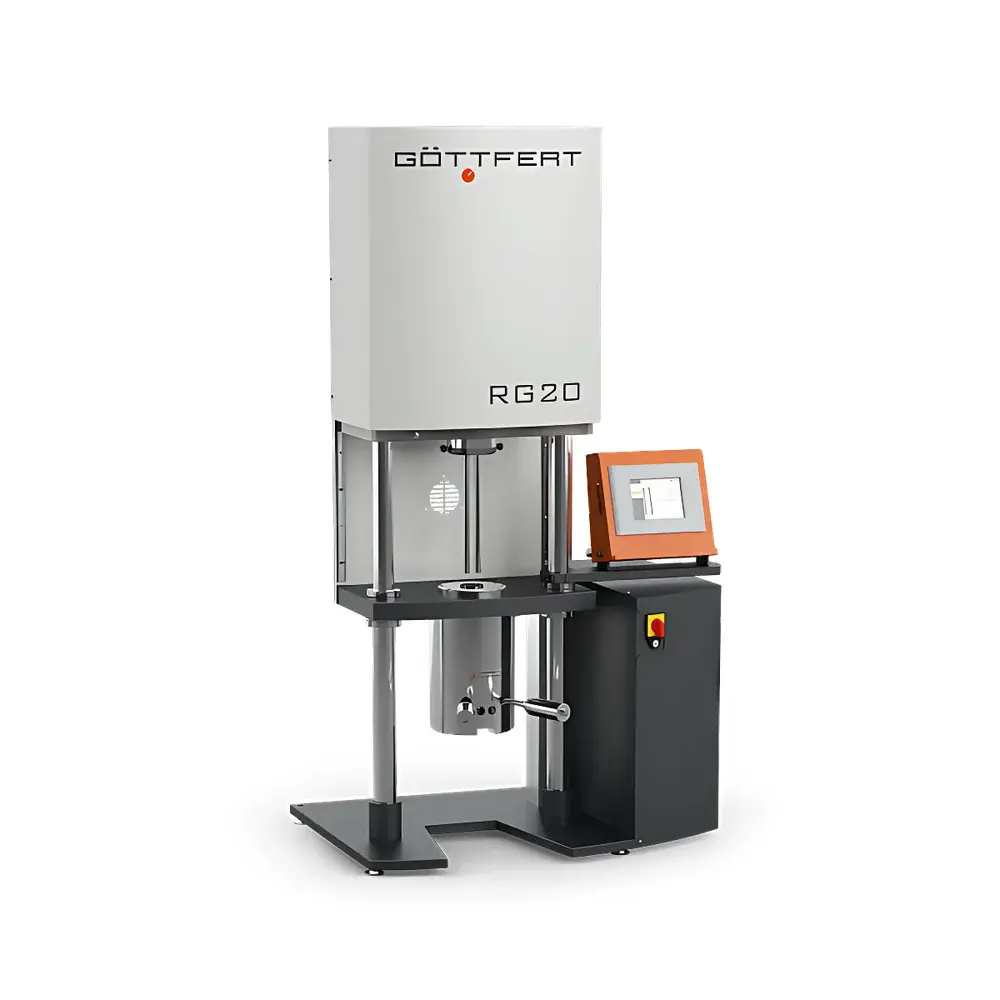
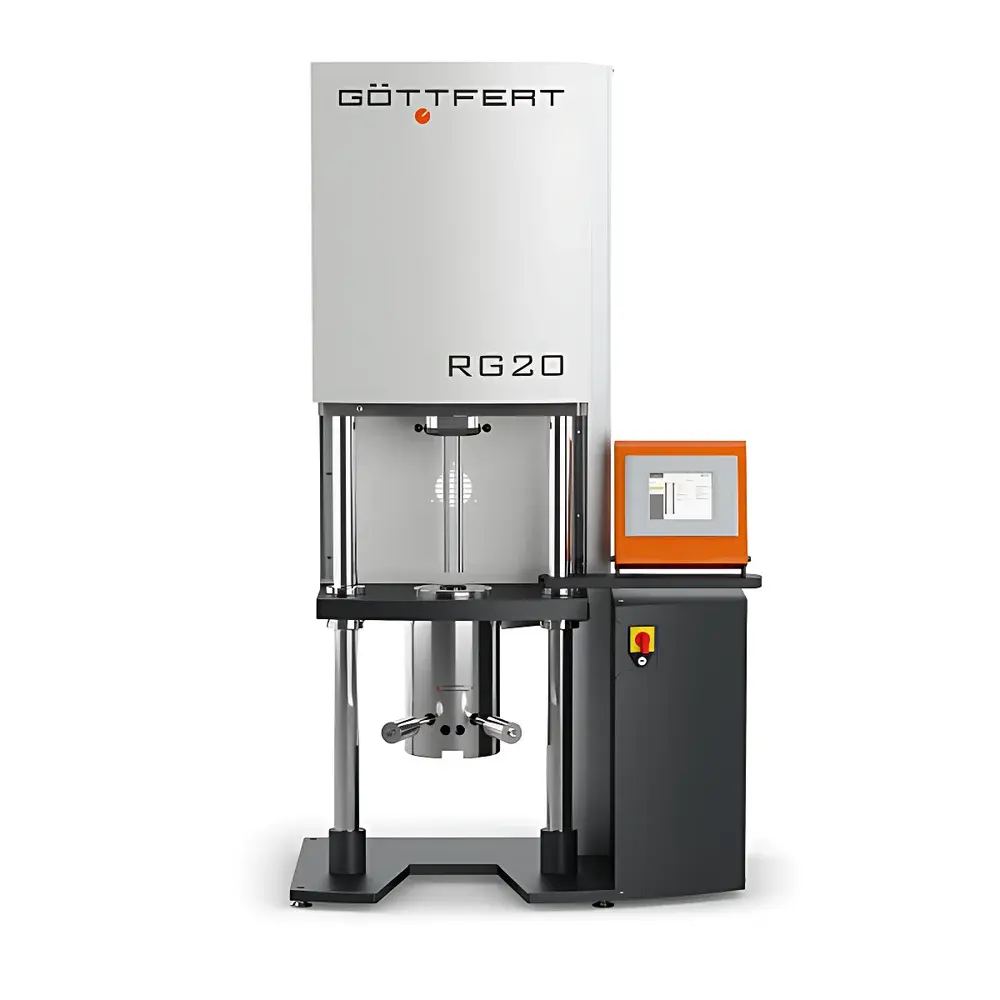
Goettfert RHEOGRAPH 20 Capillary Rheometer
| Brand | Goettfert |
|---|---|
| Origin | Germany |
| Instrument Type | Capillary Rheometer |
| Model | RHEOGRAPH 20 |
| Sample Type | High-Viscosity Thermoplastics & Elastomers |
| Sample State | Solid (Pellets, Granules, Powders) |
| Max Force | 20 kN |
| Temperature Range | 60–400 °C (optional up to 500 °C) |
| Temperature Accuracy | ±0.1 °C |
| Temperature Resolution | 0.01 °C |
| Piston Speed Range | 0.0001–30 mm/s (1:300,000 dynamic range) |
| Capillary Die Diameters | 12.0 / 15.0 / 20.0 / 25.0 mm |
| Barrel Length | 230 mm |
| Piston Length | 285 mm |
| Pressure Sensor Full-Scale Accuracy | ±0.2 % FS |
| Pressure Signal Resolution | 0.005 % FS |
| Dimensions (L×W×H) | 850 × 635 × 1550 mm |
| Weight | 270 kg |
Overview
The Goettfert RHEOGRAPH 20 is a high-precision, single-piston capillary rheometer engineered for the quantitative characterization of melt rheological behavior in thermoplastic polymers, elastomers, and highly viscous polymer melts under processing-relevant shear conditions. Based on the fundamental principle of capillary flow rheology—governed by the Hagen–Poiseuille equation—the instrument measures volumetric flow rate, pressure drop, and piston displacement to derive shear stress, shear rate, apparent viscosity, and extensional response. Designed in accordance with DIN 54811, ASTM D3835, ISO 11443, ASTM D5930 (TC), and ASTM D5099, the RHEOGRAPH 20 delivers traceable, reproducible data essential for material development, process simulation (e.g., extrusion, injection molding), and quality control in polymer manufacturing. Its 20 kN force capacity, ultra-wide piston speed range (0.0001–30 mm/s), and high-fidelity pressure transduction enable reliable measurements across both low-shear (long-term relaxation) and high-shear (processing) regimes—addressing critical gaps in conventional rotational rheometry for solid-state feedstock.
Key Features
- 20 kN hydraulic drive system with closed-loop force and position control, ensuring stable extrusion pressure even during transient flow events
- Modular single-piston barrel assembly with interchangeable die geometries (12.0, 15.0, 20.0, and 25.0 mm diameters) and standardized L/D ratios for compliance with international test standards
- High-stability temperature control system spanning 60–400 °C (optionally 500 °C), featuring dual-zone heating, axial thermal profiling, and ±0.1 °C accuracy with 0.01 °C display resolution
- Auto-identifying pressure transducers (“Plug & Measure”) with 0.005 % full-scale signal resolution and ±0.2 % FS linearity—enabling 10× improvement in measurement repeatability, particularly at low shear rates (<1 s⁻¹)
- Integrated 10.1″ color touchscreen HMI with intuitive workflow navigation, real-time parameter monitoring, and embedded calibration logging
- Rugged steel frame construction (270 kg total mass) with vibration-damped base, optimized for laboratory environments subject to ambient mechanical interference
Sample Compatibility & Compliance
The RHEOGRAPH 20 accepts solid-state polymeric feedstocks—including pellets, granules, and powders—with minimal pre-conditioning. Its high-force extrusion capability ensures complete melt homogenization and eliminates air entrapment in high-viscosity systems (e.g., PC, PEEK, filled PP, silicone rubber compounds). All standard test configurations comply with ISO 11443 Annex A (capillary rheometry), ASTM D3835 (melt flow rate and viscosity), DIN 54811 (polymer melt rheology), and ASTM D5930 for thermal conductivity-coupled testing. The system supports GLP/GMP-aligned operation through audit-trail-enabled software, electronic signature capability, and configurable user access levels—fully compatible with FDA 21 CFR Part 11 requirements when deployed with validated software modules.
Software & Data Management
The instrument operates via Goettfert’s proprietary RheoWin 5 software platform—a Windows-based application supporting automated test sequencing, multi-parameter acquisition (pressure, temperature, piston displacement, time), and real-time calculation of shear viscosity (ηa), first normal stress difference (N1), Bagley and Rabinowitsch corrections, and die swell ratio. Raw data are stored in ASCII and HDF5 formats; export options include CSV, Excel, and universal .rhe files for third-party rheological modeling tools (e.g., Polyflow, Moldflow, MATLAB). Software modules support advanced analysis workflows including time–temperature superposition (TTS), master curve generation, and linear viscoelastic envelope (LVE) mapping. All calibration certificates, method templates, and operator logs are digitally archived with timestamped metadata and tamper-evident integrity checks.
Applications
- Processing window definition for extrusion, blow molding, and film casting via shear-thinning index and melt fracture onset detection
- Quality assurance of incoming polymer lots using standardized melt viscosity profiles at multiple shear rates (10–10⁵ s⁻¹)
- Development of filled or reinforced composites—quantifying filler-induced viscosity elevation and non-Newtonian transition points
- PVT (Pressure–Volume–Temperature) characterization for equation-of-state modeling and shrinkage prediction
- Extensional rheology assessment using optional Rheotens or haul-off units for strain hardening evaluation
- Surface defect analysis (e.g., shark-skin, melt fracture) via synchronized high-speed imaging and pressure fluctuation spectroscopy
- Die swell and extrudate recovery quantification using integrated optical measurement kits
FAQ
What standards does the RHEOGRAPH 20 comply with?
DIN 54811, ASTM D3835, ISO 11443, ASTM D5930 (TC), ASTM D5099, and DIN ISO 48—covering capillary rheometry, melt flow rate, and thermal conductivity testing.
Can it measure extensional viscosity?
Not natively—but integration with the optional Rheotens or Haul-Off unit enables controlled uniaxial extensional testing per ISO 19921 and ASTM D7175 protocols.
Is PVT testing supported out of the box?
No—PVT functionality requires the dedicated Goettfert PVT Test Unit, which mounts directly to the barrel and interfaces seamlessly with RheoWin 5.
What is the minimum measurable shear rate?
Down to 0.001 s⁻¹ (dependent on die geometry and sample viscosity), enabled by ultra-low piston speed (0.0001 mm/s) and high-resolution pressure sensing.
How is temperature uniformity ensured along the barrel?
Through independently controlled axial heating zones, precision-machined copper thermal shunts, and real-time PID feedback from five embedded Pt100 sensors distributed over the 230 mm barrel length.
Related Products



