
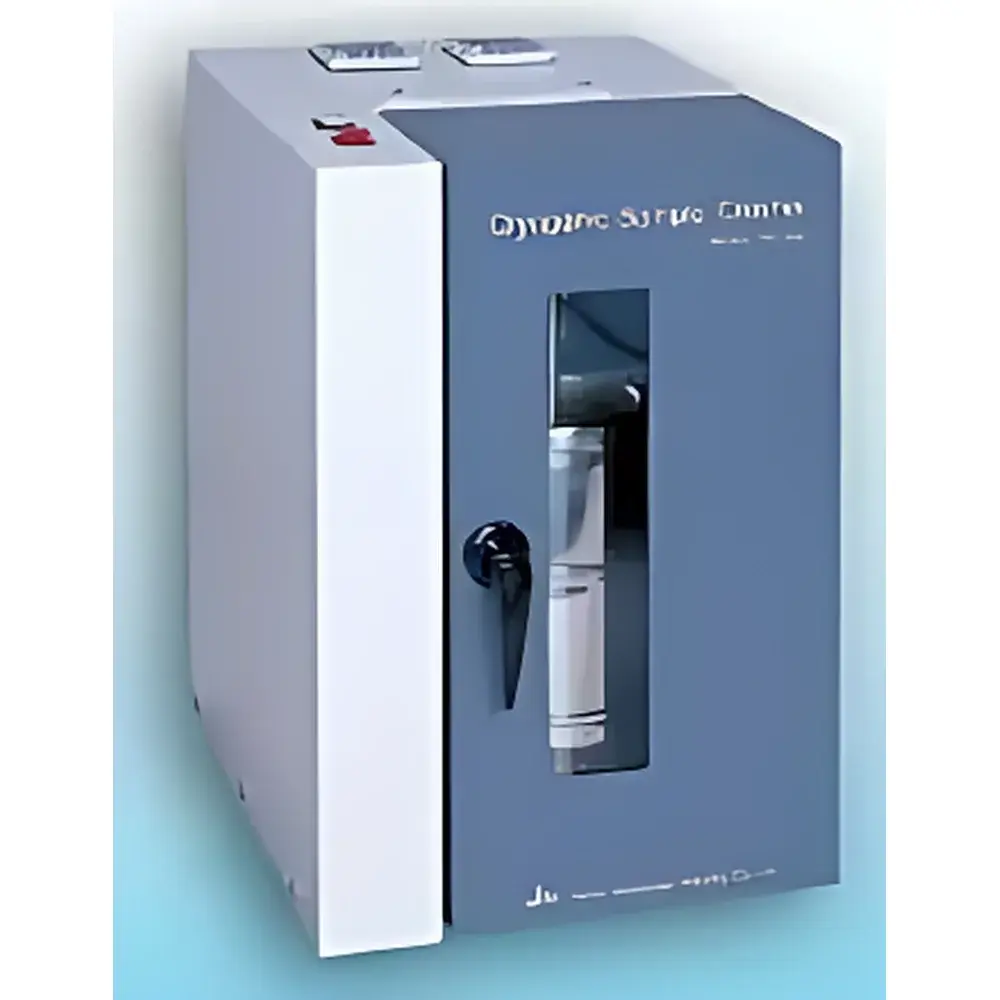
JAI JFC-300 Cryogenic Ball Mill
| Brand | JAI |
|---|---|
| Origin | Japan |
| Model | JFC-300 |
| Sample Type | Cryogenic |
| Max Feed Size | <15 mm |
| Final Particle Size | <40 µm |
| Batch Capacity | 6 mL (up to 3 g) |
| Operating Frequency | 1250–1450 cycles/min (50/60 Hz) |
| Vial Volume | 12 mL |
| Liquid Nitrogen Dewar Volume | 1000 mL |
| Power Supply | AC 100 V ±10%, 5 A |
Overview
The JAI JFC-300 Cryogenic Ball Mill is an engineered solution for the controlled, low-temperature mechanical comminution of temperature-sensitive and tough polymeric, elastomeric, and biological materials. Operating on the principle of high-frequency vertical reciprocation within a cryogenically cooled environment, the system utilizes tungsten carbide balls inside sealed sample vials immersed in liquid nitrogen (−196 °C). This thermal stabilization prevents thermal degradation, plastic deformation, or phase transitions during grinding—critical for preserving volatile components, crystallinity, and molecular integrity prior to downstream analytical workflows including FTIR, solid-state NMR, GC-MS, and DSC.
Unlike ambient or refrigerated mills, the JFC-300 maintains sample integrity through sustained sub-zero conditions throughout the entire pulverization cycle—from pre-cooling to final particle formation. Its robust architecture integrates precise timing control for both pre-chilling and active milling phases, ensuring reproducible kinetic energy transfer while minimizing heat buildup from friction or impact.
Key Features
- Vertical reciprocating motion at 1250 cycles/min (50 Hz) or 1450 cycles/min (60 Hz), delivering consistent impact energy without rotational shear artifacts
- Cryogenic operation with integrated 1000 mL vacuum-insulated liquid nitrogen dewar, enabling extended run times with minimal LN₂ consumption
- 12 mL capacity stainless-steel or optional titanium alloy sample vials—chemically inert, non-magnetic, and compatible with trace-level analysis
- Pre-programmable dual-stage timer: independent settings for pre-cooling duration and active milling time (0–99 min each)
- Standard tungsten carbide grinding media (density: 14.5 g/cm³) ensures high-energy impact without metallic contamination of polymer or biological matrices
- Compact footprint and CE-compliant electrical design (AC 100 V ±10%, 5 A) suitable for ISO Class 5–7 laboratory environments
Sample Compatibility & Compliance
The JFC-300 is validated for processing a broad spectrum of thermally labile and mechanically resilient materials, including but not limited to: polystyrene (PS), high-impact polystyrene (HIPS), polyethylene (LDPE/HDPE), polypropylene (PP), polymethyl methacrylate (PMMA), ethylene-vinyl acetate (EVA), acrylonitrile-butadiene-styrene (ABS), nylon 6 and MXD6 composites, polyphenylene sulfide (PPS), polyoxymethylene (POM), rigid and flexible PVC, polytetrafluoroethylene (PTFE), polyetheretherketone (PEEK), silicone rubber, vulcanized IIR, cellulose derivatives, printed circuit board substrates, and natural biomass (e.g., wood chips, plant tissues, freeze-dried mammalian tissue). It supports ASTM D3418 (DSC sample prep), USP (cryogenic grinding for pharmaceutical excipients), and ISO 17892-3 (soil and sediment comminution for elemental analysis). All standard accessories comply with RoHS and REACH directives.
Software & Data Management
The JFC-300 operates as a standalone hardware platform with no embedded firmware or digital interface. All operational parameters—including pre-cool time, milling duration, and frequency selection—are set manually via front-panel controls. This analog architecture eliminates software validation requirements under FDA 21 CFR Part 11 and simplifies qualification for GLP/GMP-regulated laboratories where audit trails and electronic signatures are not mandated. For full compliance documentation, users may log settings and batch records manually in accordance with internal SOPs or integrate timestamps into LIMS via external environmental monitoring systems.
Applications
- Preparation of homogeneous, sub-40 µm polymer powders for quantitative FTIR spectroscopy using KBr pelletization—particularly effective for sulfur-cured rubbers and filled composites
- Generation of ultra-fine, cryo-stabilized samples for high-resolution solid-state 13C and 1H NMR, where crystallinity preservation and minimal line-broadening are essential
- Routine homogenization of frozen biological tissues prior to metabolite extraction or proteomic digestion
- Particle size reduction of thermoplastic resins for rheological masterbatch formulation and additive dispersion studies
- Comminution of composite materials (e.g., glass-fiber-reinforced PPS, ceramic-loaded nylons) without fiber pull-out or matrix delamination
- Supporting ASTM D5296 (gel permeation chromatography) and ISO 1628 (viscosity number determination) by producing representative, non-degraded feedstock
FAQ
What types of sample containers are supplied with the JFC-300?
The standard configuration includes one 12 mL stainless-steel sample vial rated for 3 g maximum load, one tungsten carbide ball, one reciprocating rod assembly, one 1000 mL vacuum-insulated LN₂ dewar, and a complete toolkit.
Can titanium alloy vials be used instead of stainless steel?
Yes—titanium vials are available as optional accessories and are recommended for applications requiring ultra-low metal background (e.g., ICP-MS trace elemental analysis).
Is the JFC-300 suitable for regulated pharmaceutical testing?
It is routinely deployed in QC labs for sample prep compliant with USP and ICH Q5C; however, method validation must be performed per internal SOPs due to its manual operation.
How much liquid nitrogen is typically consumed per 5-minute run?
Approximately 120–180 mL per cycle, depending on ambient humidity and vial sealing integrity—optimized for cost-effective operation relative to continuous-flow cryomills.
Does the system require calibration or routine maintenance?
No scheduled calibration is required. Users should inspect O-rings, vial threads, and rod coupling integrity before each use; tungsten carbide media should be replaced after ~500 cumulative minutes of operation.



