
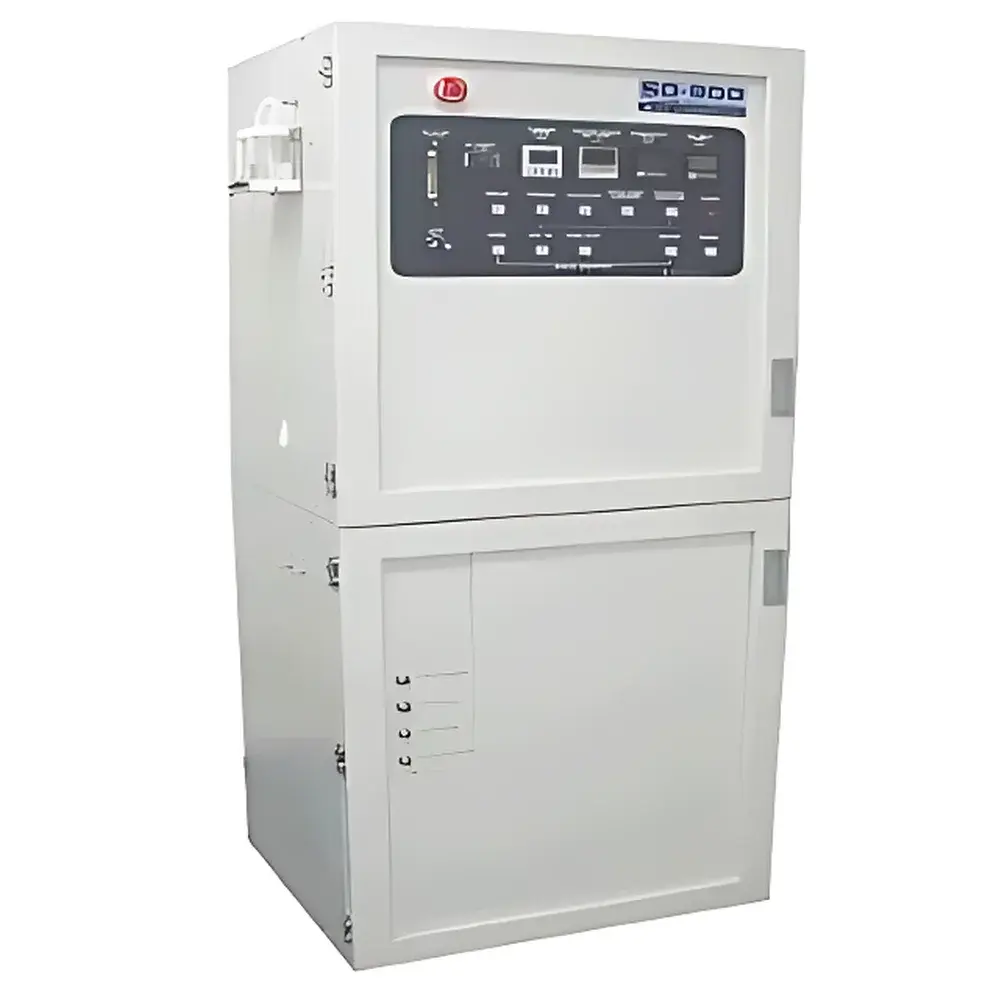
JAI SD-900 Solvent Recovery System
| Brand | JAI |
|---|---|
| Origin | Japan |
| Manufacturer Type | Authorized Distributor |
| Origin Category | Imported |
| Model | SD-900 |
| Pricing | Available Upon Request |
| Distillation Method | Simple Distillation |
| Heating Method | Electric Oil Bath |
| Temperature Control Range | Ambient to 78 °C |
| Distillation Vessel Material | SUS316 with PTFE Coating |
| Distillation Vessel Capacity | 19 L (Usable Volume: ~15 L) |
| Cooling Tower | Glass Ball Condenser, 500 mm Height |
| Temperature Controller | Digital PID Display |
| Timing Function | Digital Stopwatch |
| N₂ Pressure Control | Integrated Digital Pressure Sensor |
| Heater Type | Stirred Oil Bath Heater |
| Power Rating | 1.5 kW |
| Control Logic | Sequential Automated Control |
| Transfer Pump | Electromagnetic Gear Pump (Max Flow: 1.5 L/min) |
| Valves | Four 3-Way Solenoid Valves |
| Emergency Shutdown | Manual Master Power Cut-off Button |
| Tubing & Fittings | PTFE Tubing, PTFE Connectors, SUS316/SUS303 Hardware |
| Dimensions (W×H×D) | 600 × 1530 × 480 mm |
| Electrical Supply | Single-phase AC 200 V / 10 A or AC 100 V / 5 A |
| Net Weight | 100 kg |
Overview
The JAI SD-900 Solvent Recovery System is an engineered solution for the safe, efficient, and compliant reclamation of halogenated solvents—particularly chloroform—commonly used in chromatographic sample preparation, extraction protocols, and organic synthesis workflows. Designed in accordance with Japanese industrial safety standards and aligned with international laboratory sustainability objectives, the SD-900 employs simple distillation under controlled thermal conditions to separate volatile solvents from non-volatile residues. Its core operating principle relies on precise oil-bath heating (ambient to 78 °C), enabling stable, uniform thermal input without localized hot spots—critical for preserving solvent integrity and minimizing decomposition risk in thermally sensitive halogenated compounds. The system integrates real-time digital monitoring of temperature, pressure, and timing, supporting reproducible recovery cycles while maintaining full operator visibility and process traceability.
Key Features
- Stirred electric oil bath heater (1.5 kW) with PID-controlled digital temperature display ensures consistent thermal profiles across the full 15 L usable distillation volume.
- Distillation vessel constructed from SUS316 stainless steel with internal PTFE coating—resistant to corrosion from acidic or halogen-rich residues and compatible with GLP-compliant cleaning validation.
- Integrated glass ball condenser (500 mm height) provides high-efficiency vapor condensation with minimal hold-up volume and low backpressure.
- Automated sequential control logic manages distillation initiation, heating ramp, condensate collection, and shutdown—reducing manual intervention and operator error.
- Four 3-way solenoid valves enable programmable fluid routing for feed introduction, distillate collection, inert gas purging (N₂), and emergency venting.
- Dedicated electromagnetic gear pump (max. 1.5 L/min) supports controlled feed transfer with chemical compatibility verified for chlorinated solvents.
- Full metal enclosure with no exposed glass components enhances structural integrity and meets IEC 61010-1 requirements for laboratory electrical equipment safety.
- Emergency master power cutoff button provides immediate de-energization in response to abnormal thermal events or pressure excursions.
Sample Compatibility & Compliance
The SD-900 is optimized for chloroform recovery but demonstrates broad compatibility with other low-boiling, halogenated solvents including dichloromethane, carbon tetrachloride, and 1,1,1-trichloroethane—provided boiling points fall within its operational temperature range (≤78 °C). It is not intended for mixtures containing high-boiling contaminants (>150 °C), water-immiscible azeotropes, or reactive species such as acyl chlorides or peroxides. All wetted materials (SUS316, PTFE, borosilicate glass) conform to USP Class VI and FDA 21 CFR 177.1550 specifications. The system supports audit-ready operation under ISO/IEC 17025-accredited laboratories and aligns with EPA Method 8240B solvent reuse guidance for analytical waste minimization. Built-in digital logging (temperature, time, pressure) facilitates compliance with GLP documentation requirements and internal QA review.
Software & Data Management
The SD-900 operates via embedded microcontroller-based logic with no external PC dependency. All critical process parameters—including setpoint temperature, elapsed time, and N₂ pressure—are displayed on dual digital panels with non-volatile memory retention. While the system does not feature network connectivity or proprietary software, its analog-digital hybrid interface supports manual data recording into laboratory notebooks or LIMS-compatible spreadsheets. For regulated environments, users may integrate optional RS-232 or 4–20 mA output modules (sold separately) to feed temperature and status signals into validated SCADA or ELN platforms. Audit trails are maintained through timestamped operator logs and physical record of distillate batch labels—consistent with FDA 21 CFR Part 11 principles when paired with documented SOPs.
Applications
- Recovery of chloroform from HPLC mobile phase preparation waste streams in pharmaceutical QC labs.
- On-site reprocessing of spent extraction solvents in natural product isolation workflows.
- Reduction of hazardous waste disposal volumes in academic and contract research organizations adhering to ISO 14001 environmental management systems.
- Supporting green chemistry initiatives by lowering solvent procurement frequency and associated supply-chain carbon footprint.
- Enabling closed-loop solvent use in regulated stability testing programs where reagent purity must meet USP residual solvent limits.
FAQ
What solvents are compatible with the SD-900 besides chloroform?
Chlorinated solvents with boiling points ≤78 °C and chemical compatibility with PTFE/SUS316—such as dichloromethane (b.p. 39.6 °C) and 1,1,1-trichloroethane (b.p. 74 °C)—are suitable. Do not process solvents containing stabilizers (e.g., ethanol in chloroform) without prior validation.
Does the SD-900 meet explosion-proof certification requirements?
It is not certified for Class I Division 1 hazardous locations. Installation requires ventilation per ANSI Z9.5 and separation from ignition sources; optional N₂ blanketing mitigates flammability risk during operation.
Can the system be validated for GMP environments?
Yes—its fixed-geometry design, material certifications, and deterministic control logic support IQ/OQ protocols. Users must perform PQ with chloroform spiked with known impurities to verify distillate purity (e.g., GC-FID analysis per USP ).
What maintenance is required for long-term reliability?
Quarterly inspection of PTFE seals, annual calibration of temperature sensor against NIST-traceable reference, and periodic cleaning of condenser internals with acetone followed by nitrogen purge.
Is remote monitoring supported out of the box?
No—remote functionality requires third-party analog signal integration. JAI offers optional analog output kits for temperature and pressure signals compatible with standard PLC or DCS architectures.



