
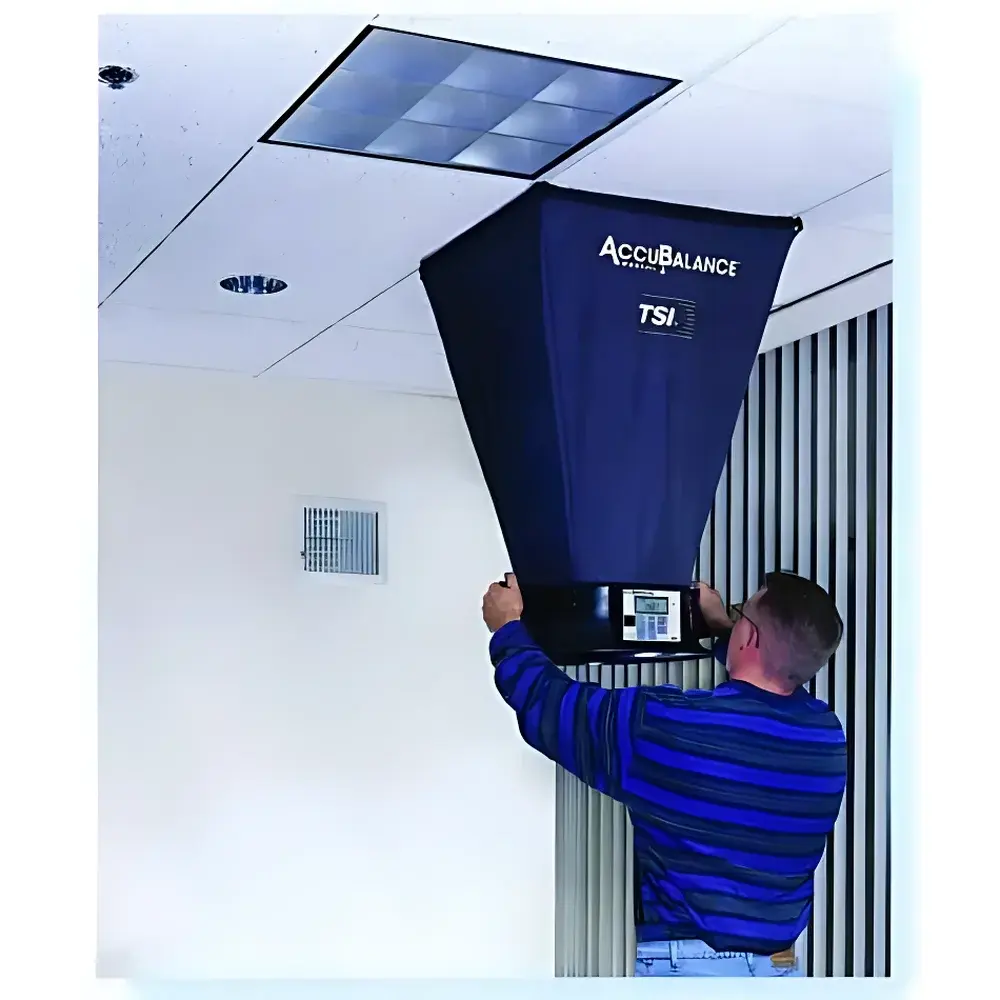
TSI AccuBalance Hood Air Flow Capture System Model 8371
| Origin | USA |
|---|---|
| Manufacturer Type | Authorized Distributor |
| Origin Category | Imported |
| Model | 8371 |
| Price Range | USD 2,600–6,500 (est.) |
| Instrument Type | Air Flow Capture Hood |
| Flow Range | 5–1000 L/s (18–3600 m³/h) |
| Operating Temperature | 0–60 °C |
| Operating Humidity | 0–95 % RH (non-condensing) |
| Resolution | 0.1 L/s |
| Accuracy | ±3 % of reading or ±0.5 L/s (whichever is greater) |
| Weight | 3.4 kg (for 610 × 610 mm hood) |
| Power Supply | 4 × C-cell alkaline batteries (40 h continuous operation) |
| Display | Backlit LCD with real-time flow readout |
| Optional Accessories | Portable thermal printer, calibration certificate traceable to NIST |
Overview
The TSI AccuBalance® Hood Air Flow Capture System (Model 8371) is a portable, NIST-traceably calibrated instrument engineered for rapid, field-deployable volumetric air flow measurement at HVAC diffusers, grilles, registers, and exhaust hoods. Unlike anemometers or pitot tubes requiring velocity profiling and area integration, the AccuBalance system operates on the principle of direct volumetric capture: air entering or exiting a ducted outlet is fully enclosed by a rigid, low-leakage hood connected to an internal averaging sensor array and microprocessor-controlled differential pressure transducer. This architecture eliminates spatial averaging errors and turbulence-induced inaccuracies common in point-velocity methods—delivering high reproducibility across variable flow profiles, including turbulent, swirling, or asymmetric discharge patterns typical of ceiling-mounted diffusers and VAV terminals.
Key Features
- Direct volumetric flow capture with integrated pressure-sensing manifold—no manual velocity traverse or correction factors required
- Real-time digital display showing both actual flow (L/s or CFM) and standardized flow (at 20 °C and 101.325 kPa), with automatic unit conversion
- K-factor compensation algorithm enabling accurate flow quantification across diverse diffuser geometries (e.g., perforated plates, linear slots, swirl vanes) without recalibration
- Backlit LCD interface optimized for low-light mechanical rooms and ceiling plenum access points
- Auto-detect flow direction: displays positive (supply) or negative (exhaust) values—critical for balanced ventilation verification per ASHRAE Standard 62.1
- Lightweight modular design (3.4 kg for standard 610 × 610 mm hood); compatible with optional extended-depth hoods (e.g., 914 × 914 mm, 1220 × 1220 mm) for large-area outlets
- 40-hour battery life using industrial-grade C-cell alkaline batteries; hot-swappable power configuration minimizes downtime during extended commissioning sequences
Sample Compatibility & Compliance
The AccuBalance 8371 is validated for use with supply and exhaust outlets ranging from 150 × 150 mm to 1220 × 1220 mm (via accessory hoods). It meets ISO 16813:2006 requirements for HVAC system performance testing and supports compliance with ASHRAE Guideline 1–2019 (Commissioning Process), LEED v4.1 EQ Credit: Enhanced Indoor Air Quality Strategies, and ISO 5218 (ventilation rate verification). All factory calibrations are traceable to the National Institute of Standards and Technology (NIST), with optional on-site recalibration kits available for GLP/GMP-regulated facilities requiring documented metrological continuity. The instrument does not require external environmental sensors—ambient temperature and humidity compensation are embedded in its flow algorithm to maintain accuracy across 0–60 °C and 0–95 % RH (non-condensing).
Software & Data Management
While the Model 8371 operates as a standalone field instrument, it supports data export via optional RS-232 or USB-to-serial interface (using TSI’s TrakPro™ Lite software). Exported datasets include timestamped flow readings, K-factor identifiers, hood dimensions, operator ID fields, and pass/fail flags against user-defined setpoints. TrakPro™ Lite generates compliant PDF reports aligned with ISO/IEC 17025 documentation requirements—including audit trails, calibration metadata, and electronic signatures. For regulated environments (e.g., pharmaceutical cleanrooms under FDA 21 CFR Part 11), the system supports secure user authentication, change logging, and report locking features when paired with enterprise license modules.
Applications
- HVAC commissioning and retrocommissioning per ASHRAE Guideline 0 and BCxP standards
- Annual airflow verification in healthcare facilities (per FGI Guidelines and Joint Commission EC.02.05.09)
- Room pressure cascade validation in laboratories and isolation rooms
- Ventilation rate assessment for indoor air quality (IAQ) studies per EPA IAQ Tools for Schools protocol
- Exhaust hood face velocity and total flow verification in chemical fume hood certification (ANSI/AIHA Z9.5)
- Energy audits and demand-controlled ventilation (DCV) system baseline characterization
FAQ
Is the AccuBalance 8371 suitable for exhaust stack measurements?
No—the instrument is designed exclusively for terminal-level airflow capture at diffusers, grilles, and registers. Stack flow requires thermal mass flow meters or pitot arrays meeting ANSI/ASHRAE 111.
Does the device require annual recalibration?
Yes. TSI recommends annual NIST-traceable recalibration for applications governed by ISO/IEC 17025, GMP, or regulatory commissioning protocols. Field verification using zero-flow and span checks is advised before each use day.
Can the 8371 measure temperature or humidity?
No—unlike the 8375 variant, the 8371 measures only volumetric airflow. Temperature and relative humidity sensing are exclusive to the 8375 model.
What hood sizes are included with the base 8371 configuration?
The standard shipment includes one 610 × 610 mm rigid aluminum hood with integrated seal skirt. Additional hood sizes (e.g., 305 × 305 mm, 914 × 914 mm) are orderable separately as accessories.
How is leakage minimized during measurement?
The hood features a dual-seal silicone gasket system and adjustable tension straps that compress uniformly against irregular surfaces—validated to limit bypass leakage to <1.5 % of measured flow under worst-case installation conditions.







