
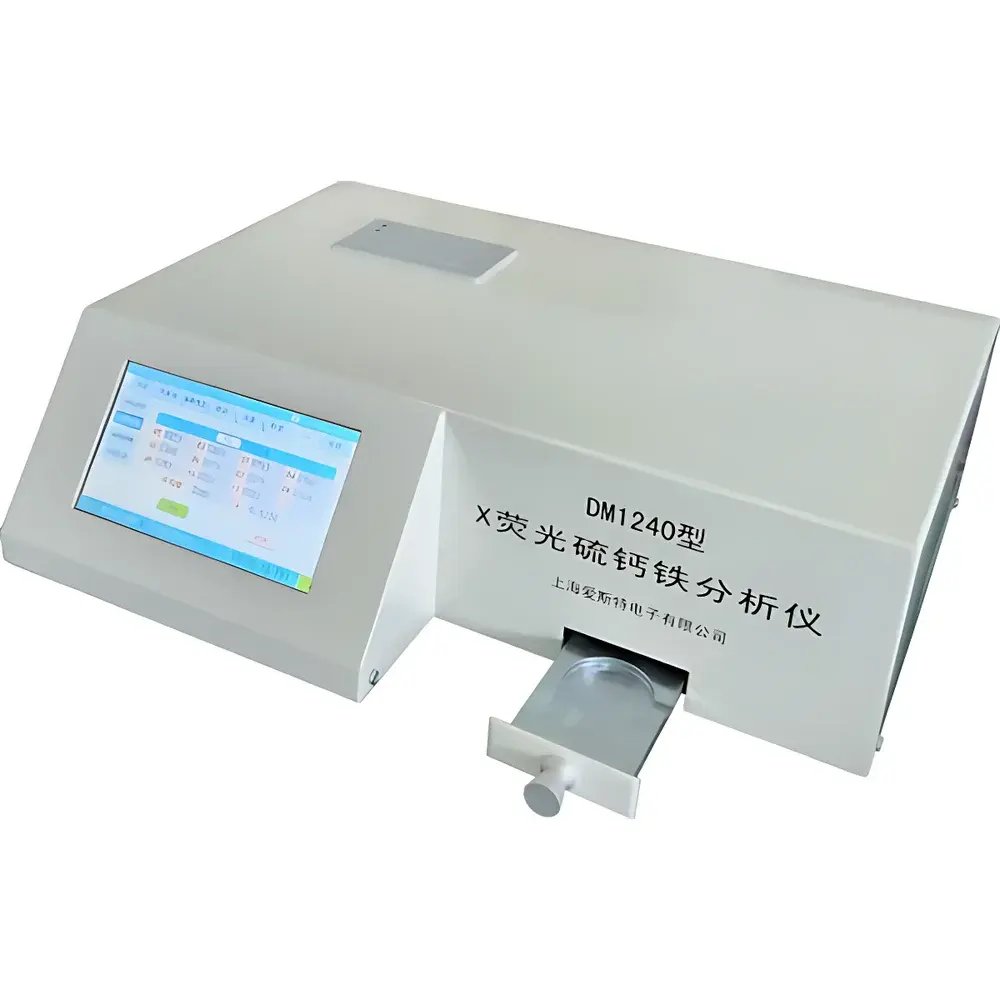
AST ST DM1240 Energy-Dispersive X-Ray Fluorescence (EDXRF) Sulfur-Calcium-Iron Analyzer
| Brand | AST ST |
|---|---|
| Model | DM1240 |
| Technology | Energy-Dispersive X-Ray Fluorescence (EDXRF) |
| Excitation Source | Low-power micro-focus X-ray tube (≤10 kV, ≤0.5 mA, ≤5 W) |
| Detector | Ultra-thin beryllium-window proportional counter |
| Measurement Time | 1–999 s (default 60 s) |
| Accuracy | SO₃ ≤ ±0.05 wt%, CaO ≤ ±0.09 wt%, Fe₂O₃ ≤ ±0.05 wt% |
| Sample Form | Solid pellets (powder pressed into 32 mm diameter discs) |
| Compliance | GB/T 176–2017, JC/T 1085–2008, JB/T 11145–2011 |
| Dimensions | 470 × 365 × 130 mm (W×D×H) |
| Weight | 15 kg |
| Operating Environment | 5–40 °C, ≤85% RH (at 30 °C), 220 V ±20 V, 50 Hz, ≤50 W |
| Radiation Class | Exempt device per Chinese regulatory requirements (no shielding enclosure required) |
Overview
The AST ST DM1240 Energy-Dispersive X-Ray Fluorescence (EDXRF) Sulfur-Calcium-Iron Analyzer is a purpose-built, benchtop elemental analyzer engineered for rapid, non-destructive quantification of SO₃, CaO, and Fe₂O₃ in cementitious materials—including raw meal, clinker, finished cement, and industrial minerals. It employs fundamental EDXRF physics: a low-power (<5 W) micro-focus X-ray tube excites characteristic Kα and Lα emissions from sulfur (S Kα at 2.308 keV), calcium (Ca Kα at 3.692 keV), and iron (Fe Kα at 6.404 keV); these photons are resolved by an ultra-thin Be-window proportional counter coupled with a digitally controlled multi-channel pulse height analyzer (MCA). The instrument utilizes secondary target filtration and optimized beam geometry to enhance peak-to-background ratios—critical for achieving sub-0.05 wt% precision on SO₃ in high-Ca matrices. Unlike wavelength-dispersive systems, the DM1240 requires no vacuum or helium purge, operates at ambient pressure, and delivers certified-compliant results within 60 seconds per pelletized sample—enabling real-time process feedback in cement quality control laboratories and automated raw mix control loops.
Key Features
- Simultaneous tri-element analysis: Quantifies SO₃, CaO, and Fe₂O₃ in a single measurement cycle without reconfiguration or hardware switching.
- Downward-beam optical architecture: X-ray irradiation path directs vertically onto the sample surface, eliminating cross-contamination risk to detector window—essential for dusty, abrasive cement powders.
- High-stability digital signal processing: FPGA- and DSP-based multi-channel analyzer with variable-gain amplification, automatic gain stabilization, and real-time dead-time correction ensures long-term calibration retention (>6 months under routine use).
- Touch-enabled human interface: 7-inch full-color capacitive touchscreen replaces legacy membrane keypads; intuitive workflow navigation supports one-button operation—from sample loading to report generation.
- Radiation safety compliance: Certified as radiation-exempt per national regulatory guidelines (GB 18871–2002); no lead shielding, interlocks, or licensing required for installation or operation.
- Robust embedded architecture: Modern ARM-based CPU with soldered-on flash memory and surface-mount PCB design minimizes thermal drift, electromagnetic interference, and mechanical failure points—MTBF > 20,000 hours.
Sample Compatibility & Compliance
The DM1240 accepts homogenized, dried, and pelletized samples (32 mm diameter, ≥8 t/cm² pressure) of cement raw meal, clinker, Portland cement, limestone, slag, fly ash, and other silicate-based solids. Liquid or slurry samples require prior evaporation and pelletization; no digestion, acid treatment, or consumable gases (e.g., He, Ar) are needed. All measurements comply with mandatory standards for cement chemistry testing: GB/T 176–2017 (equivalent to ISO 29581–1:2019 for XRF-based oxide determination), JC/T 1085–2008 (performance criteria for cement XRF analyzers), and JB/T 11145–2011 (general specifications for XRF spectrometers). Instrument validation includes linearity assessment (r ≥ 0.996 for all three oxides across 11 NIST-traceable cement reference materials), repeatability verification (3σ ≤ 0.071% for SO₃, ≤0.23% for CaO, ≤0.014% for Fe₂O₃), and bias evaluation against reference wet-chemistry methods per ASTM C114 protocols.
Software & Data Management
Firmware-integrated analysis software implements matrix-corrected fundamental parameter (FP) quantification using empirically derived calibration functions: C = D + E·IC + F·IC², where IC is background-subtracted, dead-time-corrected net intensity. Calibration coefficients are stored per element and user-definable working ranges (SO₃: 0.5–5.5 wt%, CaO: 45–65 wt%, Fe₂O₃: 0.5–5.0 wt%). Raw spectra, processed intensities, and final oxide concentrations are timestamped and archived locally in non-volatile memory (≥10,000 records). Data export via USB 2.0 supports CSV and XML formats compatible with LIMS platforms and statistical process control (SPC) tools. Audit trail functionality logs all operator actions, method changes, and calibration updates—supporting GLP/GMP documentation requirements per FDA 21 CFR Part 11 when deployed in regulated manufacturing environments.
Applications
Primary deployment is in cement plant QC/QA labs for closed-loop raw mix optimization: SO₃ content governs gypsum dosage and setting time; CaO/Fe₂O₃ ratio directly correlates with clinker mineralogy (C₃S/C₄AF balance) and burnability. Secondary applications include coal ash characterization (CaO/Fe₂O₃ for slagging/fouling prediction), limestone purity screening (CaO vs. MgO interference), and industrial by-product certification (e.g., fly ash classification per ASTM C618). The analyzer integrates seamlessly into automated “Analyzer–PLC–Belt Scale”配料 systems, providing 60-second feedback for real-time adjustment of limestone, iron ore, and pyrite feed rates. Field use extends to power generation (coal combustion residue analysis), brick manufacturing (clay composition control), metallurgical sinter plants, and geological survey laboratories performing bulk rock geochemistry screening.
FAQ
Does the DM1240 require daily recalibration?
No. With stable hardware and internal reference channel monitoring, recalibration is recommended only after major maintenance, relocation, or when drift exceeds ±0.03 wt% over 30-day verification checks using control samples.
Can it analyze unpressed powder samples?
No. Quantitative accuracy requires homogeneous, flat-surfaced pellets to ensure consistent take-off geometry and minimize particle-size effects. Loose powder introduces unacceptable scatter and absorption variability.
Is spectral deconvolution performed in real time?
Yes. The FPGA-based MCA resolves overlapping peaks (e.g., S Kα and Ca Lα at ~2.3–2.5 keV) using least-squares fitting with pre-loaded pure-element library spectra and empirical background models.
What is the minimum detectable limit (MDL) for sulfur in cement?
Based on 60-s counting statistics and typical clinker matrix, MDL for SO₃ is 0.012 wt% (3σ of blank), validated per ISO 11885 Annex B protocols.
Does the system support remote diagnostics or firmware updates?
Yes. Optional Ethernet module enables secure SSH access for technical support; firmware upgrades are delivered as signed binary packages via USB stick with cryptographic verification.





