
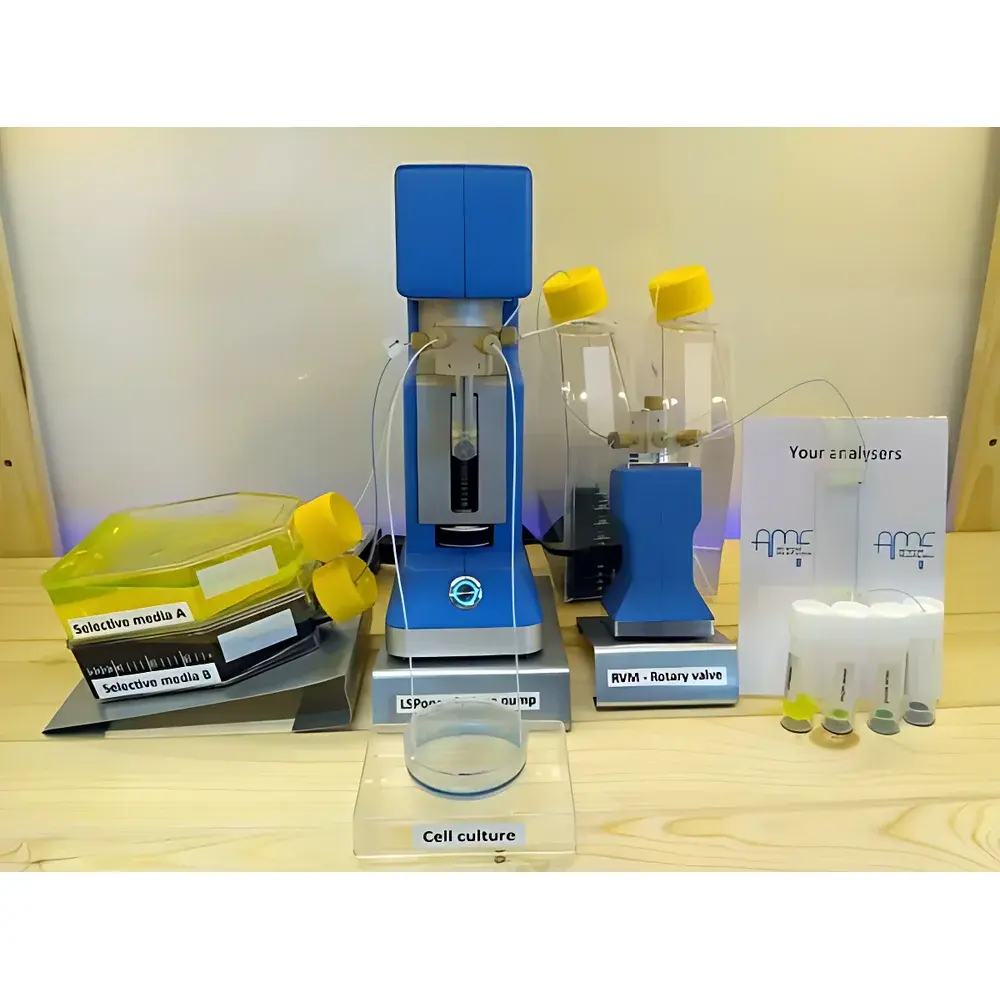
AMF-perfusion Advanced Microfluidic Cell Perfusion System
| Brand | Advanced MicroFluidics (AMF) |
|---|---|
| Origin | Switzerland |
| Model | AMF-perfusion |
| Automation | Fully Automated |
| Reservoir Capacity | mL-scale |
| Flow Rate Range | 0.25 nL/min – 30 mL/min |
| Syringe Volume Options | 25–1000 µL |
| Valve Types | VD/VFD Series (2–12 ports, PCTFE/PTFE construction) |
| Max Pressure | 7 bar (valves), 5 bar (pump) |
| Dead Volume | As low as 1.5 µL |
| Flow Precision | <1% deviation at full stroke |
| Operating Temperature | 5–40 °C |
| Operating Humidity | 20–80% RH (non-condensing) |
| Certifications | CE, CB |
| Compliance | Designed for GLP-compliant workflows |
Overview
The AMF-perfusion Advanced Microfluidic Cell Perfusion System is a fully automated, modular platform engineered for precise, long-term, and dynamically controlled fluid delivery to microphysiological systems—including organ-on-chip devices, 3D cell cultures, and live-cell imaging chambers. Built upon AMF’s proprietary SPM syringe pump and RVM distribution valve architecture, the system leverages positive-displacement micro-injection principles to achieve ultra-low dead-volume fluid handling across six orders of magnitude in flow rate (0.25 nL/min to 30 mL/min). Its core operational paradigm integrates deterministic sequencing of reagent introduction, programmable temporal gradients, and real-time flow path reconfiguration—enabling physiologically relevant perfusion profiles such as pulsatile shear stress, cyclic hormone exposure, or multi-step differentiation protocols. Unlike pressure-driven systems, this pump-valve architecture eliminates compressibility artifacts and provides true volumetric accuracy independent of fluid viscosity or backpressure fluctuations up to 7 bar—making it suitable for integration with high-resistance microfluidic chips fabricated in PDMS, glass, or thermoplastics.
Key Features
- Fully automated, software-controlled perfusion sequences with sub-microliter dose resolution (down to 0.05 µL per step)
- Modular valve manifold support: configurable 2–12-port VD/VFD series valves with PCTFE/PTFE wetted paths and dead volumes as low as 1.5 µL
- High-precision SPM syringe pumps featuring linear encoder–based stepper motor control, 30,000 microsteps per full stroke (24,000-step high-resolution option available), and pulse-free displacement
- Multi-syringe compatibility: interchangeable PTFE- or UHMW-PE–lined syringes (25–1000 µL) optimized for aqueous buffers, serum-containing media, and viscous hydrogels
- Industrial-grade connectivity: USB Mini, RS232, RS485, and I²C interfaces; supports integration into LabVIEW, Python (PySerial), and MATLAB environments
- Robust mechanical design: aluminum chassis (245 × 143 × 85 mm), 2.2 kg mass, rated for continuous operation under ambient lab conditions (5–40 °C, 20–80% RH non-condensing)
Sample Compatibility & Compliance
The AMF-perfusion system is validated for use with primary human cells, iPSC-derived lineages, co-cultures, and spheroid/organoid models maintained under laminar perfusion. All fluidic components comply with ISO 10993–1 biocompatibility standards for short-term (<24 h) and extended (>72 h) contact. Wetted materials—including PCTFE, PTFE, borosilicate glass, and UHMW-PE—are chemically inert toward common cell culture reagents (e.g., DMEM/F12, Matrigel®, collagen I, cytokine cocktails). The system architecture supports audit-ready operation: time-stamped event logs, user-access controls, and electronic signature capability when paired with compliant LIMS or ELN platforms. While the base hardware carries CE and CB marks, full 21 CFR Part 11 compliance requires deployment with validated third-party software (e.g., AMF Control Suite v3.2+ with digital signature modules and immutable audit trails).
Software & Data Management
The system ships with AMF Control Suite—a native Windows/macOS application supporting protocol scripting, real-time flow monitoring, and synchronized hardware triggering. Users define multi-phase perfusion schedules via intuitive timeline editors or Python-based API calls. All pump and valve events are timestamped with microsecond resolution and exported in CSV/JSON format for downstream analysis in GraphPad Prism, Python (Pandas), or MATLAB. The software enforces parameter validation (e.g., flow rate vs. syringe volume constraints) and includes built-in safety interlocks—such as over-pressure detection, syringe stall sensing, and valve position verification—to prevent unintended media exchange or air bubble ingress. Remote operation is supported via Ethernet-to-serial gateways, enabling centralized management across multi-instrument core facilities.
Applications
- Long-term maintenance of vascularized organ-chips under physiological shear stress (e.g., liver sinusoids, blood-brain barrier models)
- Time-resolved immunofluorescence labeling with sequential antibody incubation and wash steps without manual intervention
- Live-cell confocal or light-sheet microscopy requiring stable, vibration-free perfusion during acquisition
- Drug toxicity screening with dynamic concentration gradients (e.g., ramped cisplatin exposure over 48 h)
- Stem cell differentiation assays involving timed morphogen pulses (e.g., BMP4 → Activin A → FGF2 sequences)
- Microbiome–host interface studies using anaerobic chamber–compatible gas-tight configurations (optional N₂-purged manifolds)
FAQ
What is the minimum controllable flow rate with the smallest syringe configuration?
With the S25-P syringe (25 µL volume), the system achieves a sustained minimum flow rate of 0.25 nL/min—equivalent to ~1.5 nL per second—while maintaining <1% volumetric accuracy.
Can the system handle viscous solutions such as 5 mg/mL collagen or 10% Matrigel®?
Yes. The S1000-U syringe (UHMW-PE barrel) and VFD1-12 valve configuration support viscosities up to 50 cP at 100 µL/min flow rates; pre-warming and inline filtration (0.22 µm) are recommended for hydrogel-based media.
Is tubing priming automated?
Priming is semi-automated: the software guides users through sequential valve actuation and low-speed pump withdrawal to evacuate air from syringes and manifolds; full closed-loop air detection requires optional capacitive bubble sensors.
How is calibration traceability maintained?
Each pump module undergoes factory calibration against NIST-traceable gravimetric standards; users may perform field verification using certified microbalance and timed dispensing protocols documented in the AMF Calibration Handbook (Rev. 4.1).
Does the system support parallel perfusion of multiple chips?
Yes—via multi-channel valve manifolds (e.g., VFD1-12) or synchronized dual-pump configurations; independent flow control per outlet requires optional flow sensors (AMF-FS-100 series, sold separately).



