
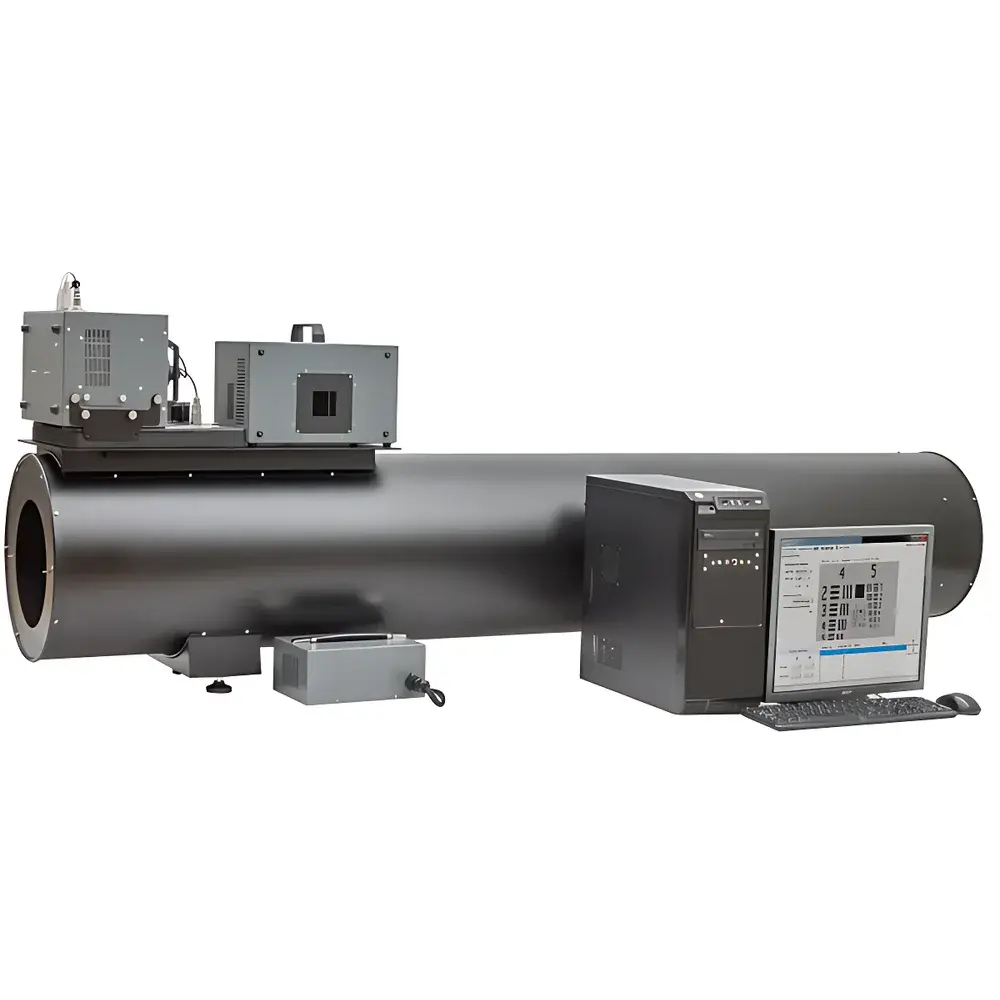
Inframet ST Short-Wave Infrared (SWIR) Camera Test System
| Brand | Inframet |
|---|---|
| Origin | Poland |
| Model | ST |
| Light Source | Dual-mode (Halogen 400–2200 nm & 1060 nm LED) |
| Collimator Type | Reflective, Off-axis |
| Aperture | 40 mm (off-axis), 100–200 mm (primary) |
| Blackbody Temperature Range | 50–600 °C |
| Target Wheel | 8-position, motorized, RS-232/USB 2.0 controlled |
| Spatial Resolution | ≥160 lp/mrad |
| Halogen Luminance Range | 0.02–3000 cd/m² |
| LED Dynamic Range | 10⁴:1 |
| Spectral Coverage | 0.4–15 µm |
| Target Temperature Stability | ±0.05 °C |
| Temperature Settling Time | <30 min |
| Target Mounting Diameter | 54 mm |
| Mirror Coatings | Aluminum (parabolic), Gold (flat) |
| Power Supply | 115–230 VAC, 50/60 Hz |
Overview
The Inframet ST Short-Wave Infrared (SWIR) Camera Test System is a metrology-grade optical characterization platform engineered for the quantitative evaluation of SWIR imaging sensors operating in the 0.9–1.7 µm spectral band—primarily based on InGaAs focal plane arrays (FPAs). Unlike thermal infrared systems that rely solely on emitted radiation, SWIR cameras detect both reflected solar radiation and low-level thermal emission, enabling dual-mode imaging analogous to both low-light TV (LLLTV) and mid-wave infrared (MWIR) systems. The ST system implements a traceable, collimated projection architecture to deliver calibrated spatial, radiometric, and geometric stimuli to the device under test (DUT). Its core measurement principle combines ISO 12233-based spatial frequency analysis with blackbody-referenced radiometric calibration and geometric distortion mapping—ensuring compliance with international standards for electro-optical testing of imaging sensors.
Key Features
- Reflective off-axis collimator with 40 mm secondary aperture and selectable primary apertures (100–200 mm), optimized for minimal wavefront error and high MTF preservation across the SWIR band
- Dual-source illumination: broadband halogen lamp (400–2200 nm, 2856 K CCT) for full-spectrum modulation transfer function (MTF) and noise evaluation; monochromatic 1060 nm LED for wavelength-specific responsivity and uniformity testing
- Motorized 8-position target wheel (MRW-8) with precision digital temperature control, supporting rapid interchange of reflective and emissive targets without realignment
- High-stability mid-temperature blackbody (50–600 °C), calibrated to NIST-traceable references, with temperature uncertainty <0.005×T and stability ≤±0.05 °C
- Comprehensive target suite: USAF 1951 resolution charts, field-of-view (FOV) and distortion grids, knife-edge targets (reflective and IR-optimized), 4-bar patterns, and 8-hole arrays for non-uniformity and dead-pixel analysis
- Aluminum-coated parabolic mirror and gold-coated flat folding mirror—both spectrally optimized for >95% reflectance from 0.4 µm to 15 µm
- Integrated image acquisition via PCIe frame grabber and real-time software-controlled synchronization of illumination, target position, and blackbody temperature
Sample Compatibility & Compliance
The ST system accommodates SWIR cameras with sensor formats up to 1280×1024 pixels and pixel pitches ≥5 µm. It supports both lens-coupled and windowless configurations through adjustable working distance and collimated beam divergence control. All radiometric measurements are referenced to SI-traceable blackbody calibrations, fulfilling requirements of ISO 18526-2 (Electro-optical imaging system performance—Part 2: Measurement of MTF), ISO 15529 (Radiometry—Calibration of blackbodies), and MIL-STD-3009 (Imaging sensor test methodology). The system’s thermal control architecture meets GLP audit requirements for temperature logging (timestamped, digitally signed records), and its software supports 21 CFR Part 11-compliant user access control and electronic signatures when deployed in regulated QA/QC environments.
Software & Data Management
Inframet’s proprietary ST Control & Analysis Suite provides a unified interface for hardware orchestration, image capture, and parameter extraction. Key modules include: (1) Automated MTF calculation using slanted-edge and sine-wave target methods per ISO 12233; (2) Radiometric linearity and dynamic range analysis via stepwise blackbody ramping; (3) Geometric distortion mapping using polynomial and fisheye-corrected grid fitting; (4) Non-uniformity correction (NUC) coefficient derivation from temporal and spatial noise profiling; (5) Batch report generation with PDF/CSV export, including pass/fail thresholds aligned with customer-defined specifications. Raw image data is stored in 16-bit TIFF format with embedded EXIF metadata (wavelength, irradiance, integration time, target ID, temperature timestamp). Audit trails record all parameter changes, user logins, and calibration events—fully compliant with ISO/IEC 17025 documentation requirements.
Applications
- Factory acceptance testing (FAT) and incoming inspection of InGaAs-based SWIR cameras for defense, aerospace, and industrial machine vision
- Development validation of SWIR optics—including cold shields, dewar windows, and anti-reflection coatings—using spectral irradiance and stray light analysis modes
- Quantitative comparison of detector technologies (e.g., extended-InGaAs vs. HgCdTe) under identical illumination and thermal boundary conditions
- Support for DO-160 Section 22 (electrostatic discharge) and MIL-STD-810H environmental stress screening by correlating optical performance degradation with thermal cycling profiles
- Traceable calibration services accredited to ISO/IEC 17025 for third-party metrology laboratories serving semiconductor and photonics OEMs
FAQ
What spectral bands does the ST system support for SWIR camera characterization?
The system covers 0.4–15 µm via broadband halogen and 1060 nm LED sources, with primary focus on the 0.9–1.7 µm InGaAs-sensitive band. Optional narrowband filters enable discrete wavelength testing at 1.3 µm and 1.55 µm.
Can the ST system validate cryogenically cooled SWIR cameras?
Yes—the collimated beam path is compatible with vacuum-compatible DUT mounts and cold-shielded interfaces. Blackbody temperature control remains stable during extended cooldown cycles, and software supports synchronized thermal soak protocols.
Is the system compatible with third-party image analysis tools?
All raw images are exported in standard 16-bit TIFF format with embedded metadata. MATLAB, Python (OpenCV, NumPy), and ENVI can directly ingest datasets; API documentation for real-time data streaming over TCP/IP is provided upon request.
How is geometric distortion quantified?
Using a high-contrast FOV grid projected onto the DUT, the software fits radial/tangential distortion coefficients via least-squares optimization and reports RMS residual error in pixels and angular units (mrad), conforming to ISO 9039.
Does the system support automated pass/fail reporting per MIL-STD-3009?
Yes—predefined test sequences include configurable thresholds for MTF@Nyquist, PRNU (<2%), temporal noise (≤50 e⁻ rms), and dead pixel count (<0.01%). Reports include annotated images, statistical summaries, and digital signatures.




