
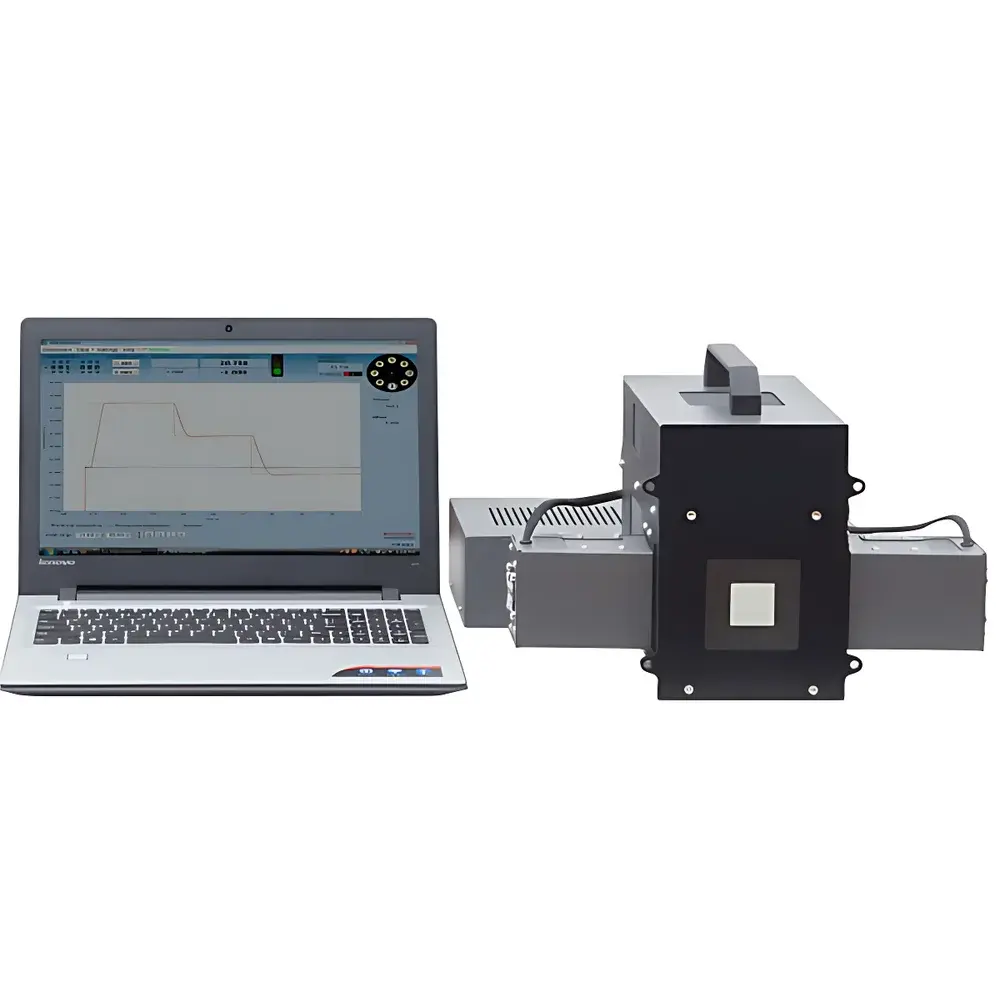
Inframet DCB Multi-Color Blackbody Source
| Brand | Inframet |
|---|---|
| Origin | Poland |
| Model | DCB |
| Temperature Range | 0 °C to +100 °C (ΔT = −25 °C to +75 °C at 25 °C ambient) |
| Emissivity | 0.95 ± 0.01 (MWIR), 0.96 ± 0.01 (LWIR) |
| Aperture (Blackbody & Source) | 35 × 35 mm |
| Emitter Size | 50 × 50 mm |
| Temperature Uniformity | < 0.01 °C or 4% of ΔT |
| Resolution & Setpoint Accuracy | 1 mK |
| Calibration Stability | ±3 mK @ ΔT = 10 °C |
| Heating Rate | 0.8 °C/s |
| Cooling Rate | 0.3 °C/s |
| Stabilization Time | < 30 s |
| Spectral Bands | 420–750 nm (SEM1), 830–850 nm (SEM2), 350–1700 nm (HAL), 300–1100 nm (XEN) |
| Luminance Range | 0.2–2000 cd/m² (SEM1/SEM2/XEN, daylight) |
| Control Interface | USB 2.0 |
| Power Supply | 115–230 VAC, 50/60 Hz |
| Operating Temp. | +5 °C to +45 °C (non-condensing) |
| Storage Temp. | −10 °C to +60 °C |
| Dimensions | ~50 × 31 × 34 cm |
| Weight | 9–14 kg (version-dependent) |
Overview
The Inframet DCB Multi-Color Blackbody Source is a precision-calibrated, dual-mode radiometric reference instrument engineered for high-fidelity calibration and verification of multi-spectral imaging systems, thermal cameras, and photometric sensors operating across ultraviolet–visible–shortwave infrared (UV–VIS–SWIR) and mid-to-longwave infrared (MWIR–LWIR) bands. Unlike conventional single-mode blackbodies, the DCB integrates a thermally controlled high-emissivity cavity emitter with a co-aligned, spectrally selective illumination module—enabling simultaneous or independent generation of broadband thermal radiation (2–14 µm) and calibrated visible–NIR optical flux (300–1700 nm). Its core architecture leverages a temperature-stabilized ceramic emitter with active feedback control, achieving <0.01 °C spatial uniformity and absolute temperature uncertainty of |T − 25 °C| + 12 mK over its full 0–100 °C operational range. The device operates on the principle of Planckian radiation for IR calibration while maintaining spectral neutrality (i.e., near-Lambertian, wavelength-independent reflectance) in the UV–SWIR region via a proprietary white-diffusing surface—effectively functioning as a “cold” reflective standard below ~2.5 µm and a “hot” emissive standard above.
Key Features
- Modular dual-function design: integrated blackbody cavity (50 × 50 mm emitter, 35 × 35 mm effective aperture) and independently controllable spectral light source module (same aperture geometry)
- High emissivity performance: 0.95 ± 0.01 (MWIR), 0.96 ± 0.01 (LWIR), verified per ASTM E1543 and ISO 18434-1 traceable calibration protocols
- Precision thermal control: 1 mK setpoint resolution, <30 s stabilization time, ±3 mK long-term calibration stability (measured over 12 months under GLP-compliant lab conditions)
- Multi-band illumination options: interchangeable SEM1 (420–750 nm), SEM2 (830–850 nm), HAL (350–1700 nm), and XEN (300–1100 nm) sources supporting photopic, scotopic, and mesopic luminance simulation
- Full USB 2.0 digital control with programmable ramp profiles, real-time temperature logging, and error-code diagnostics compliant with IEEE 1278.1–2020 instrumentation interface standards
- Rugged benchtop form factor (50 × 31 × 34 cm) with passive convection cooling; no external chiller or compressed air required
Sample Compatibility & Compliance
The DCB accommodates optical sensors with entrance apertures ≤35 mm and focal lengths ≥50 mm. It supports both collimated and f/number-matched beam geometries through optional adapter plates and alignment fixtures. All configurations meet IEC 61000-6-3 (EMC emission) and IEC 61010-1 (safety) requirements. Radiometric calibration certificates are supplied with NIST-traceable uncertainties and include full spectral emissivity characterization (2–14 µm) and bidirectional reflectance distribution function (BRDF) data (0.2–2.5 µm). The system is compatible with ISO/IEC 17025-accredited calibration workflows and supports audit-ready metadata export for FDA 21 CFR Part 11–compliant environments when used with validated third-party software.
Software & Data Management
Inframet provides DCB-Control Suite v3.x—a Windows-based application supporting automated calibration sequences, multi-point temperature sweeps, luminance ramping, and cross-spectral correlation analysis. Raw sensor output (temperature, luminance, status flags) is logged in HDF5 format with embedded timestamps, firmware version, and environmental metadata (ambient T/RH). Export modules generate CSV, MATLAB .mat, and SI-traceable PDF reports conforming to ISO/IEC 17025 clause 7.8.2. Remote operation via TCP/IP is available through optional API libraries (C/C++, Python, LabVIEW), enabling integration into automated test benches compliant with MIL-STD-461G and ECSS-E-ST-20-07C frameworks.
Applications
- Factory and field calibration of MWIR/LWIR thermal imagers (e.g., cooled InSb, uncooled VOx microbolometers)
- Verification of multispectral camera spectral response uniformity across UV–SWIR bands
- Luminance and chromaticity validation of automotive ADAS camera systems per ISO 16505 and SAE J2803
- Development and testing of night-vision equipment (image intensifiers, SWIR cameras) under simulated day/night irradiance conditions
- Reference source for hyperspectral radiometer validation (e.g., ASD FieldSpec, Ocean Insight QE Pro)
- Research-grade studies in atmospheric transmission modeling, material emissivity mapping, and non-uniformity correction (NUC) algorithm development
FAQ
Is the DCB suitable for calibrating cryogenically cooled MCT detectors?
Yes—its stable MWIR/LWIR output and low spatial non-uniformity (<0.01 °C) meet the requirements for characterizing detector responsivity drift in systems operating down to 77 K, provided appropriate cold-shield alignment is maintained.
Can the blackbody and light source operate simultaneously without spectral crosstalk?
Yes—the optical paths are physically separated and spectrally isolated using dichroic beam combiners; spectral leakage between modules is <10⁻⁴ across all configured bands, verified by Fourier-transform spectroscopy.
What is the recommended recalibration interval?
Annual recalibration is advised for metrology-critical applications; biennial intervals are acceptable for production QA/QC use when operated within specified environmental limits and supported by in-house verification using reference thermistors.
Does the system support custom spectral irradiance profiles?
Yes—via user-defined spectral power distribution (SPD) tables imported into DCB-Control Suite, enabling simulation of CIE illuminants A, D65, F11, or application-specific spectra (e.g., solar noon, urban LED streetlight).
Is firmware update capability included?
Yes—field-upgradable firmware is delivered via secure HTTPS portal; updates preserve all user calibration history and comply with IEC 62443-3-3 SL2 cybersecurity requirements.





