
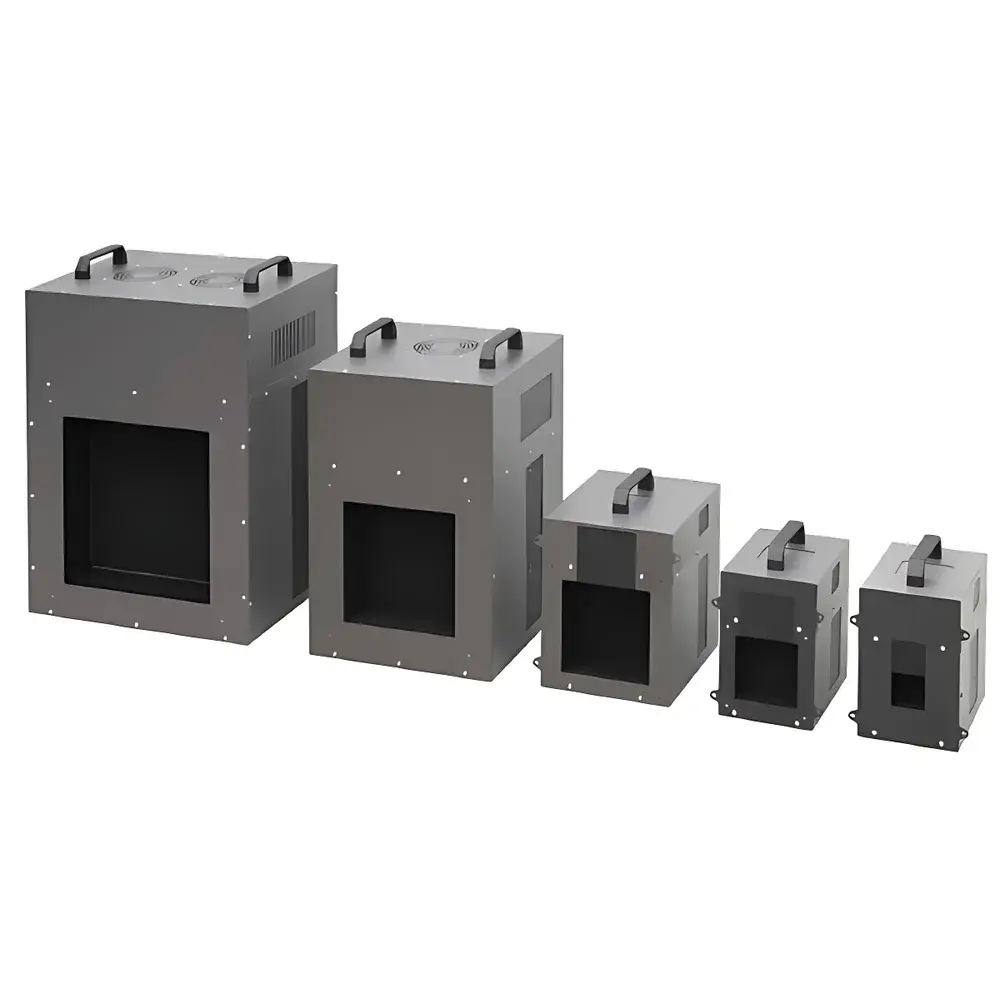
Inframet TCB Series Ultra-Precision Differential Area-Source Blackbody
| Brand | Inframet |
|---|---|
| Origin | Poland |
| Model | TCB |
| Aperture Options | 50×50 mm to 500×500 mm |
| Temperature Range (Standard) | −20 °C to +80 °C |
| Extended Ranges | EX (−30 °C to +100 °C), UEX (−35 °C to +130 °C), HT (+180 °C max), LT (−40 °C min) |
| Emissivity | 0.98 ± 0.005 (HE option: 0.99 ± 0.005) |
| Spatial Uniformity | < 0.01 °C or 0.4%· |
| Temperature Stability | ±2 mK |
| Total Uncertainty | 0.03 °C |
| Resolution | 1 mK |
| Warm-up/Cool-down Rates | 0.15–10 °C/s (model-dependent) |
| Stabilization Time | <30 s to <80 s |
| Control Interface | USB 2.0 |
| Power Supply | 115–230 VAC, 50/60 Hz |
| Operating Ambient | +5 °C to +45 °C (non-condensing) |
| Dimensions & Weight | 160×230×180 mm / 7.5 kg (TCB-2D) to 430×630×880 mm / 165 kg (TCB-20D) |
| Compliance | Designed for ISO/IEC 17025-accredited calibration labs |
Overview
The Inframet TCB Series Ultra-Precision Differential Area-Source Blackbody is a laboratory-grade infrared reference source engineered for high-fidelity thermal imaging system characterization, radiometric calibration, and national metrology applications. Based on a thermally stabilized, actively controlled cavity architecture with differential temperature control capability, the TCB operates on the principle of Planckian radiation emission from a precisely defined, uniform aperture surface. Its core function is to generate spectrally stable, spatially homogeneous, and temporally reproducible infrared radiance across the MWIR and LWIR bands (3–14 µm), enabling quantitative evaluation of thermal camera responsivity, non-uniformity correction (NUC) performance, NETD, MRTD, and dynamic range. Unlike conventional single-temperature blackbodies, the TCB’s differential design allows simultaneous or sequential generation of two distinct, highly stable thermal scenes—critical for evaluating thermal contrast sensitivity, differential linearity, and drift compensation algorithms in modern IR systems.
Key Features
- Ultra-high temperature stability: ±2 mK short-term stability with total uncertainty of ≤0.03 °C (k = 2), traceable to NIST or PTB standards via accredited calibration protocols.
- Differential operation mode: Independent control of two adjacent or alternating apertures enables precise ΔT stimulus generation (e.g., −20 °C to +80 °C differential range) without mechanical repositioning.
- Exceptional spatial uniformity: <0.01 °C peak-to-peak temperature variation across the active aperture surface, verified by calibrated IR scanning thermography and validated per ISO 18434-1 Annex B.
- High emissivity cavity: Standard 0.98 ± 0.005 (±0.5% relative), with optional High-Emissivity (HE) version at 0.99 ± 0.005—certified per ASTM E1543 and compliant with IEC 62906-5-2 requirements for primary standard sources.
- Multi-range thermal flexibility: Configurable variants include Extended (EX), Ultra-Extended (UEX), High-Temperature (HT), Low-Temperature (LT), and Temperature-Controlled Chamber (TC) integration options—supporting operation from −40 °C to +180 °C within specified differential constraints.
- Programmable thermal dynamics: Adjustable ramp rates (0.15–10 °C/s) and stabilization times (<30 s for smallest apertures) enable simulation of transient thermal signatures per MIL-STD-3007 test profiles.
Sample Compatibility & Compliance
The TCB series accommodates a broad spectrum of optical configurations: collimated beam paths, direct-aperture viewing, and integration into environmental test chambers via flanged mounting (ISO-KF or CF options available). All models meet electromagnetic compatibility (EMC) requirements per EN 61326-1 and are constructed using low-outgassing, non-magnetic stainless steel and Invar components suitable for cleanroom and vacuum-compatible environments (optional). The system is designed to support GLP/GMP-compliant workflows: full audit trail logging (timestamped setpoint, actual temperature, stability status), user access levels, and electronic signature readiness per FDA 21 CFR Part 11 when used with Inframet’s certified calibration software suite. Traceability documentation includes individual unit calibration certificates issued by Inframet’s ISO/IEC 17025:2017-accredited metrology lab (PL-0156).
Software & Data Management
Control and data acquisition are managed via Inframet’s TCB Control Suite v4.x—a Windows-based application supporting USB 2.0 communication with real-time monitoring of all thermal parameters. The software provides programmable temperature profiles (ramp/soak/step), automated stability verification (±0.01 °C threshold detection), and export of time-stamped datasets in CSV and HDF5 formats. Integrated API (DLL and Python bindings) enables seamless integration into custom test automation frameworks (e.g., LabVIEW, MATLAB, Python-based CI/CD pipelines). All measurement records include embedded metadata: instrument ID, calibration due date, ambient conditions, and operator credentials—ensuring full data integrity for ISO 17025 audits and regulatory submissions.
Applications
- Radiometric calibration of uncooled and cooled thermal imagers (microbolometers, InSb, MCT, QWIP detectors)
- Validation of NUC algorithms and temporal noise characterization
- Thermal contrast transfer function (TCTF) and minimum resolvable temperature difference (MRTD) testing
- Reference source for national metrology institutes performing inter-laboratory comparisons
- Development and verification of AI-driven thermal anomaly detection models requiring ground-truth radiance labeling
- Environmental stress screening of IR optics and dewar assemblies under controlled thermal gradients
FAQ
What is the traceability basis for TCB temperature calibration?
Each unit ships with a certificate of calibration traceable to national standards (PTB, NIST, or NMi) through Inframet’s ISO/IEC 17025-accredited laboratory (PL-0156). Calibration includes cavity surface mapping and spectral radiance validation at multiple wavelengths.
Can the TCB be integrated into an existing environmental chamber?
Yes—models with TC (Temperature-Controlled) option feature flanged mounting interfaces and extended cabling for integration into chambers operating from −40 °C to +70 °C. Thermal isolation and feedthrough specifications are provided in the mechanical integration manual.
Is the HE (0.99 emissivity) option necessary for routine testing?
The HE variant is recommended for primary standard applications, inter-lab comparisons, or when calibrating systems with absolute radiometric accuracy requirements <1%. For routine MRTD or NETD testing, the standard 0.98 version meets ASTM E1543 Class I specifications.
How does differential operation improve thermal imager testing?
It eliminates stage movement artifacts and enables sub-second ΔT switching—essential for measuring detector linearity across small temperature differentials (e.g., 0.1 °C steps) and quantifying spatial non-uniformity drift under thermal load.
What maintenance is required to sustain specified uncertainty?
Annual recalibration is recommended. Users must verify aperture cleanliness (using spectroscopic-grade lint-free wipes and IPA), inspect gasket integrity, and validate ambient temperature sensor accuracy before critical measurements. Full service manuals and preventive maintenance checklists are included with shipment.





